

Chameleons Uganda: Jackson’s Chameleon and More
Uganda is celebrated for mountain gorillas, tree-climbing lions, elephants, and the thunderous Murchison Falls. However, beneath the forest canopy and among dense vegetation lives another remarkable group of wildlife that often goes unnoticed—Chameleons Uganda. These extraordinary reptiles are among the country’s most fascinating creatures, captivating wildlife enthusiasts, photographers, birdwatchers, and herpetologists from around the world.
From the iconic Jackson’s Chameleon with its distinctive three horns to tiny leaf chameleons that blend perfectly into forest vegetation, Uganda offers exceptional opportunities to observe these masters of camouflage in their natural habitat. Whether exploring the misty mountains of Bwindi Impenetrable National Park, hiking the forests of Kibale, or discovering hidden trails around Murchison Falls National Park, encountering a chameleon adds an unforgettable dimension to any Ugandan safari.
Unlike the common belief, chameleons do not simply change color to match their surroundings. Their color transformations communicate mood, regulate body temperature, attract mates, and intimidate rivals. This incredible ability, combined with independently rotating eyes, projectile tongues, and slow, deliberate movement, makes every encounter with these reptiles fascinating.
If you’re planning a safari with Murchison Falls Park Safari, understanding Uganda’s chameleon diversity will help you appreciate one of Africa’s most overlooked wildlife treasures.
Why Uganda is a Great Destination for Chameleons
 Uganda’s diverse landscapes provide ideal habitats for numerous reptile species. The country lies within the Albertine Rift, one of Africa’s richest biodiversity hotspots, where tropical rainforests, montane forests, savannah woodlands, wetlands, and highland ecosystems create perfect environments for different chameleon species.
The combination of warm temperatures, seasonal rainfall, abundant vegetation, and relatively undisturbed forests supports healthy populations of these reptiles. Many visitors searching for the famous Big Five overlook Uganda’s extraordinary smaller wildlife, yet guided forest walks frequently reveal hidden reptiles, amphibians, butterflies, and insects that make safaris even more rewarding.
Many Uganda wildlife safaris now include nature walks where experienced guides introduce visitors to these often-overlooked species. Slow-paced forest exploration dramatically increases the chances of spotting chameleons resting on shrubs, climbing vines, or basking on branches.
Jackson’s Chameleon – Uganda’s Most Famous Chameleon
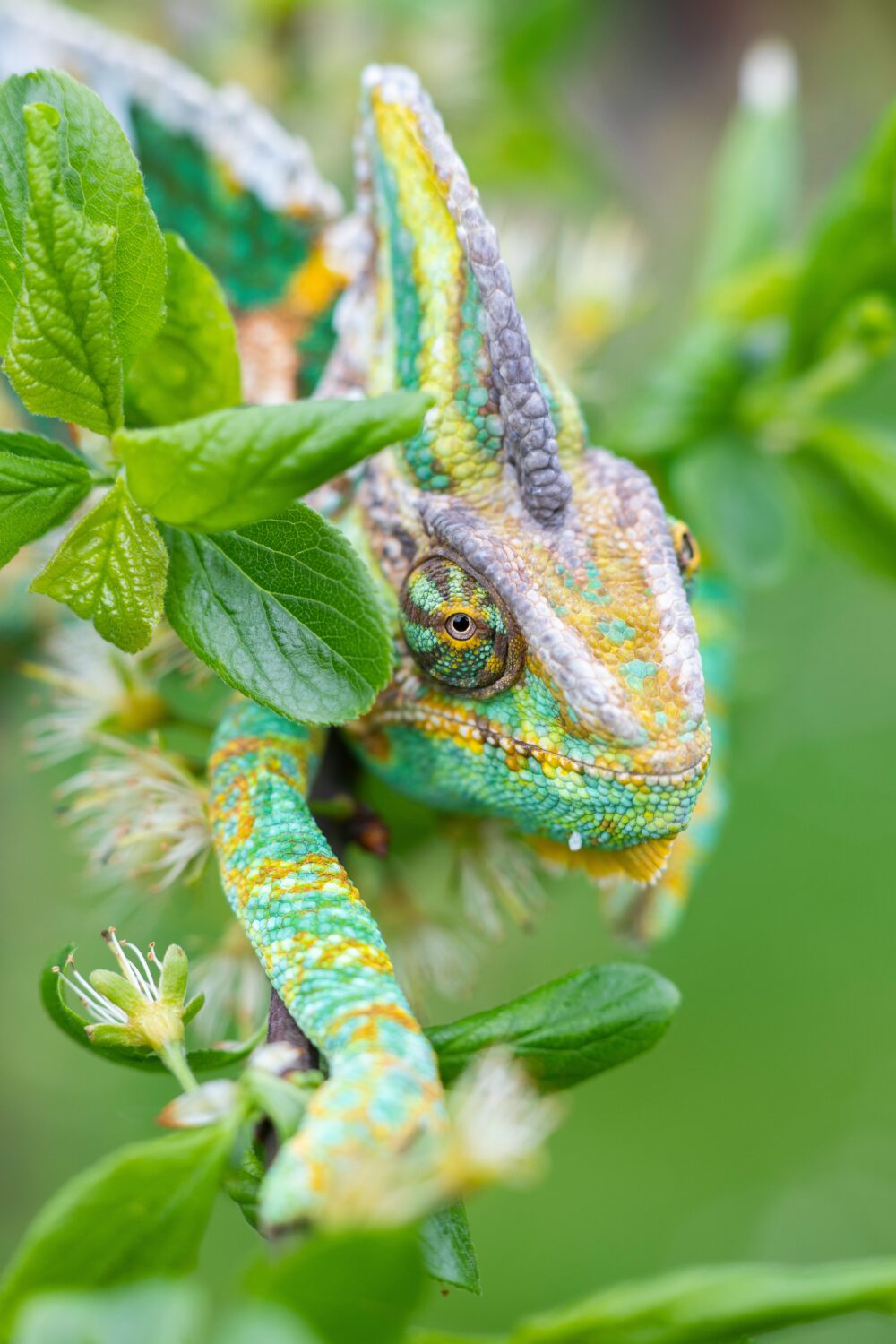
Among all Chameleons Uganda, none attracts more attention than the magnificent Jackson’s Chameleon (Trioceros jacksonii).
Originally native to East Africa, this striking species inhabits cool montane forests and forest edges throughout parts of Uganda, Kenya, and Tanzania.
Male Jackson’s Chameleons are instantly recognizable by their three prominent horns projecting from the head, giving them an appearance resembling miniature dinosaurs or mythical dragons. These horns are used primarily during territorial disputes between males.
Their bodies display beautiful shades of emerald green, bright yellow, turquoise, olive, and occasional blue markings depending on environmental conditions and emotional state.
Females lack the impressive horns but remain equally beautiful with softer green coloration and graceful movements.
Unlike many reptiles, Jackson’s Chameleons give birth to live young rather than laying eggs. A single female may produce between 8 and 30 babies after several months of gestation.
Watching a Jackson’s Chameleon move through forest vegetation is mesmerizing. Every step is slow and calculated while its tail tightly grips branches for balance.
Other Chameleon Species Found in Uganda
Although Jackson’s Chameleon receives most attention, Uganda hosts several other fascinating species that contribute to the country’s incredible reptile diversity.
The Rwenzori Three-Horned Chameleon (Trioceros johnstoni) inhabits the high-altitude forests of the Rwenzori Mountains. Closely related to Jackson’s Chameleon, this species thrives in cool, moist mountain environments and displays spectacular green, yellow, and blue coloration.
The Rudis Chameleon (Trioceros rudis) is another montane species commonly found in southwestern Uganda. Smaller than Jackson’s Chameleon, it possesses remarkable camouflage abilities that allow it to disappear among moss-covered vegetation.
Uganda also supports several pygmy chameleon species belonging to the genus Rhampholeon. These tiny reptiles often measure less than ten centimeters and spend much of their lives among leaf litter on forest floors. Because of their size and cryptic coloration, they are rarely seen without experienced guides.
Each species occupies its own ecological niche, helping control insect populations while serving as prey for birds, snakes, and mammals.
Where to See Chameleons Uganda
One of Uganda’s greatest strengths is that chameleons can be found in several national parks and protected forests.
Bwindi Impenetrable National Park
Best known for mountain gorilla trekking, Bwindi Impenetrable National Park also shelters diverse reptiles, including Jackson’s Chameleons and several forest-dependent species.
Night walks and guided nature hikes often reveal resting chameleons perched on low branches where they become easier to observe using flashlights.
Visitors combining gorilla trekking with forest walks significantly increase their wildlife checklist.
Kibale Forest National Park
While famous for chimpanzee trekking, Kibale Forest National Park supports exceptional reptile diversity.
Its humid rainforest environment provides excellent habitat for chameleons that thrive among dense understory vegetation.
Nature walks through Bigodi Wetland Sanctuary also provide opportunities to encounter these remarkable reptiles alongside monkeys, butterflies, and birds.
Mgahinga Gorilla National Park
The volcanic slopes of Mgahinga offer cool montane forests ideal for several highland chameleon species.
Although most visitors focus on gorilla trekking and golden monkey tracking, experienced guides occasionally locate Jackson’s Chameleons during forest hikes.
Rwenzori Mountains National Park
The Rwenzori Mountains harbor several endemic reptile species adapted to high-altitude forests.
These cooler environments provide some of Uganda’s best opportunities for observing montane chameleons in pristine habitats.
Murchison Falls National Park
Although famous for lions, elephants, giraffes, buffaloes, and the spectacular waterfall, Murchison Falls National Park also supports fascinating reptile life.
Forested sections around Budongo Forest and woodland habitats near the park occasionally reveal chameleons during guided walks.
Visitors interested in reptiles should combine traditional game drives with nature walks for a richer wildlife experience.
How Chameleons Change Color
One of the greatest misconceptions about Chameleons Uganda is that they change color purely for camouflage.
In reality, specialized skin cells called chromatophores contain pigments that shift according to environmental conditions and internal signals.
Color changes occur for several reasons.
Temperature regulation allows darker colors to absorb heat during cool mornings while lighter colors reflect sunlight during hot afternoons.
Communication between males often involves dramatic displays of bright colors during territorial confrontations.
Females display different colors depending on reproductive condition.
Stress, excitement, fear, and relaxation also trigger color transformations.
Camouflage does play a role, but it is only one part of a much more sophisticated biological system.
Incredible Adaptations of Uganda’s Chameleons
The survival of chameleons depends on several remarkable adaptations.
Perhaps the most famous are their independently rotating eyes.
Each eye moves separately, allowing the reptile to scan almost 360 degrees without moving its head. Once prey is located, both eyes focus simultaneously before striking.
Their projectile tongue extends at extraordinary speed, sometimes reaching twice the length of the body. Sticky saliva ensures insects rarely escape.
Their feet resemble specialized grasping tongs, perfectly adapted for climbing branches.
The prehensile tail acts as an additional limb, providing balance and stability while moving through vegetation.
Combined with slow movements that mimic swaying leaves, these adaptations make chameleons highly efficient predators.
What Do Chameleons Eat?
All Uganda’s chameleon species are primarily insectivorous.
Their diet includes:
Grasshoppers
Crickets
Beetles
Flies
Moths
Caterpillars
Spiders
Ants
Dragonflies
Larger species occasionally consume small lizards, nestling birds, or tiny frogs.
By controlling insect populations, chameleons contribute significantly to maintaining ecological balance within Uganda’s forests.
Best Time to See Chameleons Uganda
Chameleons may be observed throughout the year, but sightings improve during wetter months when insect activity increases.
The best periods generally include:
March to May
September to November
Night walks offer especially rewarding experiences because sleeping chameleons become easier to locate under flashlight beams. Their pale nighttime coloration contrasts with surrounding vegetation, making them surprisingly visible.
Morning forest walks also provide excellent opportunities before temperatures rise.
Photography Tips for Chameleons
Photographing chameleons requires patience rather than speed.
Move quietly and avoid sudden movements that may stress the animal.
Use natural light whenever possible.
Macro lenses produce exceptional detail, especially when capturing the intricate scales, horns, and expressive eyes.
Focus carefully on the eyes since they are usually the strongest visual feature.
Never reposition or handle wild chameleons for photographs. Ethical wildlife photography always places animal welfare before obtaining the perfect image.
Conservation Challenges Facing Uganda’s Chameleons
Although many populations remain healthy inside protected areas, several threats affect Uganda’s chameleon species.
Habitat destruction through agriculture continues reducing forest cover.
Illegal collection for the international pet trade threatens certain species.
Climate change may alter suitable habitats, particularly for mountain species dependent on cool environments.
Road construction fragments forests, isolating wildlife populations.
Fortunately, Uganda Wildlife Authority, conservation organizations, and local communities continue protecting forests through sustainable tourism, habitat restoration, environmental education, and strengthened law enforcement.
By visiting national parks responsibly, travelers directly support conservation initiatives benefiting reptiles alongside larger mammals.
Why Chameleons Matter in Uganda’s Ecosystem
While often overshadowed by charismatic mammals, chameleons perform vital ecological functions.
They regulate insect populations, helping maintain healthy forest ecosystems.
As prey for birds, snakes, and mammals, they contribute to complex food webs.
Because they are sensitive to environmental changes, scientists use them as indicators of ecosystem health.
Protecting chameleons therefore helps conserve countless other species sharing the same habitats.
Add Chameleon Watching to Your Uganda Safari
A Uganda safari offers much more than the Big Five or mountain gorillas.
Adding guided forest walks introduces visitors to hidden biodiversity rarely experienced during vehicle-based safaris.
Combining gorilla trekking, chimpanzee tracking, bird watching, boat safaris, and nature walks creates one of Africa’s most complete wildlife experiences.
At Murchison Falls Park Safari, customized itineraries can incorporate forest excursions where guests discover Uganda’s remarkable reptiles alongside mammals and birds.
Whether you are a professional wildlife photographer, conservation enthusiast, family traveler, or first-time safari visitor, spotting a Jackson’s Chameleon slowly moving through rainforest vegetation becomes one of the most memorable moments of any Ugandan adventure.
Our safari specialists can help you design an itinerary that includes gorilla trekking, chimpanzee tracking, wildlife safaris, birding, forest walks, and opportunities to discover the incredible world of Chameleons Uganda.