Sitatunga Antelope Uganda: The Swamp Specialist
Among Uganda’s incredible wildlife, few animals remain as mysterious and fascinating as the Sitatunga Antelope. Hidden within papyrus swamps, marshes, and flooded wetlands, this shy antelope rarely appears in open grasslands, making every sighting a memorable experience. Unlike many antelope species that roam the savannah, the sitatunga has evolved specifically for life in waterlogged environments, earning it the nickname “The Swamp Specialist.”
For wildlife enthusiasts, photographers, birdwatchers, and safari travelers seeking something beyond the famous Big Five, spotting a Sitatunga Uganda offers a rewarding adventure. Their secretive behavior, remarkable adaptations, and preference for inaccessible wetlands create one of Uganda’s most unique wildlife experiences.
Uganda protects several wetlands where sitatunga populations continue to survive. Destinations such as Mabamba Swamp, Lake Mburo National Park, Nabugabo Wetlands, and sections of the Nile Delta in Murchison Falls National Park provide excellent opportunities to search for this extraordinary antelope while enjoying spectacular birdlife and breathtaking landscapes.
Whether you are planning your first safari or returning to explore Uganda’s hidden wildlife treasures, the Sitatunga antelope deserves a place on your itinerary.
Meet the Sitatunga: Africa’s Wetland Antelope
The Sitatunga antelope (Tragelaphus spekii) belongs to the spiral-horned antelope family alongside bushbucks, bongos, nyalas, and kudus. It is one of Africa’s most specialized mammals because nearly every aspect of its body has evolved for life in wetlands.
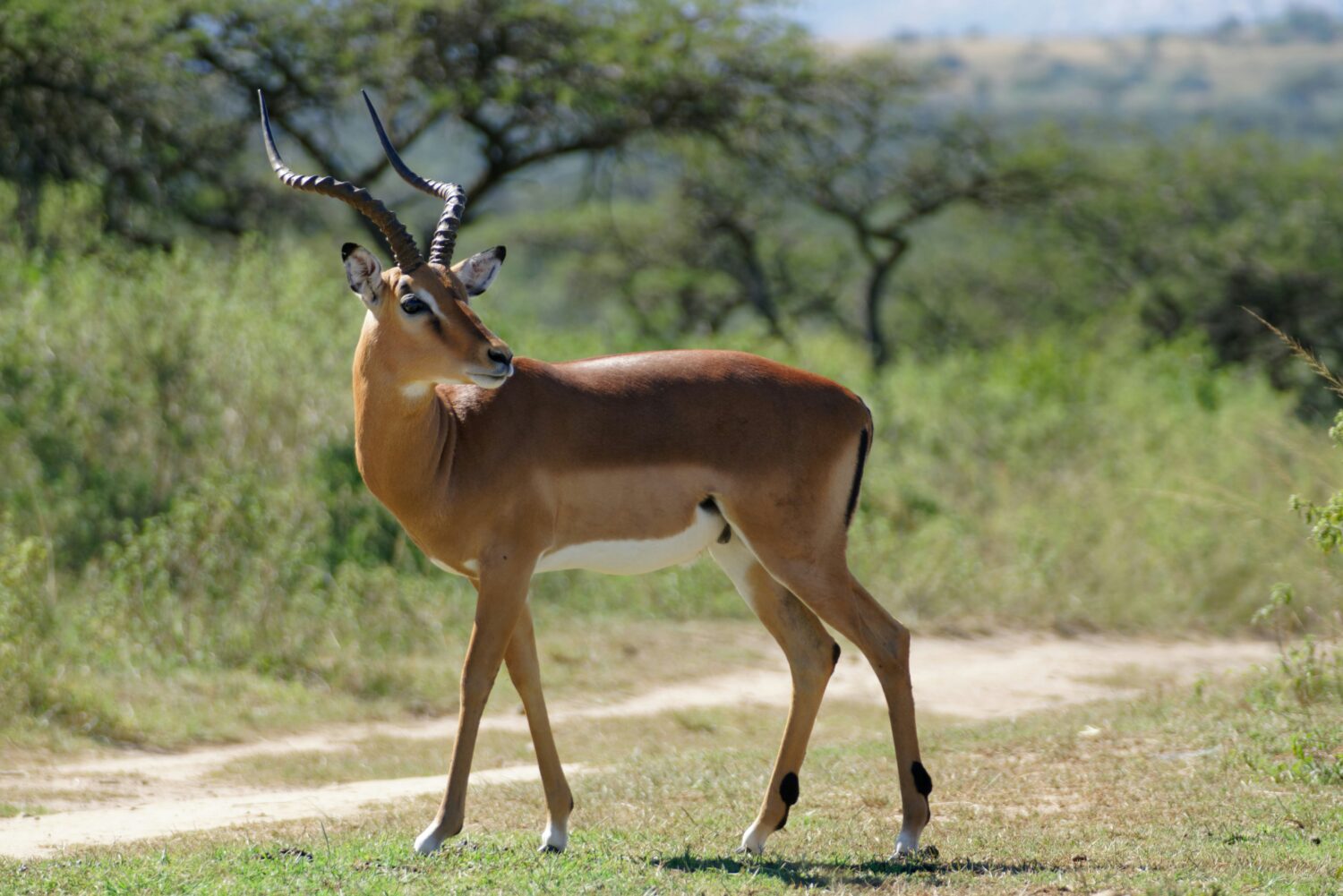
Unlike impalas or waterbucks that frequently move across open plains, sitatungas spend most of their lives inside dense papyrus swamps where water often reaches chest height. Their habitat protects them from predators while providing abundant aquatic vegetation to feed on.
Adult males are considerably larger than females and develop magnificent spiral horns that can exceed 90 centimeters in length. Their coats are dark chocolate to grey with faint white stripes, while females display lighter reddish-brown coloration that blends perfectly with marsh vegetation.
This remarkable camouflage explains why many safari visitors spend hours searching without realizing several sitatungas may be standing only a few meters away among the reeds.
Unique Physical Adaptations for Swamp Life
The most remarkable feature of the Sitatunga Uganda population is its extraordinary adaptation to swamp environments.
Unlike most antelope, sitatungas possess unusually long, widely spread hooves. These elongated hooves distribute their weight over soft mud, preventing them from sinking into marshes. This natural adaptation allows them to move effortlessly through floating vegetation where predators struggle to follow.
Their legs are also slightly longer than those of similar-sized antelope, helping them walk through deep water with ease. Combined with excellent swimming abilities, sitatungas can disappear into flooded papyrus channels whenever danger approaches.
Their shaggy waterproof coat offers insulation while spending long periods in wet habitats. Even during heavy rainfall, their thick fur protects them from cold and moisture.
These evolutionary adaptations make the sitatunga one of Africa’s most specialized mammals.
Habitat: Why Swamps Matter
The Sitatunga antelope depends almost entirely on permanent wetlands. Healthy papyrus swamps, reed beds, floodplains, marshes, and freshwater lakes provide everything they need for survival.
Wetlands supply:
Constant food sources
Safe breeding grounds
Protection from predators
Reliable freshwater
Dense cover for resting
Because they rarely venture into open landscapes, sitatungas are extremely vulnerable to wetland destruction. Draining swamps for agriculture, urban expansion, illegal grazing, and pollution directly threaten their habitat.
Uganda remains one of East Africa’s strongest refuges for sitatungas because significant wetland ecosystems continue to receive conservation attention.
Protecting wetlands not only benefits the Sitatunga Uganda population but also safeguards hundreds of bird species, fish, reptiles, amphibians, and countless other animals that depend on these fragile ecosystems.
Where to See Sitatunga in Uganda
Uganda offers several outstanding destinations for observing the Sitatunga antelope, although patience and experienced guides greatly improve your chances.
Mabamba Swamp
The world-famous Mabamba Swamp, located along Lake Victoria, is internationally known for Shoebill stork sightings. However, its vast papyrus wetlands also support healthy sitatunga populations.
Early morning canoe excursions offer visitors the best opportunity to search for these elusive antelope while simultaneously enjoying one of Africa’s finest birding destinations.
The combination of wildlife, scenic waterways, and exceptional photography opportunities makes Mabamba one of Uganda’s premier wetland experiences.
Lake Mburo National Park
Lake Mburo National Park remains one of Uganda’s top destinations for antelope diversity. Besides zebras, impalas, elands, and topis, the park’s extensive swamp systems provide excellent habitat for sitatungas.
The Rubanga Forest wetlands and surrounding marshes are particularly productive.
Boat cruises across Lake Mburo often reveal sitatungas feeding quietly among reeds, especially during calm mornings.
Murchison Falls National Park
Although visitors primarily come to Murchison Falls National Park for elephants, lions, giraffes, buffaloes, and the spectacular waterfall, the Nile Delta contains extensive papyrus swamps where sitatungas thrive.
Boat cruises toward the delta occasionally reveal these shy antelope emerging along the shoreline.
Combining a classic wildlife safari with wetland exploration creates one of Uganda’s richest wildlife experiences.
Nabugabo Wetlands
Lake Nabugabo, near Lake Victoria, supports one of Uganda’s quieter wetland ecosystems.
Visitors seeking less crowded wildlife experiences can explore these marshes while searching for sitatungas alongside numerous waterbirds and aquatic species.
Behavior and Lifestyle
The Sitatunga antelope lives a remarkably secretive life.
Unlike many grazing antelope that form large herds, sitatungas usually occur individually, in pairs, or in very small family groups.
They remain most active during:
Early morning
Late afternoon
Evening
Night
Throughout the hottest hours of the day, they rest within thick vegetation where predators struggle to detect them.
When threatened, sitatungas often freeze completely instead of running immediately. If danger persists, they silently slip into deep water and disappear beneath dense reeds.
Their calm, cautious behavior contributes greatly to their reputation as one of Africa’s hardest antelope to observe.
Diet of the Sitatunga
The Sitatunga Uganda population feeds primarily on aquatic vegetation.
Their diet includes:
Papyrus shoots
Reeds
Aquatic grasses
Fresh leaves
Sedges
Marsh herbs
Fallen fruits
Tender shrubs
Seasonal flooding influences food availability, encouraging sitatungas to move gradually between different wetland sections without leaving swamp habitats.
Their digestive system efficiently processes fibrous aquatic plants that many other herbivores cannot utilize effectively.
Breeding and Life Cycle
Sitatungas breed throughout the year, although local rainfall patterns often influence birth peaks.
After a gestation period lasting approximately eight months, females usually give birth to a single calf hidden deep inside swamp vegetation.
Young calves remain concealed for several weeks while their mothers return periodically to nurse them.
This hiding strategy reduces the risk of predation by crocodiles, leopards, hyenas, and large pythons.
As calves mature, they gradually accompany their mothers through wetland habitats while learning survival skills.
Predators and Survival Strategies
Although wetlands offer excellent protection, sitatungas still face natural predators.
Potential predators include:
Leopards
Nile crocodiles
African rock pythons
Spotted hyenas
Wild dogs in some regions
Their primary defense remains concealment rather than speed.
Camouflage, silent movement, swimming ability, and knowledge of swamp channels allow sitatungas to escape many dangerous encounters.
Conservation Status
The Sitatunga antelope is currently listed as Least Concern by the International Union for Conservation of Nature (IUCN), but local populations continue to decline where wetlands disappear.
Major conservation challenges include:
Wetland drainage for agriculture remains one of the greatest threats. Expanding settlements also reduce suitable habitat, while illegal hunting continues in some areas.
Climate change introduces additional uncertainty as altered rainfall patterns affect water levels throughout East African wetlands.
Fortunately, Uganda’s protected areas continue to safeguard important sitatunga populations through habitat conservation, anti-poaching patrols, and wetland management.
Community conservation initiatives increasingly encourage sustainable wetland use while recognizing the economic importance of wildlife tourism.
Why the Sitatunga Matters to Uganda
The Sitatunga Uganda population represents far more than another antelope species.
Healthy sitatunga populations indicate healthy wetlands.
Wetlands provide critical ecosystem services including:
Water purification
Flood control
Fish breeding habitats
Carbon storage
Climate regulation
Bird nesting sites
Community livelihoods
Protecting sitatungas therefore supports entire ecosystems that millions of people rely upon.
Their presence also enhances Uganda’s reputation as one of Africa’s leading wildlife destinations beyond traditional savannah safaris.
Photography Tips for Sitatunga Safaris
Photographing a Sitatunga antelope demands patience, preparation, and suitable equipment.
Early morning provides the best lighting and highest activity levels. A telephoto lens helps capture detailed images without disturbing wildlife.
Quiet boat excursions often produce better opportunities than walking because engines remain off while guides paddle slowly through wetland channels.
Avoid sudden movements or loud conversations, as sitatungas disappear quickly into dense reeds.
Capturing reflections on calm water alongside the animal creates particularly striking wildlife photographs.
Combining Sitatunga Viewing with Other Wildlife Experiences
Searching for the Sitatunga Uganda population naturally combines with numerous other wildlife adventures.
Mabamba Swamp offers exceptional opportunities to see the iconic Shoebill alongside over 300 bird species.
Lake Mburo National Park adds zebras, impalas, buffaloes, giraffes, elands, hippos, crocodiles, and leopards.
Murchison Falls National Park combines wetland wildlife with classic game drives featuring elephants, lions, Rothschild’s giraffes, hartebeests, Uganda kobs, hyenas, and one of Africa’s most spectacular waterfalls.
Visitors can also extend their safari to Kibale Forest National Park for chimpanzee trekking or Bwindi Impenetrable National Park for unforgettable mountain gorilla encounters.
Best Time to See Sitatunga in Uganda
The best time to search for Sitatunga Uganda is during the dry seasons from December to February and June to September. During these months, access roads are generally in better condition, and boat excursions can operate more comfortably. Water levels remain sufficient for sitatungas while visibility through wetland vegetation often improves.
The rainy seasons also have advantages. Fresh vegetation attracts wildlife, wetlands become lush and beautiful, and birdlife reaches its peak. However, heavier rainfall can make access to certain swamp areas more challenging.
Regardless of the season, early morning excursions consistently provide the highest chances of successful sightings.
Planning Your Uganda Wildlife Safari
A safari focused on the Sitatunga antelope fits perfectly into a broader Uganda wildlife itinerary.
Many visitors combine Mabamba Swamp with Entebbe, continue to Murchison Falls National Park, explore Lake Mburo National Park, or extend their journey to Queen Elizabeth National Park, Kibale Forest, and Bwindi Impenetrable National Park.
A customized itinerary allows travelers to experience Uganda’s exceptional diversity, from wetlands and savannahs to tropical forests and mountain landscapes.
At Murchison Falls Park Safari, we design tailor-made Uganda safaris that maximize wildlife viewing while supporting responsible tourism and conservation.
Contact our safari specialists to plan your unforgettable Uganda wildlife adventure featuring the remarkable Sitatunga Uganda and many of Africa’s most iconic animals.
Conclusion
The Sitatunga antelope stands apart as one of Uganda’s most remarkable yet least-known mammals. Perfectly adapted to life in wetlands, it embodies the richness and ecological importance of the country’s swamp ecosystems. Its elongated hooves, excellent swimming ability, and secretive behavior have earned it the title of Africa’s true swamp specialist.
Whether you encounter one during a quiet canoe excursion through Mabamba Swamp, a boat cruise in Lake Mburo National Park, or while exploring the Nile Delta in Murchison Falls National Park, every sighting is a reminder of Uganda’s extraordinary biodiversity.
Including the Sitatunga Uganda in your safari plans adds depth to your wildlife experience while supporting the conservation of wetlands that sustain countless other species. Beyond the famous Big Five and mountain gorillas, Uganda offers rare wildlife encounters that reward travelers willing to explore its quieter natural habitats.