African Civet and Genet: Uganda’s Nighttime Safari Surprises
A night game drive in Uganda rarely delivers only the headline predators. Alongside the lions, leopards, and hyenas most travelers are hoping for, spotlights regularly pick out two smaller, stranger, and genuinely underappreciated animals: the African civet and the genet. Neither is a big cat, despite their feline appearance, and neither typically makes the front page of a safari brochure, but both are among the more consistently rewarding nocturnal sightings Uganda’s parks offer, precisely because they turn up more reliably than the country’s rarer nocturnal specialists.
Not Cats at All: What Civets and Genets Actually Are
Despite their cat-like build, lean bodies, pointed muzzles, and stealthy movement, both civets and genets belong to the family Viverridae, a group more closely related to mongooses than to true cats. This is a genuinely useful fact to know before your night drive, since guides frequently field the same question from guests convinced they’ve just spotted a small wild cat. The resemblance is a product of convergent evolution rather than close relation, both animal groups developed similar body plans suited to nocturnal, ground-and-tree hunting, without sharing much genetic history with the felid family lions and leopards belong to.
The African Civet: Uganda’s Masked Nighttime Wanderer
The African civet (Civettictis civetta) is the largest member of the Viverridae family and one of Uganda’s more distinctive nocturnal mammals, instantly recognizable by its black-and-white facial mask, ringed tail, and coarse, spotted coat running from grayish to yellow-brown. Adults typically measure between sixty-five and ninety centimeters in body length, with an additional tail of around forty centimeters, and weigh anywhere from seven to twenty kilograms depending on age, sex, and condition, making them a genuinely substantial presence when caught in a spotlight rather than a fleeting glimpse of something small.
Civet Behavior and Habitat
Civets are strictly nocturnal, emerging around dusk and remaining active until close to midnight before retreating to dense cover, tall grass near water sources, tree hollows, or rocky crevices, to sleep through the day. They’re largely solitary outside of mating periods, when small groups may briefly gather, and they’re territorial, marking their range using a musky secretion from perineal glands historically harvested commercially for perfume production before synthetic alternatives replaced it. Civets are genuinely adaptable, thriving across thick forest, grassland, savanna, and wetland-adjacent habitat, provided sufficient cover and a reliable food source are available.
Where to Find Civets in Uganda
Civets turn up across several of Uganda’s major parks, with Murchison Falls National Park, Bwindi Impenetrable National Park, and Kibale Forest National Park all offering strong habitat given their combination of thick vegetation and proximity to water. Because civets favor dense cover and forage using an acute sense of smell along fairly consistent nightly pathways, experienced night-drive guides often have a good working knowledge of likely civet territory within their specific park, meaningfully improving sighting odds relative to a purely random search.
Are Civets Dangerous?
Despite their somewhat imposing size and masked appearance, civets pose essentially no threat to safari guests. They’re shy, docile, and avoid human contact entirely, rarely biting unless directly cornered, and they carry no significant zoonotic disease risk. Their foul-smelling musk is unpleasant but entirely harmless, and a civet sighting on a night drive is best understood as a genuinely low-key, low-drama wildlife encounter rather than anything requiring caution.
The Genet: Uganda’s Agile Tree-Climbing Specialist
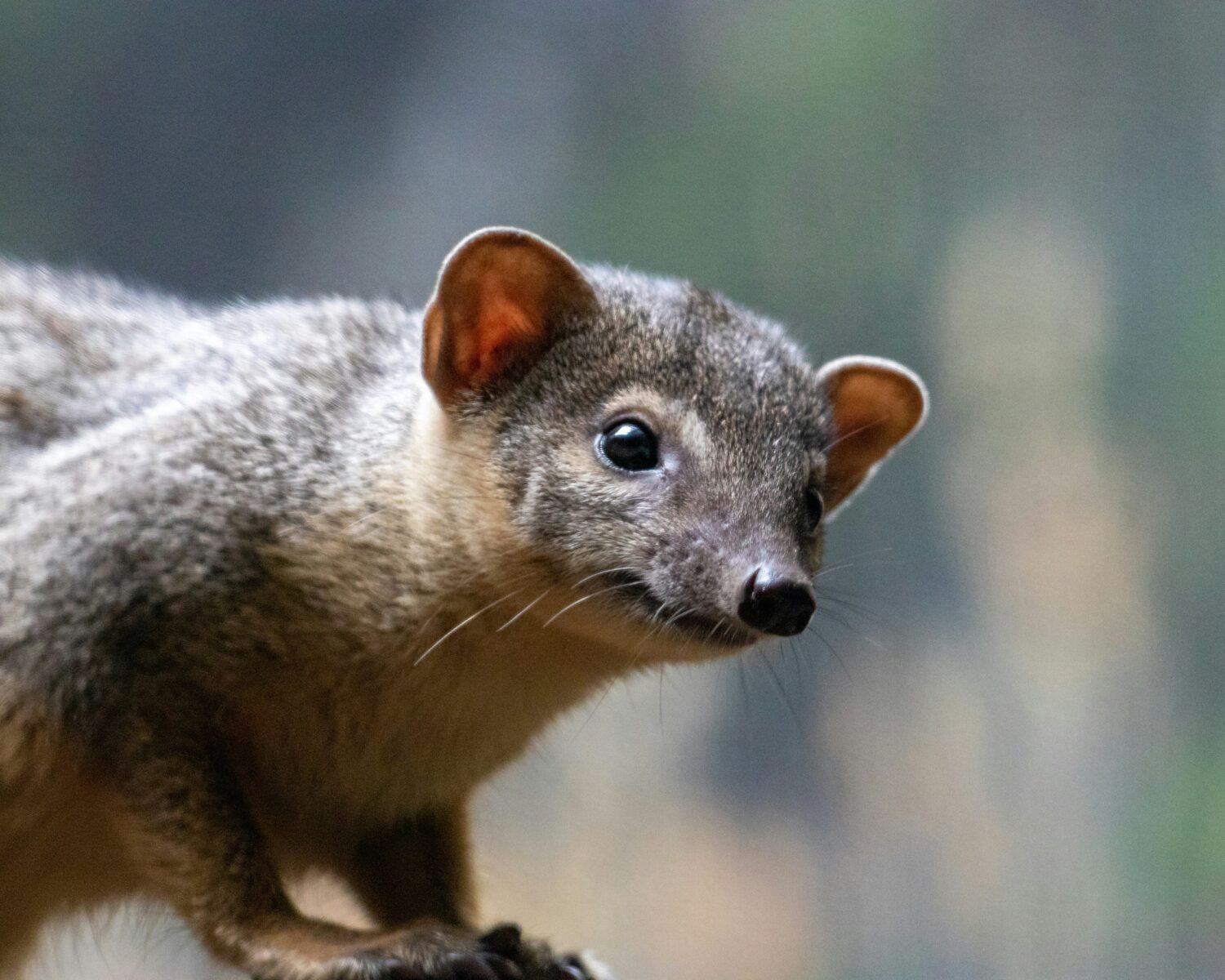
Where civets are bulky and low-slung, the genet presents an almost opposite silhouette: slender, lean, and built for agility, with a long, ring-banded tail used as a balancing pole while climbing or sprinting. Genets have large ears, a pointed muzzle, partly retractile claws suited to climbing, and large eyes with elliptical pupils adapted for excellent night vision, and their spotted coats, marked with a distinctive dark stripe running along the spine, give them a striking, almost delicate appearance quite different from the civet’s heavier build.
Genet Behavior and Habitat
Genets are generally more arboreal than civets, comfortable both on the ground and in trees, where they rest or forage depending on the specific habitat and food availability. They’re solitary, nocturnal or crepuscular, hunting primarily at dusk and after dark, and their diet includes rodents, birds, reptiles, eggs, insects, and seasonal fruit, giving them a genuinely flexible foraging strategy across different Ugandan habitats. Genets tend to avoid the most open savanna terrain, generally preferring wooded habitat, riverine forest, and woodland edges, though they can also turn up near villages and, notably, around safari lodges and campsites themselves, drawn by food waste after dark.
Where to Find Genets in Uganda
Genets are recorded across a wide range of Uganda’s parks, with forested and riverine habitat in Kibale National Park, Queen Elizabeth National Park, and Murchison Falls National Park all offering suitable conditions. One particularly notable record comes from Maramagambo Forest within Queen Elizabeth National Park, where the giant forest genet, a species more typically associated with West and Central Africa, has been documented, a genuinely unusual sighting worth knowing about for travelers with a specific interest in the region’s smaller carnivore diversity. Because genets are known to visit lodges and campsites directly, some of the most memorable genet sightings in Uganda happen not on a formal night drive at all, but around the dinner table or campfire after dark, when a genet slips into view scavenging near the kitchen or dining area.
Civet vs. Genet: How to Tell Them Apart
For travelers unfamiliar with either species, distinguishing a civet from a genet in a brief spotlight glimpse comes down to a few reliable visual cues. Civets are noticeably bulkier and heavier-bodied, with a distinctive black-and-white facial mask and a low-slung, semi-plantigrade gait, while genets are considerably more slender and cat-like in proportion, with a longer, more visibly ringed tail and a more agile, fluid movement style. If the animal you’re watching climbs a tree with real ease, it’s almost certainly a genet; if it stays low to the ground with a heavier, more deliberate walk, you’re more likely looking at a civet.
Booking a Night Drive to See Them
Both civets and genets are almost exclusively active after dark, meaning a dedicated night game drive offers by far the best chance at a sighting, rather than hoping to encounter either species during a standard daytime outing. Night drives in Queen Elizabeth National Park typically depart in the early evening after dinner, while Murchison Falls’ night drives generally run for around two hours through the park’s northern circuit, both conducted in a 4×4 vehicle with a licensed Uganda Wildlife Authority ranger guide using spotlights to scan for movement along tree lines and grass edges. Because both species turn up with meaningfully more consistency than genuinely rare nocturnal specialists like the serval or aardvark, a night drive focused broadly on nocturnal wildlife tends to deliver at least one, and often both, of these species even on a fairly ordinary evening.
Tips for a Better Sighting
A few simple habits improve the odds of a good, clear sighting rather than a brief, unsatisfying glimpse. Staying quiet during the drive matters, since both civets and genets are naturally wary and will retreat into cover quickly if startled by noise from the vehicle. A red-filtered spotlight rather than plain white light disturbs nocturnal wildlife considerably less, giving your guide more time to hold the light steady on an animal once it’s been spotted. If you’re staying at a lodge with a reputation for genet visits after dark, a quiet, still moment near the dining area or campfire can sometimes produce a surprisingly close, extended sighting without needing a vehicle at all.
Part of a Fuller Nocturnal Wildlife Picture
A night drive built around finding civets and genets naturally reveals a broader cast of Uganda’s after-dark wildlife along the way, including hyenas, leopards, and, with real luck, the more elusive serval and aardvark. Rather than treating civets and genets as a consolation prize when the rarer species don’t appear, they’re genuinely worth appreciating in their own right, distinctive, visually striking animals that reward a slower, more attentive style of wildlife watching than the fast-paced excitement of a big cat sighting.
Adding a Night Drive to Your Murchison Falls or Queen Elizabeth Itinerary
Both civets and genets fit naturally into a broader Uganda itinerary without requiring any special detour, since the same parks offering strong daytime Big Seven wildlife, Murchison Falls National Park and Queen Elizabeth National Park among them, also run the night drives where these species are most reliably seen. Building one evening night drive into an otherwise standard multi-day safari adds a genuinely different dimension to the trip at relatively low additional cost or time investment.
If you’re interested in adding a night drive to your Uganda safari to look for civets, genets, and Uganda’s wider range of nocturnal wildlife, our team at Murchison Falls Park Safari can build this into your itinerary alongside your standard game drives. Contact us to start planning a Uganda safari that covers both the daytime and nighttime sides of the park.
For more on Uganda’s harder-to-spot wildlife, our guides on the serval cat, the aardvark and Uganda’s Shy 5, and pangolin sightings and conservation are all available, here and pair well with this guide.