

September Safari at Murchison Falls: Late Dry Season Tips
September occupies an interesting spot on the Murchison Falls National Park calendar, often listed as the final month of the region’s longer mid-year dry season, yet clearly standing right at the doorstep of the wetter months that follow. Some seasonal guides count September firmly within the dry season that runs from June through September, while others already classify it as the start of a second wet stretch building toward October, the park’s rainiest month. That mix of perspectives is exactly why a September safari at Murchison Falls deserves its own close look rather than being lumped in automatically with peak July conditions or dismissed as simply “the start of the rains.” Understanding what September genuinely tends to bring helps travelers plan with realistic expectations rather than relying on a single label.
Where September Sits in Murchison Falls’ Seasonal Calendar
Murchison Falls National Park experiences a tropical climate defined by two dry periods and two wetter periods each year, and September sits at the closing edge of the longer dry stretch that typically begins in June. Rainfall generally remains lower during September than it will be in October, which many sources point to as the wettest month of the year, but the buildup toward that wetter period is already underway. This makes September something of a late-dry-season month with early hints of the transition ahead, similar in spirit to August’s in-between character but a step further along the shift toward the rains.
Daytime temperatures during September typically remain warm and comfortable, generally in a range similar to the preceding dry months, while mornings retain the cooler, crisper character travelers have come to expect from earlier in the dry season. Humidity tends to build gradually as the month progresses, and afternoon cloud cover becomes somewhat more frequent than in July, though outright heavy rain is still the exception rather than the rule for much of September.
What “Late Dry Season” Really Means for September
It is worth being precise about what this label implies in practice. September is not a guaranteed continuation of July’s crisp, fully dry conditions, nor is it yet the lush, rain-heavy landscape of October and November. Instead, it behaves as a genuine late dry season Murchison Falls window, where dry-season patterns still dominate most days, but the occasional afternoon shower becomes noticeably more common than it would have been a month or two earlier. Roads across the park generally remain in good condition through most of September, since this part of Uganda sits in a comparatively dry pocket even as the surrounding region moves into wetter weather, and any rain that does fall tends to arrive as a short, intense burst rather than an all-day washout.
Travelers who go into a September trip expecting dry-season reliability with just a touch more unpredictability than June or July tend to find their expectations line up well with reality. Those expecting an entirely rain-free, dusty dry-season experience identical to peak July may find September delivers a slightly softer, greener, and occasionally damper version of that same core experience.
Wildlife Viewing During September
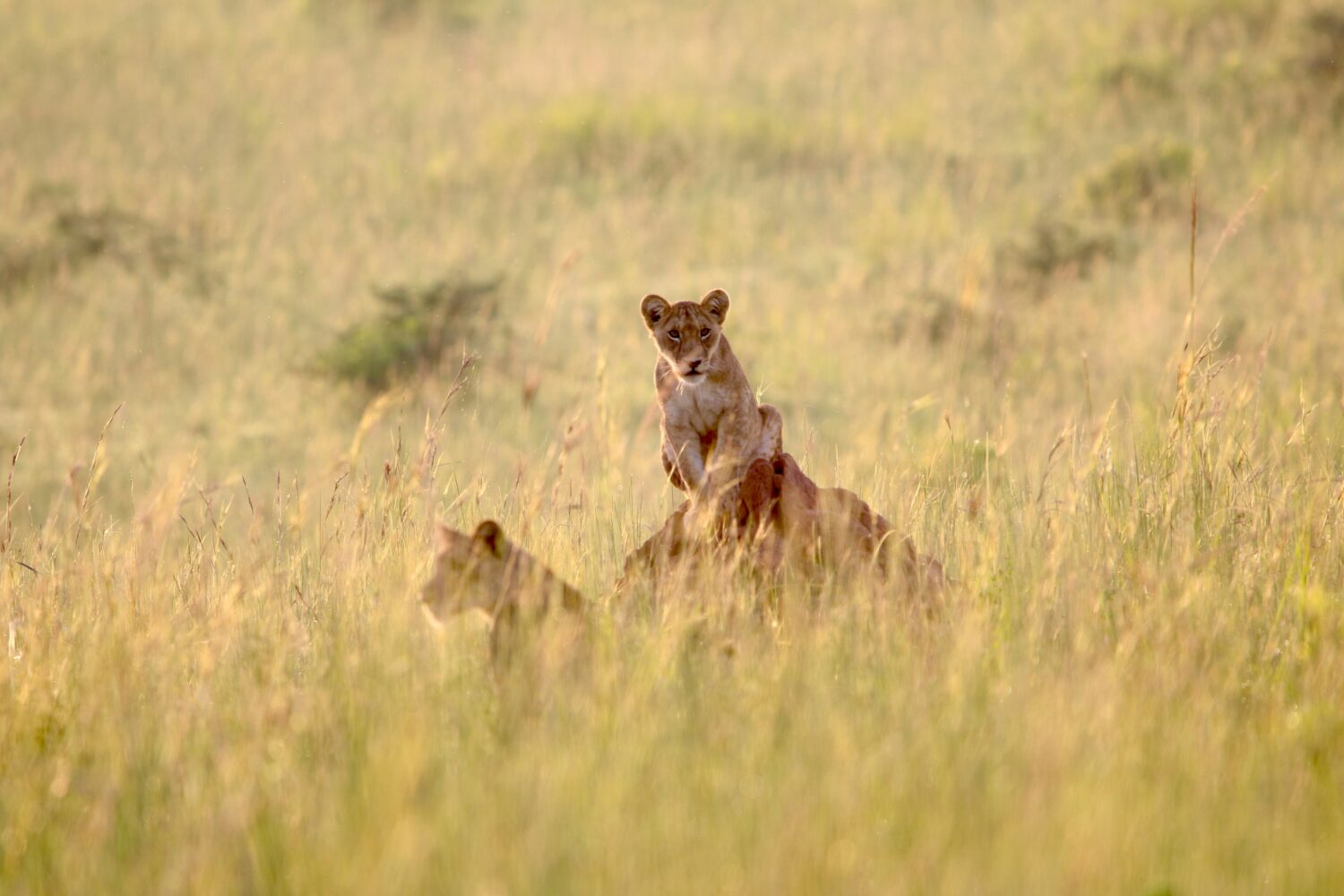
Wildlife viewing during September largely retains the strengths built up over the preceding dry months. With water sources across the park still relatively limited compared to the wetter months ahead, grazing animals such as Uganda kob, buffalo, and hartebeest continue to concentrate around the Nile and the remaining waterholes, and predators including lion generally continue to follow that pattern closely. This means dry season wildlife viewing conditions largely hold through September, and game drives along the park’s established circuits still tend to deliver strong, relatively predictable sightings.
Elephant sightings remain a near-constant feature of a September visit, with herds often visible moving between grazing areas and the riverbank as they continue to rely on the Nile for water during this final stretch before the rains fully return. Giraffe populations in the delta and northern sectors of the park also remain active and visible, taking advantage of grass that has not yet been substantially refreshed by heavy rainfall. Birdlife begins to pick up noticeably as September progresses, with the earliest signs of the wetter season’s excellent birdwatching conditions starting to appear, making this a rewarding month for travelers with an interest in the park’s bird population alongside its more traditional game-viewing highlights.
The Murchison Falls boat cruise along the Victoria Nile toward the base of the falls continues to offer strong wildlife viewing through September, with water levels still generally favorable for smooth navigation. Hippos and crocodiles remain reliably visible along the banks, and elephant and buffalo herds coming down to drink continue to make regular appearances during the cruise. The falls themselves remain a powerful, dramatic sight throughout September, and travelers visiting later in the month may notice the early signs of increased water volume as the wetter season approaches, adding a touch of extra drama to the spectacle at the gorge.
Chimpanzee Trekking and Other Activities in September
For travelers pairing their Murchison Falls itinerary with chimpanzee trekking Budongo Forest, September remains a reasonably good choice, though conditions can start to soften compared to the driest months. Trail conditions are generally still manageable through most of September, though an increased chance of rain toward the end of the month can occasionally introduce some mud and slipperiness underfoot. Many guides point to the months from October through January as the strongest window for chimp trekking overall, once fruiting season in the forest is fully underway, so September functions as a solid but not quite peak month for this particular activity. The top-of-the-falls hike and guided nature walks remain enjoyable during September as well, with generally dry ground conditions for most of the month, though a rain jacket is a sensible addition to the day pack given the slightly increased chance of a passing shower.
Crowds and Booking Considerations
September sits toward the tail end of Uganda’s broader peak travel period, following the very busy June through August stretch, and it tends to see a gradual easing of visitor numbers as the month progresses and the northern hemisphere’s summer holiday season winds down. This makes September safari booking somewhat more forgiving than the depths of peak July, though it still benefits from planning ahead rather than leaving arrangements to the final weeks before departure, particularly for the first half of the month when demand often remains elevated from the preceding peak stretch.
Lodges around Murchison Falls, including those near Paraa and along the river delta, generally see occupancy ease slightly as September moves along, which can translate into somewhat improved availability and, in some cases, softer rates compared to the height of the June-to-August period. Travelers extending their Murchison Falls trip with gorilla trekking permits in Bwindi or Rwanda should still plan ahead, since permit demand tends to remain strong through much of September even as broader lodge occupancy begins to ease.
Packing and Practical Preparation for a September Trip
Preparing for a September trip to Murchison Falls calls for a packing approach that leans on dry-season basics while building in a bit more flexibility than a July trip might require. Lightweight, breathable clothing in neutral khaki and olive tones continues to suit the warm days, while a packable rain jacket earns a more prominent place in the bag than it would for a peak dry-season trip, given the increasing likelihood of an afternoon shower as the month progresses. A warmer layer for the still-cool early mornings remains just as relevant in September as earlier in the dry season, since pre-dawn game drives can feel notably crisp before the sun fully warms the landscape.
Footwear that can handle the occasional damp or muddy patch, particularly for chimpanzee trekking in Budongo Forest, is worth including alongside the usual dry-season safari wardrobe. Sun protection remains important too, since clear skies still dominate much of September, and a good hat, sunscreen, and sunglasses continue to belong on the packing list alongside any rain-ready additions.
Malaria prevention deserves the same steady attention in September as during any other month at Murchison Falls, since the park’s warm, low-lying terrain supports mosquito activity throughout the year regardless of seasonal rainfall patterns. A treated mosquito net, consistent repellent use, and appropriate antimalarial medication prescribed ahead of the trip remain the standard baseline for safe, sensible preparation.
A Sample Flow for a September Visit
Days during a September visit to Murchison Falls tend to follow a rhythm close to that of the broader dry season, with a bit more variability layered in as the month progresses. Early morning game drives take advantage of cool temperatures and strong wildlife activity as animals move toward water sources before the day heats up, often producing some of the most rewarding sightings of the trip. Midday brings the warmest part of the day and a natural lull in animal movement, making it a sensible window to rest at the lodge or enjoy the river view. Late afternoon and early evening remain prime time for a second game drive or the Nile boat cruise, with skies sometimes building toward a brief shower that clears quickly and often adds dramatic light and color to the landscape rather than disrupting the activity itself. Evenings tend to stay pleasantly warm, with clear stretches still common enough to make riverside dinners and stargazing a regular part of the experience.
Is September the Right Time for Your Trip
September suits travelers who want most of the dependability associated with the dry season, including strong wildlife concentrations and generally accessible roads and trails, while being comfortable with a somewhat higher chance of an afternoon shower than they would encounter in June or July. It works well for travelers whose schedules fall naturally in this window, and for those who appreciate the early hints of greener scenery and improving birdlife that begin to emerge as the month moves toward its close. Travelers who want the most reliably dry and dust-free conditions available should look toward June or July instead, while those specifically chasing lush green landscapes, lower rates, and quieter crowds might find the shoulder-season months of April and May, or the wetter stretch from October through November, better suited to those particular priorities.
Travelers weighing September against other months will find it useful to compare against broader seasonal guidance covering the full Murchison Falls calendar, since understanding how September’s late-dry-season character stacks up against the more clearly defined conditions of July or the transitional feel of August helps clarify which trade-offs matter most for a given trip. Pairing that research with a solid what to pack for Murchison Falls safari checklist and a clear malaria prevention plan rounds out preparation for a well-timed September visit.
Planning a Trip Around the September Window
For travelers drawn to a dependable safari experience with a bit more seasonal texture than the height of peak season, September offers strong wildlife viewing, generally manageable trail conditions for chimpanzee trekking, and a gradual easing of crowds compared to the busiest months of the year. Combining a Murchison Falls safari with chimpanzee tracking in Budongo Forest or an extension into Kibale or Queen Elizabeth National Park continues to work well during this window, and travelers building a multi-park itinerary around September should still factor in reasonably early planning, particularly for the earlier half of the month when demand remains closer to peak levels.
Thinking about planning a September safari at Murchison Falls and want help matching lodge availability, boat cruise timing, and chimp trekking permits to this late-dry-season window before conditions shift toward the wetter months ahead? Reach out and a local safari specialist can help build an itinerary suited to exactly what September has to offer.