White-Headed Vulture and Uganda’s Raptor Conservation Story
Vultures rarely get the sympathetic press coverage that elephants, gorillas, or big cats receive, and that gap in public attention has real consequences. Across Africa, vulture populations have collapsed so severely over the past three decades that four of the continent’s eleven species are now classified as Critically Endangered, the White-headed Vulture among them. Uganda’s savannah parks sit right in the middle of this crisis, and the country’s response, tracking programs, poison response training, and habitat protection, offers a genuinely instructive case study in what raptor conservation actually looks like on the ground.
Meeting the White-Headed Vulture
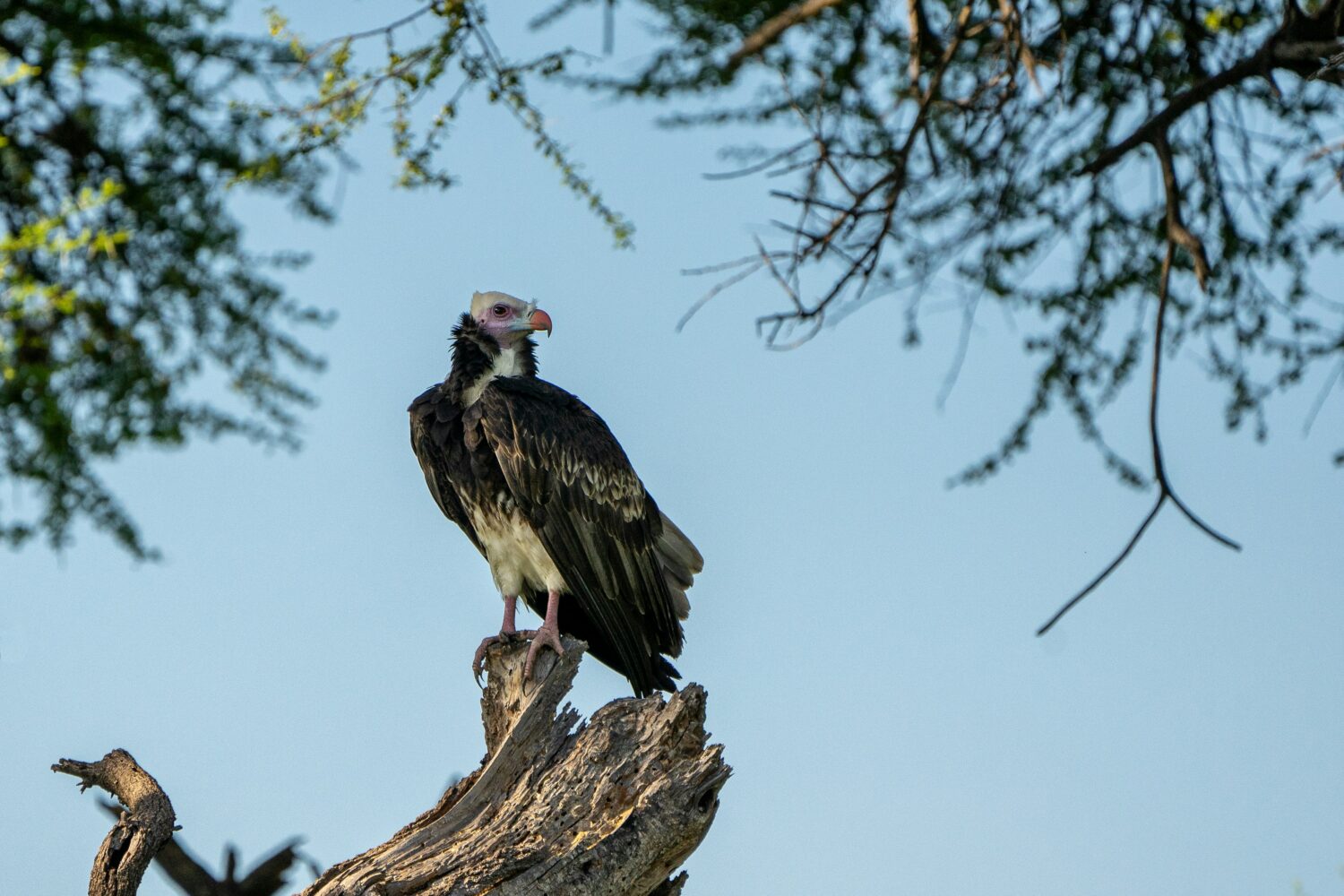
The White-headed Vulture, scientifically classified as Trigonoceps occipitalis, is an Old World vulture found only in Africa, immediately distinguishable by its bright, unmistakably white-feathered head and neck contrasting against dark body plumage, paired with a pink or reddish bill. It’s a genuinely commanding presence in the sky, and unlike some vulture species that gather in large, boisterous groups around a carcass, White-headed Vultures tend to be more solitary and less socially dominant at feeding sites, often arriving early to a kill before the more numerous and aggressive species take over.
Ecological Role: Nature’s Cleanup Crew
Vultures collectively perform one of the more underappreciated ecological services in any African ecosystem, and the White-headed Vulture is no exception. By efficiently locating and consuming animal carcasses, often within hours of death, vultures prevent the buildup of decaying material that would otherwise provide a breeding ground for disease-causing bacteria and pathogens. This scavenging role effectively functions as a natural sanitation system, removing potential disease vectors from the landscape before they can spread to other wildlife, livestock, or nearby human communities, a service whose value becomes starkly clear only once vulture populations decline and carcasses are left to rot unaddressed for longer periods.
Why the White-Headed Vulture Is Critically Endangered
The IUCN currently lists the White-headed Vulture as Critically Endangered, reflecting a steep, well-documented population decline across its African range. Two interlinked threats sit at the center of this crisis: habitat degradation, as land conversion for agriculture and settlement steadily reduces available foraging and nesting territory, and poisoning, which research consistently identifies as the single most significant driver of vulture mortality across the continent.
The Poisoning Crisis in Uganda
Poisoning in Uganda takes two distinct but equally damaging forms. The first stems from human-wildlife conflict, when local communities lace a livestock carcass with insecticide, commonly carbofuran, as retaliation after a lion or leopard has killed a cow, sheep, or goat, only for vultures feeding on that same carcass to be poisoned in the process, often in large numbers given how many birds can descend on a single carcass. The second, more recent and more deliberate threat comes directly from the elephant poaching crisis: because circling vultures act as a visual signal that draws attention to a fresh carcass, ivory poachers have begun deliberately poisoning elephant carcasses specifically to kill vultures before they can alert rangers and law enforcement to the poaching site, turning the birds’ own ecological role into the reason they’re targeted. This poaching-linked poisoning now accounts for a significant share of all recorded vulture poisoning incidents, a genuinely disturbing escalation from opportunistic retaliation poisoning toward calculated, large-scale killing.
Uganda’s Vulture Conservation Response
Facing this crisis, Uganda has developed a genuinely coordinated, multi-organization conservation response over recent years, one worth understanding in some detail given how directly it connects to the country’s broader wildlife protection story.
Tracking Programs
Working in partnership with the Uganda Conservation Foundation and the Uganda Wildlife Authority, international conservation groups including the Endangered Wildlife Trust and the Hawk Conservancy Trust have established vulture tracking programs across Murchison Falls, Queen Elizabeth, and Kidepo Valley National Parks. These programs have fitted tracking devices on more than a dozen vultures spanning three species, generating movement data that helps researchers understand vulture ranging patterns across these parks while also functioning as an early warning system, since unusual movement patterns or a tracked bird’s sudden stillness can signal a poaching or poisoning event in progress, allowing rangers to respond considerably faster than they otherwise could.
Local Training in Poison Response
Beyond tracking, conservation partners have run dedicated training programs teaching local Ugandan teams the safe handling and processing of trapped, ringed, and tracked vultures, building genuine in-country capacity to continue this work independently rather than relying indefinitely on international specialists. Separate poison response training has focused specifically on how field teams should identify, contain, and respond to poisoning incidents when they occur, a genuinely practical skill set given how quickly a poisoning event can claim dozens of birds if not addressed promptly.
Addressing the Root Causes
Conservation groups working in Uganda have also directly assessed the supply chain behind vulture poisoning, surveying carbofuran insecticide suppliers around Murchison Falls National Park and in Kampala to understand how accessible these poisons actually are to communities in conflict with wildlife. This assessment found that restricting supply directly would be genuinely difficult given how widely available such insecticides are, leading conservation organizations to instead focus resources on addressing the underlying human-wildlife conflict driving retaliatory poisoning in the first place, working alongside existing programs focused on reducing livestock losses to lions and other predators.
Where to See the White-Headed Vulture in Uganda
Despite its declining numbers, the White-headed Vulture remains observable in Uganda’s savannah parks for travelers who know where to look. Queen Elizabeth National Park and Murchison Falls National Park are consistently identified as the country’s strongest locations, hosting the largest share of Uganda’s overall vulture population across several species, including the White-headed Vulture alongside the more commonly seen African white-backed vulture, hooded vulture, and the similarly Critically Endangered Rüppell’s vulture. Game drives across these parks’ open savannah, particularly in areas with active predator populations where kills and carcasses regularly occur, offer the most realistic opportunities to spot vultures, including the White-headed Vulture, circling or perched near a feeding site.
What Travelers Can Do to Support This Work
Vulture conservation faces a genuine public perception challenge that other, more charismatic species don’t: as one conservation organization working in Uganda has bluntly put it, vultures aren’t considered particularly attractive, and that image problem translates directly into reduced funding and public support relative to the scale of their decline. Travelers can meaningfully help simply by paying attention, asking guides directly about vulture sightings and conservation efforts during game drives, and supporting operators and lodges that contribute to conservation funding in Murchison Falls, Queen Elizabeth, or Kidepo Valley. Photographing and reporting vulture sightings, particularly of tagged or tracked individuals, can also provide genuinely useful data to the researchers running these tracking programs, turning an ordinary game drive observation into a small but real conservation contribution.
A Species Worth Watching For
The White-headed Vulture’s story in Uganda is, in many ways, a microcosm of the broader challenges facing African vulture conservation: a species performing an essential, underappreciated ecological function, pushed toward extinction by threats that are largely preventable, human-wildlife conflict and poaching-linked poisoning, rather than inevitable habitat loss alone. For travelers on safari in Murchison Falls or Queen Elizabeth National Park, a White-headed Vulture sighting is worth pausing for, not just as an addition to a wildlife checklist, but as a genuine window into one of the more urgent, if underreported, conservation stories playing out across Uganda’s parks today.
If you’re planning a Uganda safari and want your guide to specifically point out vultures and raptors, including the White-headed Vulture, alongside the classic Big Seven wildlife, our team at Murchison Falls Park Safari can build this into your itinerary across Murchison Falls, Queen Elizabeth, or Kidepo Valley National Parks. Contact us to start planning a Uganda safari that gives the country’s raptors, and their conservation story, real attention.