Oribi and Topi: Uganda’s Grassland Antelope Species
Among the many antelope species that call Uganda’s savannah parks home, two grassland specialists consistently reward travelers who take the time to look beyond the more famous headline wildlife. The oribi and topi may not carry the immediate name recognition of lions or elephants, but both offer genuinely fascinating adaptations to life on the open plains, and both add real texture to a Uganda game drive for travelers willing to slow down and appreciate the country’s full antelope diversity. Found across several of Uganda’s premier savannah parks, these two grassland specialists occupy distinct ecological niches while sharing a preference for the wide, open grasslands that define so much of the country’s classic safari scenery.
This guide takes a detailed look at both species, covering their physical characteristics, social behavior, habitat preferences, and the specific Uganda parks where sightings are most reliable, giving travelers a genuinely useful understanding of two antelope species that deserve considerably more attention than the passing glance they typically receive during a standard game drive.
The Oribi: A Small Antelope With Distinctive Markings
The oribi is a gazelle-like antelope, notably one of the largest members of Africa’s diverse group of small antelope species, standing not dramatically smaller than a Thomson’s gazelle despite its classification among the continent’s more diminutive grazers. Its coat displays a silky yellow to reddish-brown coloring across the back, contrasted sharply against white fur along the underparts and rump, giving the animal a genuinely striking appearance against Uganda’s golden savannah grasses. A distinctive white line of fur runs above each eye, paired with a bare, dark scent gland patch beneath each ear, one of the oribi’s most reliable field identification markers for travelers trying to distinguish it from Uganda’s other similarly sized antelope species.
Beyond these facial markings, the oribi carries a tuft of long hair at each knee and a short black tail, along with distinct preorbital glands positioned between the eye and mouth that appear as vertical folds along the side of the face. These glands play an important role in scent marking territory, a behavior that becomes particularly noticeable during the mating season when males work to establish and defend breeding territories against rival males.
Oribi are most typically observed in pairs or small family groups of up to five individuals, generally consisting of a single dominant male accompanying his harem of females, though larger aggregations occasionally form under favorable grazing conditions. This social structure, combined with the species’ preference for tall grassland habitat, means oribi sightings often require a slightly more attentive eye than some of Uganda’s larger, more conspicuous antelope species, since these smaller animals can blend remarkably well into dense grass cover, particularly when standing motionless in response to a perceived threat.
The Topi: A Grassland Specialist Built for Speed and Endurance
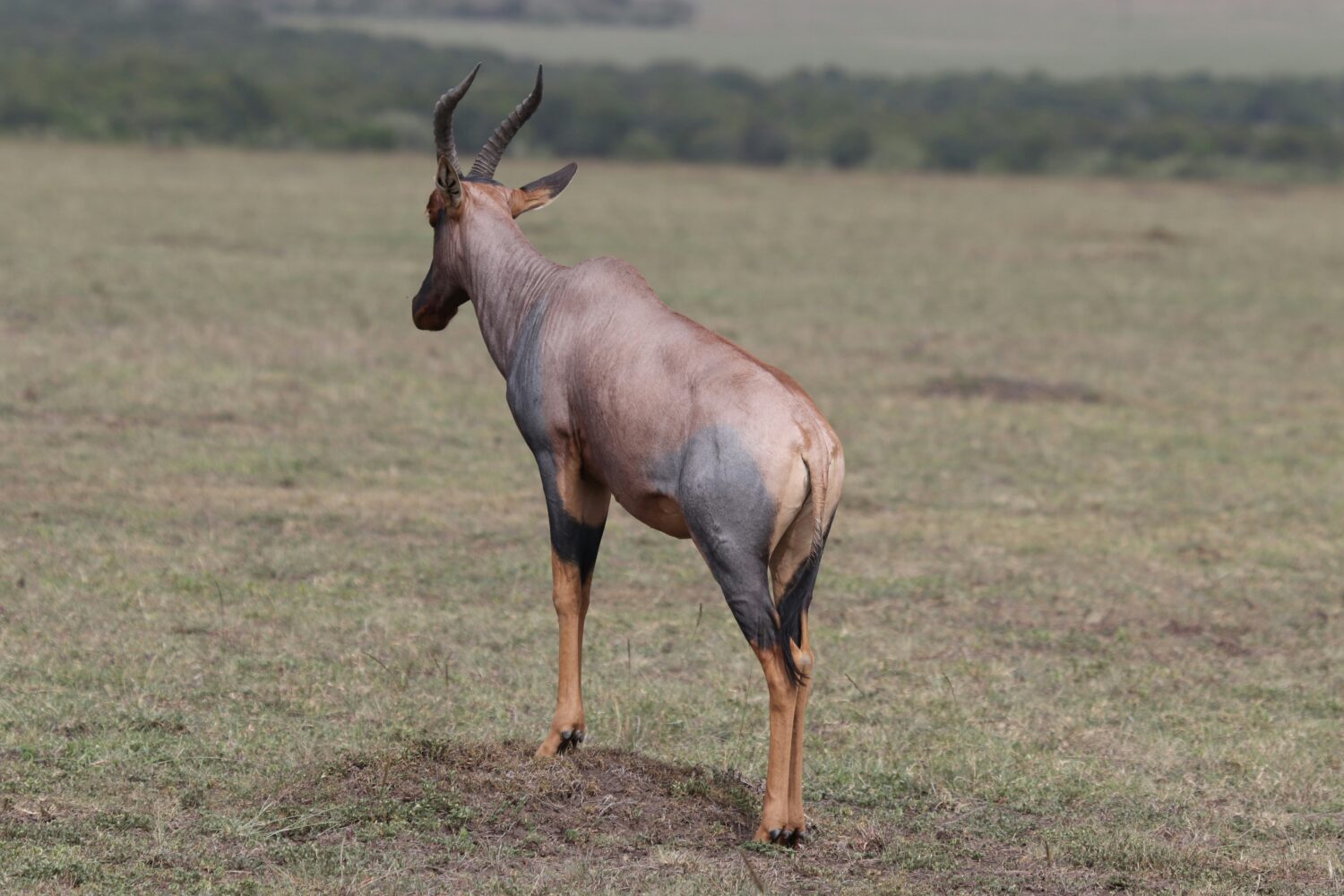
Where the oribi represents a smaller, more secretive grassland presence, the topi cuts a considerably more robust and visually distinctive figure across Uganda’s savannah landscapes. Topi display a rich reddish-brown to purplish coat marked with darker patches across the face, upper legs, and haunches, giving the species a somewhat glossy, richly patterned appearance that stands out clearly against open grassland even from a considerable distance. Both males and females carry ridged, lyre-shaped horns, a feature shared across the broader hartebeest and topi family of antelope species adapted specifically to life on Africa’s open plains.
Topi are highly social animals, typically found in herds ranging from a handful of individuals up to considerably larger aggregations where favorable grazing conditions and open terrain allow. One of the species’ most distinctive behavioral traits involves a habit of standing sentry atop termite mounds or other elevated ground, using this vantage point to scan the surrounding grassland for approaching predators, a behavior that often makes topi considerably easier to spot during a game drive than species relying more heavily on camouflage and stillness. This same behavior also reflects the topi’s broader ecological role as an early warning system within mixed grazing communities, with other antelope species and even larger herbivores often taking cues from a topi’s sudden alertness or flight response.
Topi are also recognized among East Africa’s antelope species for genuinely exceptional stamina and speed over sustained distances, an adaptation well suited to their preference for wide-open grassland habitat where outrunning a predator over considerable distance offers a more viable survival strategy than seeking dense cover. This combination of endurance, social awareness, and striking coloration makes topi one of the more visually and behaviorally rewarding antelope species to observe during an extended game drive.
Where to Find Oribi in Uganda
The oribi favors tall grassland habitat, a preference that makes it widespread across nearly all of Uganda’s savannah national parks, with one notable exception. Murchison Falls National Park stands out as one of the country’s most productive oribi viewing locations, with the species particularly widespread throughout the park’s distinctive Borassus palm grassland in the northern sector, where travelers on a game drive frequently spot pairs or small family groups moving through the tall grass alongside the park’s more commonly observed Uganda kob herds. Beyond Murchison Falls, Kidepo Valley National Park, Lake Mburo National Park, and Mount Elgon National Park all offer additional opportunities for oribi sightings, reflecting the species’ broad distribution across Uganda’s varied grassland ecosystems.
Interestingly, Queen Elizabeth National Park represents something of an exception to this broad distribution pattern, with the oribi notably less prevalent there compared to Uganda’s other major savannah parks, a detail worth keeping in mind for travelers specifically hoping to check this species off their wildlife list during a Queen Elizabeth-focused itinerary.
Where to Find Topi in Uganda
Topi distribution within Uganda centers most reliably around Queen Elizabeth National Park, where the species forms an important part of the park’s rich antelope community alongside Uganda kob, waterbuck, sitatunga, and reedbuck. The park’s Kasenyi plains and surrounding open grassland areas offer particularly strong topi viewing opportunities, especially during game drives timed for the cooler early morning and late afternoon hours when grazing activity peaks.
Lake Mburo National Park represents another excellent topi destination, with the species forming a core part of this compact park’s notably dense antelope population alongside impala, the only park in Uganda where this particular species can reliably be found, along with Burchell’s zebra, Defassa waterbuck, and reedbuck. The park’s relatively small size and high wildlife density often make Lake Mburo one of the more consistently rewarding destinations for close, extended topi observation, given the shorter distances between sightings typical of this more intimate safari setting compared to Uganda’s larger, more expansive parks.
Best Time of Year for Sightings
Because neither species undertakes significant seasonal migration within Uganda, both oribi and topi remain observable throughout the year within their respective core habitat areas. That said, Uganda’s dry seasons, generally December through February and June through September, tend to offer the clearest overall visibility across the country’s grassland parks, as shorter grass cover during these drier months makes smaller antelope species like the oribi somewhat easier to spot than during the lush, taller grass growth typical of the rainy season. Early morning and late afternoon game drives generally offer the strongest activity levels for both species, coinciding with peak grazing periods before the heat of midday drives most grassland wildlife toward shaded cover.
Conservation Status and Ecological Role
Both the oribi and topi are currently classified as species of least concern across much of their East African range, reflecting relatively stable populations within Uganda’s well-protected national park system, though localized pressure from habitat conversion and, in some regions, poaching continues to affect populations outside formally protected areas. Within Uganda’s parks specifically, sustained conservation efforts by the Uganda Wildlife Authority, supported directly by tourism revenue from park entrance fees and guided game drives, have helped maintain healthy populations of both species across their respective core habitats.
Ecologically, both species play a meaningful role within Uganda’s broader grassland food web, serving as an important prey base for the country’s resident predator populations, including lion, leopard, and spotted hyena, while their grazing patterns contribute to the overall health and structure of the savannah grassland ecosystems both species depend upon.
Including Oribi and Topi Sightings in Your Uganda Safari
For travelers building a Uganda safari itinerary, both species integrate naturally into virtually any game drive across the country’s major savannah parks without requiring any specialized activity or additional planning. A Murchison Falls safari focused on classic game drives across the park’s northern bank offers strong odds of oribi sightings within the distinctive Borassus grassland, particularly for travelers with an attentive guide who knows where family groups tend to graze during a given season. Travelers extending their itinerary to include Queen Elizabeth National Park or Lake Mburo National Park significantly improve their chances of strong topi sightings, given both parks’ well-established populations of this striking grassland species.
Our guides know precisely where to look for both species across each of these parks, and we build game drive routes that give travelers the best possible chance of observing this often-overlooked but genuinely rewarding pair of grassland antelope, alongside the more famous wildlife most visitors already have firmly on their must-see list.
Planning Your Uganda Grassland Safari
If you are building a Uganda itinerary and want to make sure your game drives capture the full richness of the country’s antelope diversity, not just the headline species but genuinely distinctive grassland specialists like the oribi and topi, our team can help design a route through Murchison Falls National Park, Queen Elizabeth National Park, and Lake Mburo National Park tailored to exactly this goal. Contact us today to start planning a Uganda safari that combines classic big game viewing with the kind of attentive wildlife observation that reveals just how much diversity Uganda’s grassland ecosystems genuinely hold, well beyond the animals that typically headline a first-time visitor’s wish list.