Vervet Monkey and Patas Monkey: Uganda’s Common Primates
While mountain gorillas and chimpanzees understandably dominate the conversation around Uganda’s primate wildlife, the country’s savannahs and woodlands are home to two considerably more frequently encountered species that deserve far more attention than they typically receive. The vervet monkey and the patas monkey may lack the marquee appeal of Uganda’s more famous great apes, but both offer genuinely fascinating behavior, striking physical adaptations, and, in the case of the patas monkey specifically, a claim to being one of the fastest primates on the planet. For travelers spending time in Uganda’s savannah parks, these two species will almost certainly appear at some point during a standard game drive, and understanding what makes each one distinctive adds real depth to what might otherwise be dismissed as just another monkey sighting.
This guide takes a close look at both species, covering their physical identification, social behavior, habitat preferences, and the specific Uganda parks where sightings are most reliable, giving travelers a genuinely useful field guide to two of the country’s most commonly encountered, and most commonly overlooked, primates.
Telling Vervet and Patas Monkeys Apart
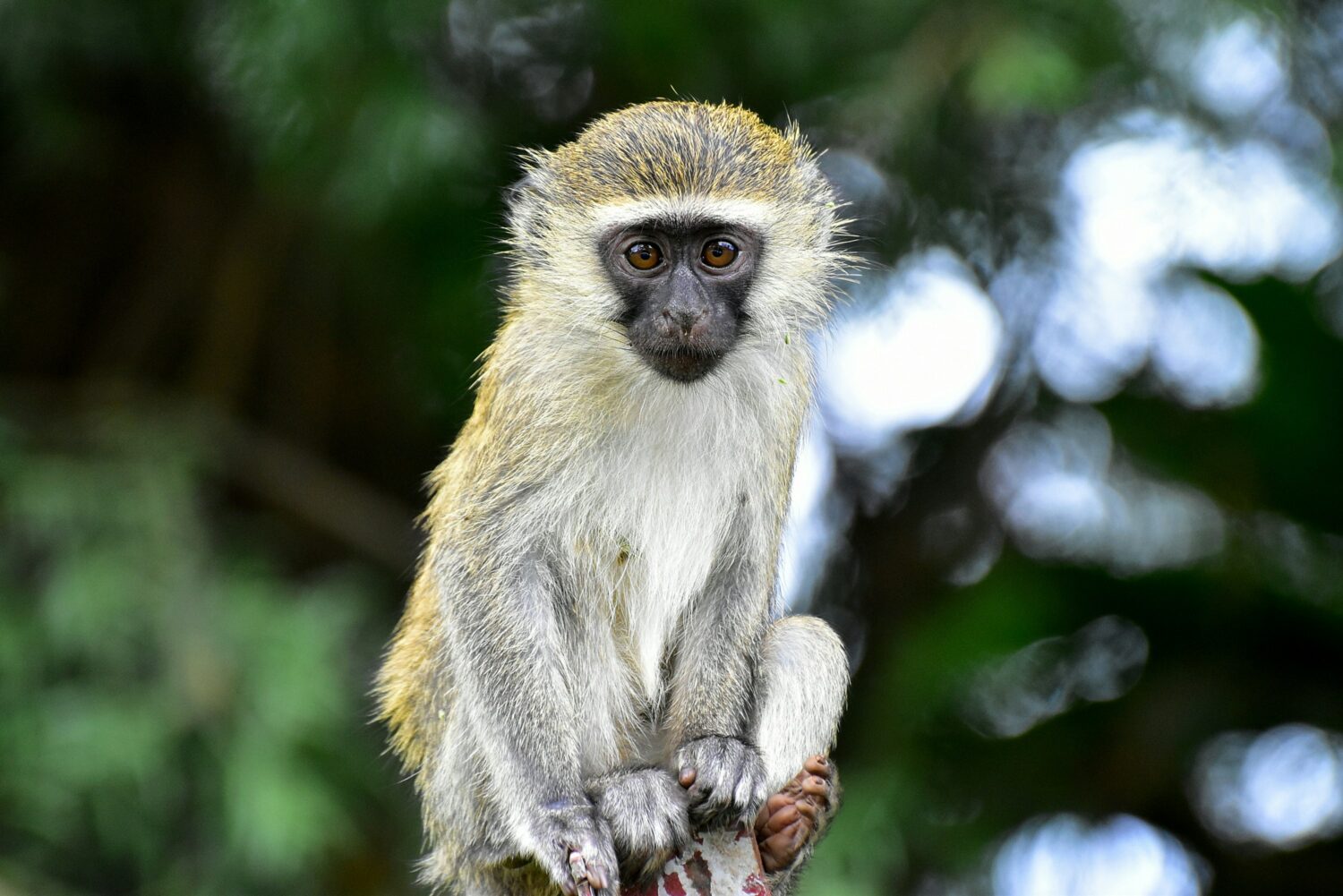
 Because both species share a broadly similar size and general body plan, travelers new to Uganda’s wildlife sometimes struggle to distinguish between the two at a glance, particularly during a brief roadside sighting. The vervet monkey, scientifically known as Chlorocebus pygerythrus, displays a grizzled grey-green coat, a distinctive black face bordered by a fringe of white hair, and, in adult males, a strikingly vivid blue coloring around the genital region that serves as a visual signal of social status within the troop. Vervets are readily identified by this combination of grey coloring and sharply defined black facial mask, along with their comparatively compact, agile build suited to both ground foraging and tree climbing.
The patas monkey, known scientifically as Erythrocebus patas and sometimes referred to by the evocative alternative names hussar monkey or wadi monkey, presents a notably different appearance. Rather than the grizzled grey of the vervet, patas monkeys display a light reddish-brown coat across the back contrasted with a pale, whitish underside, along with a distinctive black stripe or moustache-like marking above the eyes and around the mouth. Patas monkeys also carry a noticeably leaner, more elongated build than vervets, with unusually long limbs that reflect the species’ specialized adaptation for rapid ground movement rather than tree-based agility. Young patas monkeys are born with a black nose that gradually lightens as they approach sexual maturity, offering an additional identification clue for travelers observing a mixed-age troop.
The Patas Monkey: Built for Speed
Among Uganda’s primates, the patas monkey holds a genuinely remarkable distinction: it is widely considered one of the fastest primates on Earth, capable of reaching ground speeds of up to fifty-five kilometers per hour across open terrain. This exceptional speed represents a specialized evolutionary adaptation to life in dry, open savannah habitat, where extensive tree cover simply is not available as a refuge from predators in the way it is for more forest-dependent primate species. Rather than fleeing into the canopy when threatened, patas monkeys rely on raw sprinting speed across open ground to escape predators such as leopards, jackals, and birds of prey, making them functionally one of the most terrestrial primate species found anywhere in Africa.
This ground-dwelling lifestyle shapes much of the patas monkey’s broader behavior. Rather than sleeping in dense forest canopy like colobus or blue monkeys, patas monkeys favor open, elevated positions such as termite mounds, low tree branches, or raised savannah ground, from which they can maintain clear sightlines across the surrounding landscape and spot approaching danger well before it arrives. This preference for elevated vantage points also makes patas monkeys somewhat easier to spot during a game drive than their skittish, ground-hugging behavior might otherwise suggest, since travelers scanning termite mounds and low branches along the roadside frequently catch sight of a resting individual keeping watch over its troop.
Patas monkey social groups are generally organized around a single adult male accompanying a larger number of females and their offspring, a structure that differs somewhat from the more male-heavy troops typical of vervet monkeys. This social configuration, combined with the species’ specialized speed and habitat preference, has earned the patas monkey classification as near threatened on the IUCN Red List, reflecting ongoing pressure on the open savannah habitat this species depends upon across its range.
The Vervet Monkey: Uganda’s Ultimate Generalist
Where the patas monkey represents a highly specialized savannah adaptation, the vervet monkey stands as something closer to the ultimate generalist among Uganda’s primates. Vervets thrive across an extraordinarily broad range of habitats, from dense forest edges and riverine woodland to open savannah, agricultural land, and even the immediate surroundings of tourist lodges and rural settlements. This adaptability has made vervet monkeys one of the most widely distributed primate species on the entire planet, and within Uganda specifically, they are encountered with such regularity that many travelers spot their first vervet troop before even reaching their first national park boundary.
Vervet monkeys live in structured social troops typically comprising multiple adult males, a larger number of females, and their offspring, engaging in the kind of visibly social, interactive behavior, grooming, playing, and occasional squabbling over food, that makes them consistently entertaining to observe even during a brief roadside stop. Their diet reflects a similarly opportunistic, generalist approach to survival, consisting of fruit, leaves, seeds, insects, and, particularly around areas of human habitation, whatever food scraps or agricultural produce happen to be available. This adaptability, while making vervets one of the more reliably observed primates on any Uganda itinerary, has also earned them something of a mixed reputation around lodges and campsites, where habituated troops have learned to associate humans with an easy meal and will occasionally attempt to steal unattended food.
Where to See Vervet and Patas Monkeys in Uganda
Vervet monkeys are genuinely ubiquitous across nearly all of Uganda’s national parks, with reliable sightings reported in Murchison Falls National Park, Queen Elizabeth National Park, Lake Mburo National Park, and Kidepo Valley National Park, among numerous other locations. Their comfort around human activity also means vervets are frequently spotted directly around lodge grounds and picnic sites, giving travelers ample opportunity for close, extended observation without needing to venture deep into more remote sections of any given park.
The patas monkey, by contrast, occupies a considerably more restricted range within Uganda, generally limited to the country’s extreme north and northeastern dry savannah zones. Murchison Falls National Park stands as one of the most reliable locations for patas monkey sightings, particularly within the park’s open, grassy plains and dry woodland sectors, where the species’ preference for elevated, open terrain gives it away to attentive observers scanning the roadside during a game drive. Kidepo Valley National Park offers similarly strong patas monkey viewing opportunities, reflecting the park’s characteristic dry savannah ecosystem, and the Pian Upe Wildlife Reserve in the Karamoja sub-region rounds out the short list of locations where this specialized species can reliably be found within Uganda’s borders.
Why These Common Primates Deserve More Attention
It is tempting for travelers focused on Uganda’s headline wildlife, gorillas, chimpanzees, lions, and elephants, to treat vervet and patas monkey sightings as background noise rather than genuine highlights of a safari day. This overlooks what makes both species genuinely interesting from a behavioral and ecological standpoint. The patas monkey’s specialized speed adaptation represents one of the more remarkable evolutionary solutions to the challenge of surviving in open, cover-poor habitat, a genuinely different strategy from the tree-dependent escape behavior favored by most other African primates. The vervet monkey’s extraordinary adaptability, meanwhile, offers a compelling window into just how successfully a relatively small, unspecialized primate can thrive across an enormous range of environmental conditions, standing in sharp contrast to the far more habitat-dependent mountain gorilla and chimpanzee populations that require carefully protected forest ecosystems to survive at all.
For travelers building a comprehensive picture of Uganda’s primate diversity, taking a few extra minutes to properly observe a vervet troop’s social dynamics, or to watch a patas monkey break into its characteristic sprint across open grassland, adds genuine texture to a Uganda safari that might otherwise focus exclusively on the country’s more famous headline species.
Combining These Sightings With a Wider Uganda Safari
Both species integrate naturally into virtually any Uganda itinerary without requiring any specialized activity or additional permit. A Murchison Falls safari built around classic game drives and a Nile boat cruise will almost certainly deliver vervet monkey sightings without any specific effort, while patas monkey encounters within the park’s drier northern sectors add a worthwhile bonus for travelers with a genuine interest in the country’s full range of primate diversity. Travelers extending their trip north to Kidepo Valley National Park significantly increase their odds of a strong patas monkey sighting, given the park’s characteristic open, dry savannah habitat that closely matches the species’ specialized ecological niche.
Planning Your Uganda Wildlife Safari
Whether your primary interest lies in Uganda’s headline gorilla and chimpanzee trekking experiences or in building a more comprehensive picture of the country’s full primate diversity, including species like the vervet and patas monkey that many visitors overlook entirely, our team can help design an itinerary that captures the full breadth of what Uganda’s wildlife has to offer. Contact us today to start planning a Uganda safari that combines classic big game viewing in Murchison Falls National Park with the kind of attentive, well-guided wildlife observation that turns even the country’s most common primates into genuinely memorable safari moments.