Bushbuck in Uganda: A Forest Antelope Spotting Guide
Among Uganda’s diverse antelope species, few are as consistently present yet so easily overlooked as the bushbuck. This medium-sized, richly marked antelope inhabits nearly every one of Uganda’s major national parks, from the riverine woodlands of Murchison Falls to the dense forest edges of Bwindi Impenetrable National Park, yet its notably shy, solitary nature means many travelers pass through an entire safari without ever getting the extended, satisfying look this striking animal deserves. Understanding where and how to look for bushbuck transforms what might otherwise be a fleeting, half-glimpsed silhouette darting into cover into a genuinely rewarding wildlife encounter.
This guide takes a detailed look at the bushbuck’s physical characteristics, behavior, and habitat preferences, along with practical guidance on where within Uganda’s parks this species is most reliably spotted and how travelers can improve their odds of a proper, extended sighting rather than the brief flash of movement that so often defines a typical bushbuck encounter.
Identifying the Bushbuck
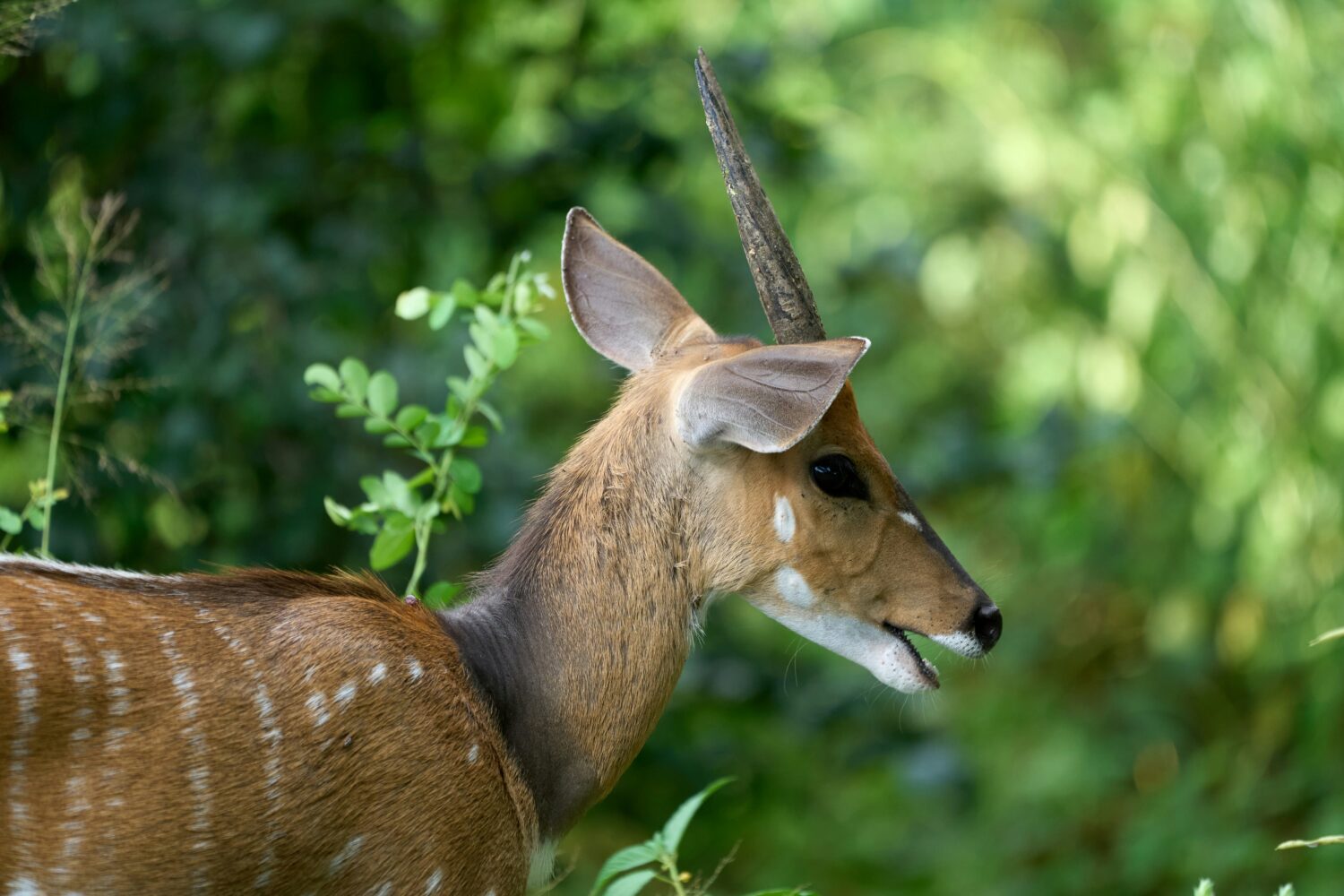
 The bushbuck, known scientifically as Tragelaphus scriptus, is a close relative of the considerably larger nyala found further south in Africa, though the bushbuck itself remains a comparatively modest-sized antelope well suited to life within thick forest and woodland cover. Its coat presents a rich, glossy brown coloring, with males typically displaying a darker, more chestnut-toned coat than females, whose fur tends toward a lighter shade of brown. Both sexes carry a distinctive pattern of white markings, including up to seven vertical white stripes running down the sides of the body, along with scattered white spots, a white throat patch, white markings on the ears, chin, tail, legs, and neck, and a notably pale, almost pure white muzzle. These bold white markings, set against the animal’s dark coat, actually function as effective camouflage within the dappled light and shadow typical of forest and thicket habitat, breaking up the animal’s outline in a way that makes it considerably harder to spot at a distance than the markings themselves might initially suggest.
Only males carry horns, gently spiraled and reaching a moderate length compared to some of Africa’s more dramatically horned antelope species. Males are noticeably larger than females, typically weighing between forty and eighty kilograms with a shoulder height ranging from seventy to one hundred centimeters, while females weigh between twenty-five and sixty kilograms with a somewhat shorter shoulder height of sixty-five to eighty-five centimeters. This size difference, combined with the darker coat typical of mature males, gives experienced guides an easy way to distinguish sex at a glance even during a brief sighting.
Habitat Preferences and Behavior
Bushbuck are remarkably adaptable animals, capable of thriving across an unusually broad range of habitat types, including dense forest, woodland, riverine vegetation, open savanna edges, and even cultivated land bordering protected areas. Despite this adaptability, the species shows a consistent underlying preference for habitats offering abundant cover, particularly thickets and dense underbrush, which provide both a reliable food source and critical protection from predators such as leopards and hyenas that represent the bushbuck’s primary natural threats across most of its Ugandan range.
This preference for dense cover shapes much of the species’ broader behavioral pattern. Unlike many of Uganda’s more visibly social antelope species, bushbuck are predominantly solitary or found in loose pairs, typically a female with a single dependent offspring or, less commonly, a male and female together during the breeding season. This solitary tendency, combined with a natural inclination toward caution and swift retreat into nearby vegetation at the first sign of disturbance, explains why bushbuck sightings so often amount to little more than a brief glimpse of movement disappearing into the undergrowth rather than the sustained, relaxed observation possible with more herd-oriented species like Uganda kob or topi.
Bushbuck are primarily active during the cooler hours of early morning, late afternoon, and into the evening, tending to rest in dense cover during the heat of midday. This crepuscular activity pattern, combined with the species’ naturally cautious temperament, means that timing a game drive or forest walk around these specific windows meaningfully improves the odds of a genuine sighting rather than simply passing through prime bushbuck habitat during a period when the animal itself is most likely tucked away out of sight.
Diet and Feeding Habits
As a mixed feeder, the bushbuck’s diet reflects its habitat versatility, incorporating leaves, shoots, fruits, and grasses depending on seasonal availability and the specific vegetation type surrounding a given individual’s home range. This dietary flexibility allows bushbuck to persist across habitat types that might prove considerably more challenging for antelope species with more narrowly specialized feeding requirements, further reinforcing the species’ broader reputation for ecological adaptability across Uganda’s varied landscapes.
Where to Find Bushbuck in Uganda
Bushbuck are genuinely widespread across Uganda’s protected area network, appearing reliably in Murchison Falls National Park, Queen Elizabeth National Park, and Bwindi Impenetrable National Park, among several other locations. Within Murchison Falls National Park specifically, the species is most consistently spotted around the Paraa area and throughout the Buligi game circuit, where the mix of riverine woodland and thicketed cover along the Nile corridor provides exactly the kind of habitat bushbuck favor. Travelers on a boat cruise toward the base of Murchison Falls occasionally spot bushbuck moving cautiously along the riverbank vegetation, offering a somewhat different vantage point than the standard vehicle-based game drive typically provides.
Queen Elizabeth National Park offers further strong bushbuck viewing opportunities, particularly within the park’s forested sections and thicker vegetation zones bordering its more open savannah habitat, where the species coexists alongside topi, waterbuck, and the park’s notable population of the more elusive, swamp-adapted sitatunga. Bwindi Impenetrable National Park, while primarily celebrated for mountain gorilla trekking, also hosts bushbuck within its dense forest interior, giving travelers already exploring the park’s trekking trails an additional wildlife encounter alongside their primary gorilla-focused activity.
Tips for Spotting Bushbuck Successfully
Because bushbuck rely so heavily on cover and tend toward genuinely cautious, solitary behavior, successfully spotting this species generally rewards a somewhat different approach than the wide-open scanning typical of savannah game drives focused on more conspicuous herd species. Moving slowly and quietly along forest edges and thicket borders, rather than scanning purely open grassland, considerably improves the odds of a sighting, since bushbuck frequently linger at the boundary between dense cover and adjacent clearings, feeding cautiously while maintaining a clear escape route into nearby vegetation.
Early morning and late afternoon game drives or forest walks offer the strongest odds of encountering an active, feeding individual, while a patient, observant guide familiar with a specific park’s known bushbuck territories can make a considerable difference in transforming a fleeting glimpse into a genuinely satisfying, extended sighting. Travelers hoping for photographs should be prepared for a shorter window of opportunity than many other antelope species allow, given the bushbuck’s tendency to retreat into cover relatively quickly once it registers the presence of a vehicle or walking group.
Conservation Status
The bushbuck is currently classified as a species of least concern on the IUCN Red List, reflecting stable, widespread populations across its considerable range throughout sub-Saharan Africa, including within Uganda’s well-protected national park system. This relatively secure conservation status stands in useful contrast to some of Uganda’s more threatened antelope species, and reflects both the bushbuck’s genuine habitat adaptability and the effectiveness of sustained protection across the country’s major parks. Continued conservation funding, supported directly by park entrance fees and tourism activity, helps ensure this adaptable, widely distributed antelope remains a consistent presence across Uganda’s varied ecosystems for years to come.
Including Bushbuck Sightings in Your Uganda Safari
For travelers building a Uganda itinerary, bushbuck sightings integrate naturally into virtually any game drive or forest walk across the country’s major parks without requiring any specialized activity or additional planning. A Murchison Falls safari that includes time exploring the Buligi game circuit or the riverine woodland around Paraa offers strong odds of a bushbuck encounter alongside the park’s more headline wildlife, while travelers combining Murchison Falls with a broader circuit through Queen Elizabeth National Park or Bwindi Impenetrable National Park significantly increase their overall chances of a memorable, extended sighting across multiple parks.
Our guides understand precisely where and when to look for this genuinely rewarding but easily overlooked species, and we build game drive and forest walk routes that give travelers the best possible opportunity to observe bushbuck properly, rather than settling for the brief, half-glimpsed encounter that defines so many casual safari sightings of this shy, solitary antelope.
Planning Your Uganda Wildlife Safari
If you want your Uganda safari to capture the full depth of the country’s antelope diversity, including species like the bushbuck that reward patience and an attentive guide rather than simply appearing in plain view on open grassland, our team can help design an itinerary through Murchison Falls National Park, Queen Elizabeth National Park, and Bwindi Impenetrable National Park tailored to exactly this goal. Contact us today to start planning a Uganda safari that combines classic big game viewing with the kind of careful, well-guided wildlife observation that turns even the country’s shyest, most overlooked antelope species into a genuinely memorable safari encounter.