Side-Striped Jackal: Uganda’s Lesser-Known Canine
Ask most travelers on a Uganda safari to name the country’s wild canine species, and the answer, if they venture one at all, will almost certainly be some version of hyena. Yet Uganda is home to a genuinely distinct and considerably more elusive predator that quietly moves through the same savannah landscapes as the country’s more famous wildlife: the side-striped jackal. Rarely photographed, seldom discussed in standard safari guides, and generally overlooked in favor of lions, leopards, and elephants, this timid, adaptable canine deserves considerably more recognition than it typically receives, both for its genuinely interesting biology and for the quiet role it plays within Uganda’s broader predator ecosystem.
This guide takes a close look at the side-striped jackal, covering its physical identification, diet, social behavior, and breeding habits, along with the specific parks and regions within Uganda where sightings are most likely, giving travelers a genuinely useful understanding of a species that rewards patient, attentive safari-goers far more than it does casual observers hoping for an easy, guaranteed encounter.
Identifying the Side-Striped Jackal
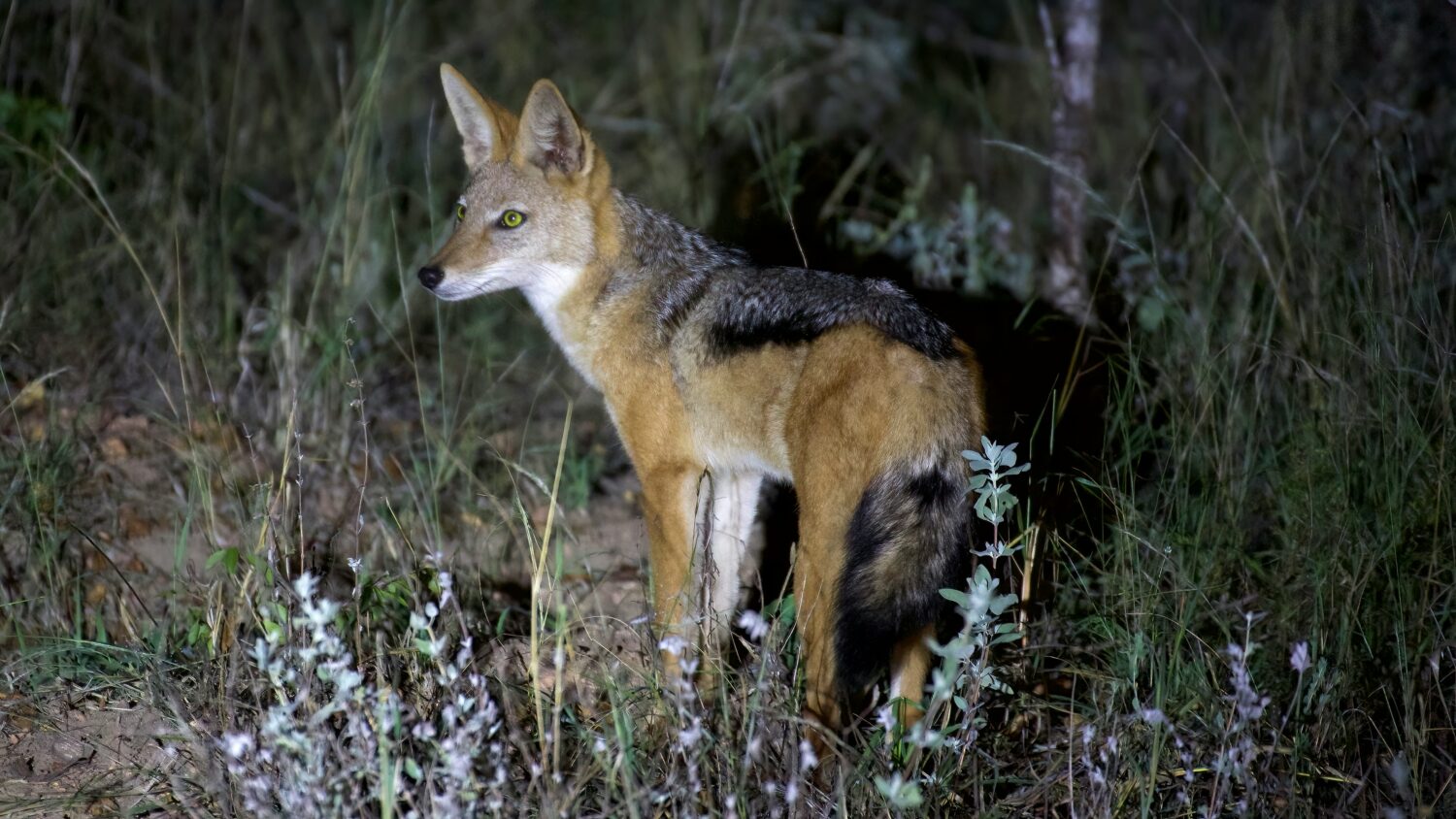
 The side-striped jackal, known scientifically as Lupulella adusta and sometimes still referenced under its older classification as Canis adustus, presents a distinctive grey to buff-colored coat, with a notably darker shade running along the back compared to the paler underside. The species takes its common name from the faint white stripe that runs along each flank, extending roughly from elbow to hip, bordered along its lower edge by a darker, blackish margin. This side-striping varies considerably in visibility from one individual to the next, with adults generally displaying more clearly defined markings than younger animals, whose stripes tend to appear fainter and less distinct.
Perhaps the most reliable field identification marker, however, lies in the tail rather than the flanks. The side-striped jackal’s tail is predominantly dark, almost black, but consistently tipped with a small tuft of white fur, a detail that remains visible even in situations where the fainter side stripes are difficult to make out in low light or from a distance. The species’ ears carry a dark, buffy coloring that further distinguishes it from Uganda’s other resident jackal species, and overall, the side-striped jackal is noticeably larger and more robustly built than the black-backed jackal, standing at a shoulder height of roughly forty to fifty centimeters and weighing between seven and twelve kilograms, with a body length ranging from sixty-five to eighty centimeters excluding its considerably long tail.
A Genuinely Adaptable Survivor
What makes the side-striped jackal such a resilient and widespread species across its African range comes down largely to its remarkable dietary and habitat flexibility. Unlike more strictly carnivorous predators that depend heavily on successful large-prey hunts, the side-striped jackal functions as a genuine omnivore, willing and able to exploit an unusually broad range of food sources depending on what happens to be available in a given season or location. Its diet includes small mammals, carrion, reptiles, birds, eggs, fruit, and even cultivated crops such as maize where its range overlaps with agricultural land, a dietary breadth that allows this species to persist successfully across habitats where more specialized predators might struggle.
This adaptability extends equally to habitat preference. Side-striped jackals occupy woodland, scrubland, savannah, grassland, marshland, and cultivated areas alike, and the species has even shown a notable capacity to exploit the fringes of urban and suburban environments where its range brings it into proximity with human settlement. Within Uganda specifically, the species shows a particular affinity for areas offering good vegetation cover situated relatively close to water sources, conditions found extensively across the country’s savannah parks.
Social Behavior and Breeding
Side-striped jackals are generally solitary or found in loose pairs, though small family groups of up to roughly six individuals occasionally form, typically consisting of a breeding pair accompanied by their most recent litter of pups still residing within the parental territory. The species is territorial, with established pairs actively defending a home range against neighboring jackals, and this territoriality, combined with the animal’s naturally timid, cautious temperament around humans and vehicles, contributes significantly to how rarely the species is actually observed compared to its considerably more visible and confident cousin, the black-backed jackal.
Breeding within side-striped jackal populations follows a notably monogamous pattern, with established pairs forming long-lasting bonds that can persist across multiple breeding seasons. Breeding activity tends to concentrate during the dry season, with females giving birth after a gestation period of roughly fifty-seven to seventy days to a litter typically consisting of three to six pups. Both parents play an active role in raising the young, with the male taking on responsibilities including assisting with hunting and defending the den, while the female handles nursing duties during the pups’ early weeks of life. Young side-striped jackals are weaned and actively mothered for roughly eight to ten weeks, reach reproductive maturity remarkably early at just six to eight months of age, and become fully independent from their parents by around eleven months, a comparatively rapid developmental timeline that supports the species’ overall resilience and widespread distribution.
In the wild, side-striped jackals can live to between eight and ten years of age, though this natural lifespan is frequently shortened by predation from larger carnivores, disease, and ongoing human-wildlife conflict in areas where the species’ range overlaps with agricultural or settled land.
Where to Find Side-Striped Jackals in Uganda
Within Uganda, the side-striped jackal maintains a genuinely broad distribution, occurring across all four of the country’s major savannah national parks, Murchison Falls, Queen Elizabeth, Kidepo Valley, and Lake Mburo, along with populations extending into the montane forest habitats of Bwindi Impenetrable and Mgahinga Gorilla National Parks. Despite this wide distribution, Murchison Falls National Park stands out as the single most reliable location for sightings within the country, with the species most consistently observed within the park’s northern sector during standard game drives.
Travelers hoping for a side-striped jackal sighting should moderate their expectations somewhat compared to more visible savannah predators. Given the species’ genuinely timid nature and largely nocturnal to crepuscular activity pattern, encounters tend to occur most often during early morning or dusk game drives, when the animal is more likely to be active and moving through open terrain rather than concealed within dense daytime cover. Night game drives, where available within a given park, offer meaningfully improved odds of a sighting given the species’ predominantly nocturnal habits, though even under these more favorable conditions, a side-striped jackal encounter should be treated as a genuine bonus rather than a guaranteed outcome of any single game drive.
Distinguishing the Side-Striped Jackal From Uganda’s Other Canines
Uganda hosts a small handful of wild canine species beyond the side-striped jackal, and understanding the broader context helps travelers appreciate exactly what makes this particular species distinctive. The black-backed jackal, considerably more restricted in its Ugandan distribution than the side-striped species, occurs primarily within Kidepo Valley National Park and the surrounding Pian Upe Game Reserve area in the country’s remote northeast, and tends to display noticeably more confident, visible behavior around vehicles compared to its more retiring side-striped relative. The golden jackal, meanwhile, technically appears on Uganda’s national wildlife checklist but has not been formally recorded within any of the country’s national parks, understood instead as an occasional vagrant occasionally spotted preying on livestock or crops outside protected areas.
This context helps clarify why the side-striped jackal, despite being the most widespread and commonly encountered jackal species across Uganda’s protected area network, still ranks among the country’s more genuinely elusive predators from a pure sighting-frequency standpoint, a status driven considerably more by behavioral timidity than by any underlying scarcity in overall population.
Conservation Status and Ongoing Pressures
The side-striped jackal is not currently classified as a threatened species, reflecting a broad, adaptable range across much of sub-Saharan Africa, including healthy populations distributed across Uganda’s national park network. That said, the species faces ongoing localized pressure from habitat loss, human-wildlife conflict, particularly around cultivated land bordering protected areas, and disease transmission risks, including its documented role in rabies transmission in some regions, which has historically contributed to targeted persecution of the species in certain areas outside formal protection.
Within Uganda’s national parks specifically, conservation efforts focused on habitat protection, community coexistence initiatives, and ongoing ecological research continue to support stable side-striped jackal populations, with tourism-generated revenue contributing directly to the broader conservation infrastructure that sustains this and other resident predator species across the country’s protected landscapes.
Including Side-Striped Jackal Sightings in Your Uganda Safari
For travelers building a Uganda itinerary with a genuine interest in the country’s full predator diversity, rather than focusing exclusively on lions and leopards, a Murchison Falls safari focused on the park’s northern sector offers the strongest overall odds of a side-striped jackal encounter, particularly for travelers willing to schedule game drives around the early morning or dusk hours when this notably shy species tends to be most active. Night game drives, where available, add a further meaningful boost to sighting odds for travelers specifically prioritizing this species as part of a broader predator-focused safari.
Our guides understand precisely where and when to look for this genuinely rewarding but frequently overlooked canine species, and we build game drive timing and routing around maximizing the chances of a memorable sighting, without setting unrealistic expectations for a species that remains, by nature, considerably harder to observe than Uganda’s more visible headline predators.
Planning Your Uganda Predator Safari
If you want your Uganda safari to go beyond the standard checklist of lions, leopards, and hyenas to include some of the country’s genuinely lesser-known predators, our team can help design an itinerary through Murchison Falls National Park and beyond specifically tailored to this goal. Contact us today to start planning a Uganda safari that combines classic big game viewing with the kind of carefully timed, attentively guided game drives that give you a genuine shot at spotting species like the side-striped jackal, one of Uganda’s quietest and most consistently underappreciated wild canines.