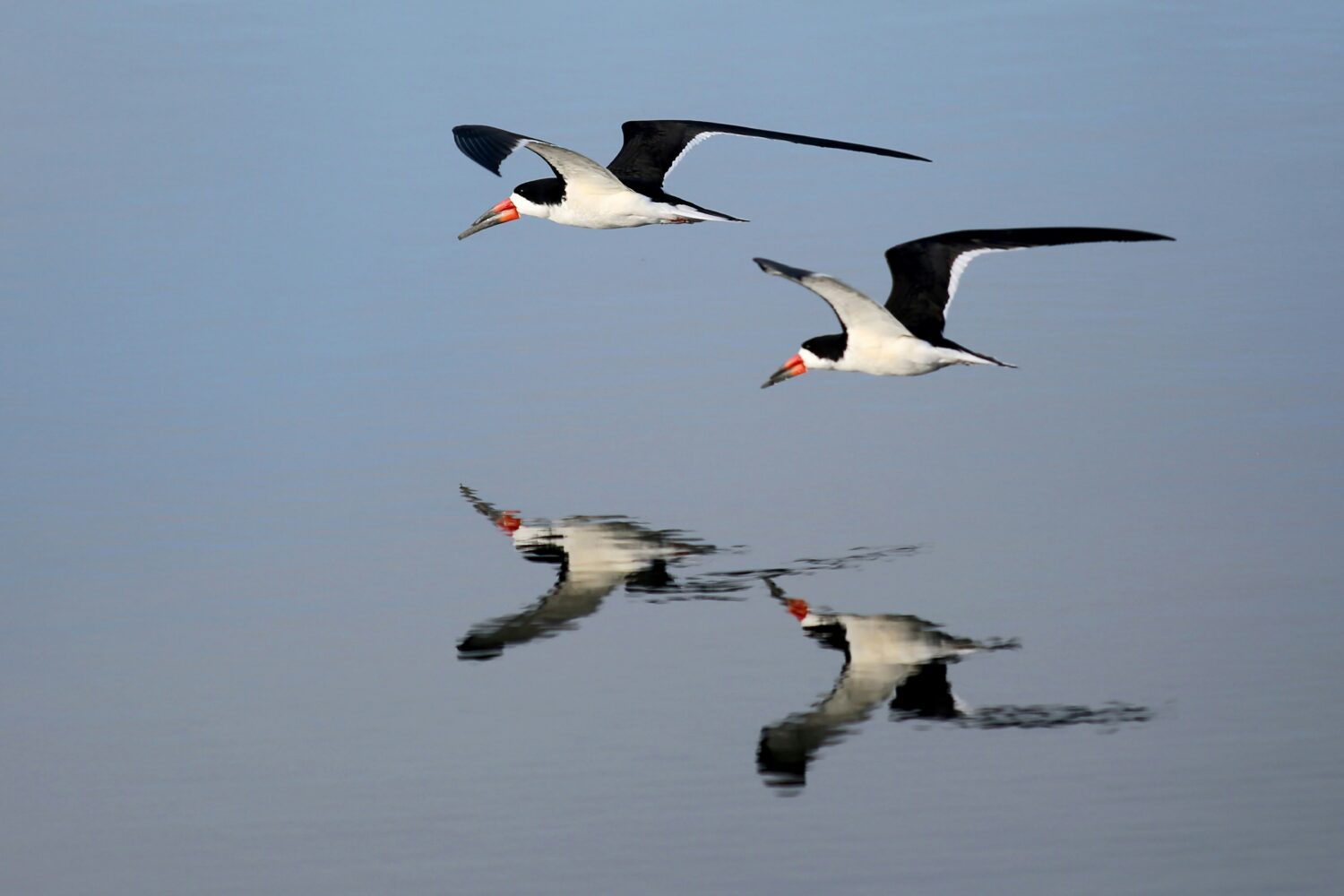
African Skimmer on the Nile: Where to Spot This Unique Bird
Most water birds catch fish by diving, wading, or stalking. The African Skimmer does something considerably stranger, flying in a straight, low line just above the water’s surface, its oversized lower bill slicing through the surface film until it strikes a fish, at which point the bill snaps shut instantly on contact. It’s one of the more genuinely unusual feeding behaviors in the entire bird world, and Uganda’s rivers and channels, including stretches of the Nile itself, offer a realistic, if not guaranteed, chance to witness it firsthand.
What Makes the African Skimmer So Unusual
The African Skimmer, scientifically classified as Rynchops flavirostris, is immediately recognizable once you know what to look for: a striking black crown, hindneck, and back set against otherwise white plumage, a forked white tail, bright red legs, and, most distinctively, a bright orange bill with a yellow tip where the lower mandible extends noticeably longer than the upper, flattened sideways almost like a blade. This unusual bill structure exists for exactly one purpose: skimming. The bird flies low over calm water with its elongated lower mandible cutting through the surface, and the instant it makes contact with a fish, it snaps its bill shut with remarkable speed and precision, a hunting technique found in only a small handful of bird species worldwide.
Feeding Behavior and Diet
Skimmers hunt primarily during crepuscular hours, dawn and dusk, when calm water and low light conditions favor their surface-skimming technique, and they’re equipped with excellent night vision that supports this activity pattern. Their diet consists of a range of small fish species found in Uganda’s rivers and channels, and groups of skimmers are often observed flying in coordinated lines above the water, dipping in near-unison as they work a stretch of river together, a genuinely striking sight when witnessed from a boat or riverbank at the right time of day.
Breeding Behavior on Sandbanks
African Skimmers nest in loose colonies on large exposed sandbanks, typically consisting of fewer than fifty breeding pairs, with each pair laying two to three eggs, occasionally four, in a simple scrape dug directly into the sand rather than a constructed nest. These sandbank colonies sometimes share space with other sand-nesting species, including the collared pratincole, pied avocet, and white-fronted plover, creating a genuinely active, mixed-species breeding site during the right season. Because these colonies depend entirely on exposed sandbanks, they only become viable when river water levels drop low enough to expose sufficient sand, tying the species’ breeding cycle directly to Uganda’s dry season water conditions.
Migration Patterns
African Skimmers are partial intra-African migrants, following the seasonal rise and fall of river water levels across the continent rather than making the long-distance intercontinental journeys some other African birds undertake. They generally move as water levels begin falling with the onset of the dry season, roughly April through June, taking advantage of the exposed sandbanks this creates, before moving back as rivers rise again with the start of the rains, typically November through January. This pattern directly shapes when and where sightings are most likely across Uganda’s waterways.
Conservation Status
The African Skimmer is widely classified as Near Threatened on the IUCN Red List, reflecting a declining population trend across its African range driven primarily by habitat loss and disturbance at the sandbank sites it depends on for breeding. The total global population is estimated at somewhere between 15,000 and 25,000 individuals, a genuinely modest number spread across a wide geographic range from Senegal through the southern Nile Valley down to South Africa, making any individual sighting a meaningful one for birders tracking declining species.
Where to Find the African Skimmer in Uganda
Kazinga Channel: Uganda’s Most Reliable Site
The Kazinga Channel, the waterway connecting Lake George and Lake Edward within Queen Elizabeth National Park, holds the strongest reputation among Uganda’s birding guides as the country’s most consistent location for the African Skimmer, with a resident population present through much of the year. The channel’s calm, sheltered water and the boat cruise activity already built into most Queen Elizabeth itineraries make this the most practical and dependable place to specifically look for the species without adding extra activities to your trip.
The Victoria Nile at Murchison Falls
The Victoria Nile within Murchison Falls National Park, including the broad sandy banks and shallower stretches below the falls, does host African Skimmers, particularly during the dry season when falling water levels expose the sandbanks the species depends on for both feeding and breeding. Sightings here are genuinely less predictable than at Kazinga Channel, and some assessments describe the species as rare along this stretch of the Nile specifically, so it’s worth treating a Murchison sighting as a rewarding bonus during your Nile boat cruise rather than the primary reason for the trip.
Lake Albert’s Shoreline
Lake Albert, connected to the Nile system and bordering Murchison Falls National Park to the west, offers a further, if similarly less predictable, opportunity, with its extensive shallow bays and delta areas providing suitable habitat. Sightings here are considered less guaranteed than either Kazinga Channel or the Nile itself, but the lake’s shoreline remains a worthwhile addition for birders building a dedicated, comprehensive skimmer-focused route through western Uganda.
Best Time to Look for Skimmers
Timing matters considerably for this species, and the dry season windows, roughly December through March and June through September, offer the strongest odds, since lower water levels expose the sandbanks skimmers depend on and concentrate feeding activity into more predictable, visible stretches of water. Early morning, generally before nine, and late afternoon into early evening are the most productive times of day, aligning with the species’ crepuscular feeding pattern, and arriving at a likely spot before sunrise gives the best chance of catching skimmers in active feeding flight.
Tips for a Successful Sighting
A few practical habits improve your odds meaningfully. Scanning open sandbanks and calm stretches of water with binoculars offering a wide field of view helps cover more ground quickly than trying to track a single narrow section, since skimmers can appear and move through an area relatively fast. Local boat captains and fishermen, particularly along the Nile and Lake Albert, often have direct, current knowledge of where skimmers have recently been active, and it’s worth asking directly rather than relying purely on general guidance, since sandbank conditions and bird activity shift with water levels through the season.
Combining a Skimmer Search with Your Broader Itinerary
Given that Kazinga Channel’s boat cruise is already a standard, well-established activity within most Queen Elizabeth National Park itineraries, a dedicated skimmer search requires little additional planning for travelers already visiting that park. For a more complete western Uganda birding route, pairing a Queen Elizabeth stop with the Nile boat cruise at Murchison Falls National Park, and potentially extending to Lake Albert’s shoreline, creates a genuinely thorough attempt at the species across the destinations where it’s actually been recorded in Uganda, while also delivering the broader wildlife and scenery each of these locations is known for regardless of whether the skimmer itself makes an appearance.
If you’re planning a Uganda birding trip and want to build in a dedicated search for the African Skimmer along the Kazinga Channel, the Nile, or Lake Albert, our team at Murchison Falls Park Safari can design an itinerary around these specific locations and timing windows. Contact us to start planning a Uganda birding safari built around the country’s more unusual and declining species.
For more on Uganda’s exceptional birdlife, our guides on the Papyrus Gonolek and wetland birding hotspots, the Great Blue Turaco, and Murchison Falls National Park’s game drives and boat cruises are all available, here and pair well with this guide.