Kazinga Channel Boat Cruise: Queen Elizabeth’s Best Wildlife Viewing
Ask safari guides across Uganda which single activity delivers the most wildlife per hour of effort, and the Kazinga Channel boat cruise comes up more often than almost anything else in the country, including a fair number of gorilla trekkers who admit the channel actually outshone their primate encounter. That’s a bold claim for a slow, two-hour boat ride, but it holds up once you understand what’s actually concentrated along this thirty-two-kilometer stretch of water in Queen Elizabeth National Park. Where a typical game drive means scanning open savanna hoping animals happen to be nearby, the Kazinga Channel simply gathers the wildlife for you, because in this stretch of Uganda, the water itself is the reason everything shows up. For anyone building a Uganda safari itinerary that includes Queen Elizabeth National Park, this cruise deserves to be treated as a headline activity rather than an afternoon filler.
What the Kazinga Channel Actually Is
The Kazinga Channel is a natural, thirty-two-kilometer waterway connecting Lake Edward to its smaller neighbor, Lake George, both named for members of the British royal family during the colonial era and both sitting within the boundaries of Queen Elizabeth National Park in southwestern Uganda. Unlike a river with directional current, the channel functions more as a wide, slow-moving connector between the two lakes, and its banks have become one of the most reliable wildlife-viewing corridors anywhere on the continent, precisely because animals across this stretch of the park depend on the channel as their primary water source. Rather than dispersing across the park’s savanna to find scattered water holes, Queen Elizabeth’s wildlife concentrates along the channel’s banks in numbers that consistently surprise even well-traveled safari-goers.
Boat cruises along the channel have been running since 1952, making this one of the longest continuously operated wildlife tourism activities in Uganda, and the format has remained essentially unchanged for decades because it simply works: a slow, low-disturbance boat moving along the water gives you sustained, close-range access to wildlife that would be far harder to approach on foot or by vehicle.
The Hippo Numbers That Make This Channel Famous
If there’s one statistic that defines the Kazinga Channel’s reputation, it’s the hippo population. Estimates place the channel’s hippo numbers somewhere between sixteen hundred and well over two thousand individuals, making it one of the densest concentrations of hippopotamus found anywhere in the world, rivaling or exceeding populations in far more famous wildlife destinations elsewhere in Africa. What makes this genuinely remarkable in person, rather than just an impressive number on paper, is the sheer density visible from the boat — pods of thirty to fifty hippos are common along a single stretch of bank, submerged or half-submerged in the water with only eyes, ears, and nostrils breaking the surface, occasionally surfacing fully with the characteristic yawning gape that serves as both a territorial display and a genuinely startling photograph opportunity.
Hippo behavior itself becomes a small education over the course of the cruise, since unlike most of the park’s other large mammals, hippos spend the entire day submerged in the channel’s water rather than out on land, only emerging after dark to graze on nearby grasslands before returning to the water each morning before sunrise. Guides on the cruise typically explain this pattern in real time, along with the physiological reason behind it — hippos lack the sweat glands and protective coloring that would otherwise shield their skin from direct equatorial sun, making the water not just a habitat preference but a genuine survival necessity.
Beyond Hippos: What Else You’ll See
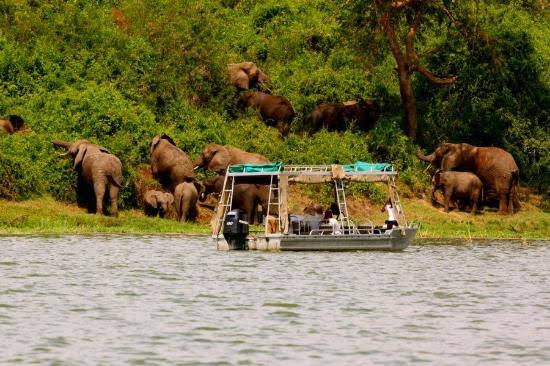
While hippos are the headline attraction, the channel’s banks host a genuinely impressive range of other wildlife across a single two-to-three-hour cruise. Nile crocodiles bask along the shoreline in substantial numbers, some reaching genuinely large sizes, having repopulated the channel over recent decades after an earlier absence linked to historic volcanic activity in the region. Elephants and buffalo herds regularly come down to the water’s edge to drink, and elephants in particular are sometimes seen swimming across the channel itself, occasionally requiring the boat to pause and give a crossing herd the space it needs. Monitor lizards move along the banks and rocky outcrops, and with patience and a bit of luck, lions and even leopards are occasionally spotted coming down to drink at the water’s edge, particularly during the drier months when the channel becomes an even more concentrated draw for the park’s predators.
Birdlife is where the channel earns its reputation among serious birdwatchers specifically, with over sixty species regularly recorded on a single cruise and the total count for the wider area running past a hundred. African fish eagles perch prominently along the banks, their distinctive calls carrying across the water, while pied kingfishers and the striking malachite kingfisher work the shallows for fish. Great white pelicans and yellow-billed storks congregate in numbers, and the African skimmer, a genuinely striking bird known for skimming its lower bill along the water’s surface while in flight to catch prey, is a specific highlight for visiting birders who’ve traveled specifically hoping to spot one.
How the Cruise Actually Works
Boat cruises depart from a jetty near Mweya Peninsula, the park’s main tourism hub, roughly twenty kilometers west of the Kasese-Mbarara highway and reached via the Katunguru gate. Most operators run two to three scheduled departures daily, typically a mid-morning session between roughly nine and eleven, and an afternoon session running from early afternoon through late afternoon, with some operators adding a later departure timed closer to sunset when demand allows. Each cruise generally runs between two and three hours, covering roughly ten to twelve kilometers of the channel’s total length before turning back, which is more than enough distance to pass through the highest-density wildlife stretches without turning the outing into an overly long sit.
Two main boat options are typically available. The Uganda Wildlife Authority operates a larger, double-decker vessel capable of carrying upward of forty passengers split across two levels, priced at around thirty US dollars per person for foreign non-residents, with reduced rates for foreign residents and East African citizens. This is the standard, most widely booked option and offers a reasonably comfortable, if more communal, experience. Private boat charters, including smaller vessels operated by lodges like Mweya Safari Lodge, cost considerably more, generally in the range of one hundred to two hundred dollars depending on the operator and boat size, but offer a smaller, quieter, more flexible experience, better suited to serious photographers or travelers who want more control over positioning near specific wildlife sightings rather than sharing a larger vessel’s fixed itinerary. It’s worth noting that the boat cruise fee is separate from Queen Elizabeth National Park’s general entrance fee, which applies on a per-day basis regardless of which specific activities you undertake within the park.
Choosing Between Morning and Afternoon Cruises
Both scheduled cruise windows offer strong wildlife viewing, but they have genuinely different characters worth considering when planning your visit. Morning cruises tend to catch hippos still settling into the water after their overnight grazing excursions, along with generally cooler, calmer conditions and often better visibility before any midday haze sets in. Afternoon cruises, particularly the later departures, are frequently cited by photographers as offering the best light of the day, with the low, warm angle of late-afternoon sun producing noticeably better photographs of both wildlife and the channel’s broader scenery than the flatter light of a late-morning session. If your itinerary allows flexibility, and especially if photography is a priority, timing your cruise for the later afternoon departure is generally the stronger choice, though a morning cruise paired with an afternoon game drive elsewhere in the park is an equally valid way to structure your day.
Best Time of Year for the Cruise
While the Kazinga Channel delivers strong wildlife viewing essentially year-round, given that its resident hippo and crocodile populations are permanent rather than seasonal, the surrounding land-based wildlife concentrates most heavily along the banks during Uganda’s dry seasons, roughly June through September and December through February, when water sources elsewhere in the park become scarcer and animals rely more heavily on the channel itself. Visiting during these drier stretches tends to produce the highest concentrations of elephants, buffalo, and antelope species coming down specifically to drink, on top of the channel’s permanent hippo and crocodile population, making this the optimal window for travelers specifically prioritizing maximum wildlife density during their cruise.
Practical Tips for a Great Cruise
A few practical details make a genuine difference to how much you get out of the experience. Sitting on the upper deck of the larger UWA vessel, where available, typically offers better sightlines and photography angles over the boat’s railings than the lower level, though it also means more direct sun exposure, so a hat and sunscreen are worth having regardless of which deck you choose. A pair of binoculars is genuinely useful here, since while hippos and crocodiles are visible at close range, many of the channel’s bird species and more distant land mammals benefit considerably from a closer look than the naked eye provides. Remaining seated and following your guide’s instructions around hippo pods matters more than it might seem at first — hippos are responsible for a disproportionate number of wildlife-related human injuries in Africa, largely because they’re territorial and unpredictable despite their calm, half-submerged appearance, and boat operators maintain safe distances specifically because these animals can and do act aggressively if they feel crowded or threatened, particularly males guarding calves.
Building the Cruise Into a Queen Elizabeth Itinerary
The Kazinga Channel cruise pairs naturally with the rest of Queen Elizabeth National Park’s activity roster, and most well-structured itineraries build a full day or two around the park specifically to combine it with game drives across the northern Kasenyi plains or the southern Ishasha sector, famous for its unusual tree-climbing lions, along with chimpanzee tracking in the nearby Kyambura Gorge. Travelers interested in the region’s cultural side often add a stop at Lake Katwe’s centuries-old salt mining works, situated within the same broader park boundary, rounding out a Queen Elizabeth visit with both wildlife and history in a single extended stay.
Combining Queen Elizabeth With a Murchison Falls Safari
For travelers whose primary anchor destination is Murchison Falls National Park in Uganda’s northwest, Queen Elizabeth National Park and its Kazinga Channel sit considerably further south, making this a natural addition for a longer, multi-park itinerary rather than a simple day trip. Many travelers structure exactly this kind of extended circuit, opening with the raw scale and power of Murchison Falls and its own Nile boat cruise below the falls, before heading south through western Uganda toward Kibale Forest for chimpanzee trekking and on to Queen Elizabeth National Park for the Kazinga Channel and its unmatched hippo and bird concentrations. The contrast between Murchison’s dramatic waterfall and open northern savanna and Queen Elizabeth’s slower, water-corridor wildlife viewing gives a longer Uganda trip genuine variety rather than repeating the same experience twice.
Our team at Murchison Falls Park Safari can help build exactly this kind of multi-park itinerary, connecting a Murchison Falls-anchored trip with an extension south to Queen Elizabeth National Park and the Kazinga Channel cruise. Reach out through our contact page to start planning a circuit that includes both destinations, or browse our current Murchison Falls safari packages to see how our core northern itinerary typically comes together before extending south. If you’re mapping out the cost of a longer, multi-park Uganda trip, our guide to estimating your Uganda safari cost by month is a useful next stop, and if chimpanzee trekking is part of your plan on the way south, our guide to the chimpanzee habituation experience in Kibale Forest pairs naturally with a Queen Elizabeth extension.
Few wildlife experiences in Africa deliver as much, as reliably, in as little time as a slow boat moving along the Kazinga Channel. For travelers who want to see genuinely staggering numbers of hippos, crocodiles, elephants, and birds without a single hour of bumping across dusty savanna tracks, this is Queen Elizabeth National Park at its absolute best.