Mongoose Species of Uganda: A Field Guide
Ask most first-time safari travelers what they hope to see in Uganda, and mongooses rarely make the list. Lions, elephants, and gorillas understandably dominate the wish list, yet Uganda quietly hosts one of the richest concentrations of mongoose diversity anywhere on the continent, with roughly ten recorded species moving through its savannahs, wetlands, and forest edges. For travelers who enjoy the smaller, stranger corners of African wildlife, or simply want a richer appreciation of what is moving through the grass alongside the Big Five, a proper look at the mongoose species of Uganda adds a genuinely rewarding layer to any safari through Murchison Falls National Park and beyond.
What Exactly Is a Mongoose
Before getting into individual species, it helps to understand what unites this family in the first place. Mongooses belong to the family Herpestidae, a group of small, low-slung carnivores easily distinguished by their long bodies, short legs, pointed snouts, and tails that often run nearly as long as the rest of the body. Fur tends toward brown or grizzled grey across most species, though a handful carry distinctive markings, from the banded mongoose’s dark stripes to the ringed tails seen in a few other African species. Weight varies enormously across the family, from squirrel-sized dwarf species weighing a few hundred grams up to the considerably larger, cat-sized species that can reach several kilograms.
What makes mongooses consistently fascinating to watch on safari, beyond their small size, is their behavior. Most species are active during daylight hours, making them genuinely visible on game drives rather than confined to night sightings, and their non-retractile claws, built for digging burrows and unearthing prey, keep them constantly busy investigating termite mounds, leaf litter, and the base of trees. Many species are also famously willing to take on venomous snakes, a trait that has cemented the mongoose’s reputation as a fearless, opportunistic hunter across the cultures and landscapes where it lives.
Banded Mongoose: Uganda’s Most Recognizable Species
 The banded mongoose stands as the species most safari travelers will actually encounter in Uganda, and for good reason. Found reliably in both Murchison Falls National Park and Queen Elizabeth National Park, this mongoose lives in extended family groups that can number as many as twenty to forty individuals, sleeping together in a shared underground den and rotating between different den sites every few days. Their grayish-brown fur, marked by the dark bands across their back that give the species its name, along with a tail nearly the length of their body, make them straightforward to identify even at a distance.
What sets banded mongoose groups apart behaviorally is their tight social structure and cooperative parenting. Males play an unusually active role in raising young within the group, a rare trait among mammals more broadly, and the entire troop will band together to drive off predators or even chase down a threat that has managed to catch one of their own. Termite mounds are a favorite excavation target and frequent den site, so travelers on a Murchison Falls game drive who spot a large termite mound worth a second look are often rewarded with a scattering of banded mongoose emerging to forage in the cooler hours of morning and late afternoon.
Marsh Mongoose: A Specialist of Wetter Ground
Uganda’s abundance of rivers, papyrus swamps, and floodplain habitat makes it excellent territory for the marsh mongoose, a species built for life near water rather than the drier savannah favored by many of its relatives. Larger and darker than many other mongoose species found in the region, the marsh mongoose is closely associated with riverbanks, wetlands, and the delta habitat found where the Nile meets Lake Albert within Murchison Falls National Park, making it a species travelers on a Nile boat cruise stand a genuine chance of spotting along the water’s edge.
Unlike the highly social banded mongoose, the marsh mongoose tends toward a more solitary existence, foraging alone along muddy banks for crabs, frogs, and other aquatic prey rather than joining large cooperative groups. Its slightly heavier build and darker coloring, adapted to life in and around water, make it a rewarding spot for travelers paying close attention during a slow cruise along the delta rather than relying purely on standard game drive routes.
Egyptian Mongoose: The Largest of the Family
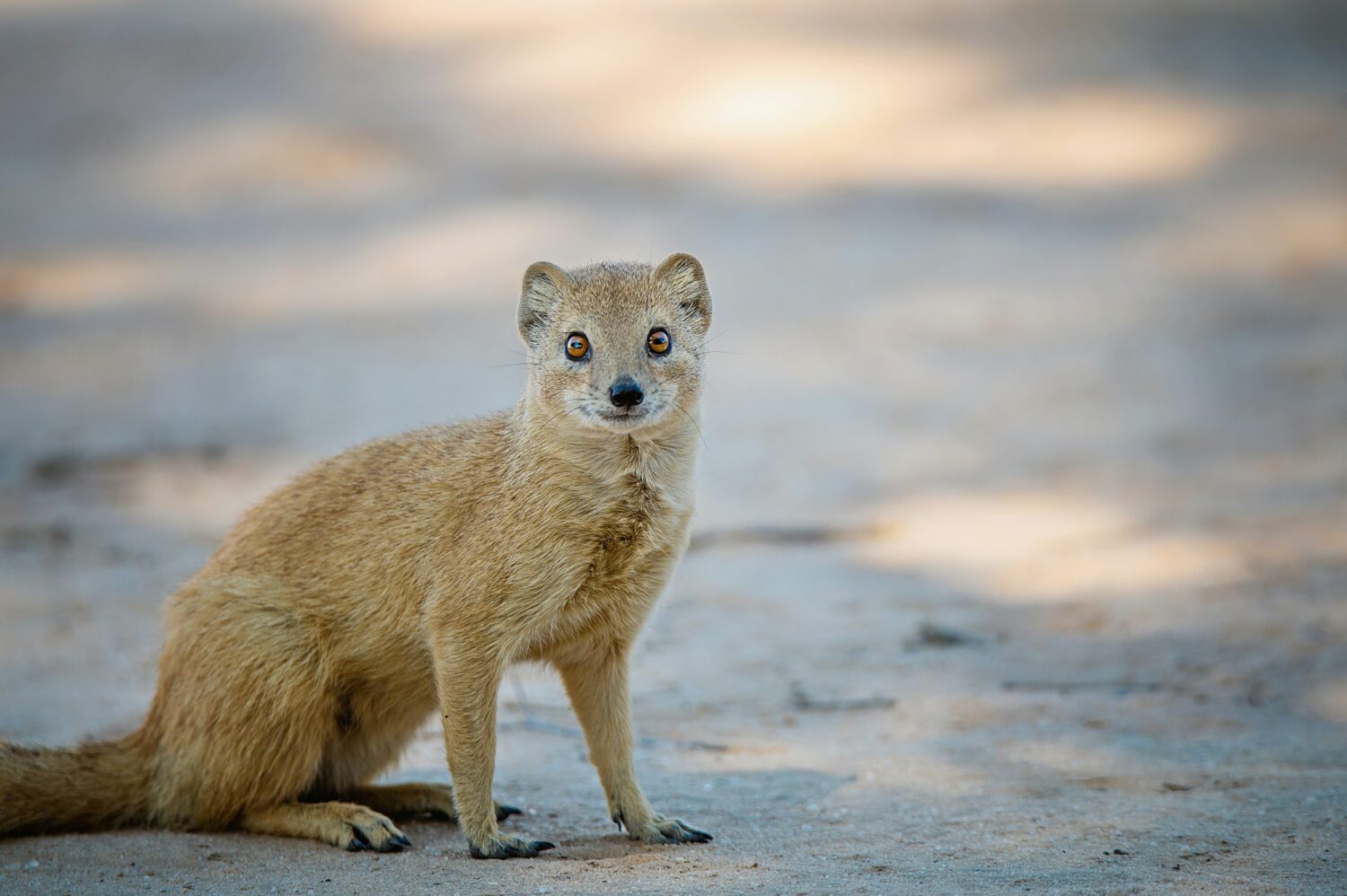
Among the mongoose species recorded in Uganda, the Egyptian mongoose ranks as one of the largest, with adults capable of reaching around sixty centimeters in length, not including the tail. Widespread across much of Africa and parts of the Middle East and southern Europe, this species tends to favor a broad range of habitats, from open grassland to areas closer to water, and its larger size combined with a uniformly grizzled coat helps distinguish it from smaller relatives sharing the same landscape.
Egyptian mongoose sightings in Uganda tend to be less predictable than banded mongoose encounters, since the species is generally more solitary and less habituated to vehicle traffic than the highly social banded groups found around well-traveled game drive routes. Patient observers scanning open grassland during quieter stretches of a game drive stand the best chance of spotting this striking, substantially built member of the mongoose family.
White-Tailed Mongoose: A Nocturnal Exception
Most mongoose species are creatures of daylight, active and visible during the warmer hours when safari game drives typically operate, but the white-tailed mongoose breaks from this pattern as a largely nocturnal species. Recognizable by its notably bushy, pale tail, this is also one of the larger mongoose species recorded across the African continent, generally solitary outside of the breeding season and far less likely to be encountered during standard daytime activities.
For travelers hoping to spot a white-tailed mongoose, an evening game drive or a night drive where available offers a much better chance than a standard morning or afternoon outing, since this species tends to remain hidden and inactive during the exact hours when most Murchison Falls safari activities take place.
Slender Mongoose and Common Dwarf Mongoose: The Smaller Cousins
Two of Uganda’s smaller mongoose species round out the family in a genuinely different size category. The slender mongoose, sometimes recorded under related regional names depending on the specific taxonomy referenced, is a lean, agile hunter found across a range of habitats and known for its solitary, quick-moving foraging style, often seen darting through grass or along the base of trees in pursuit of insects and small reptiles.
The common dwarf mongoose takes the size distinction even further, standing as Africa’s smallest member of the entire order Carnivora, with adults typically weighing well under half a kilogram and measuring under twenty-five centimeters in body length. Despite its diminutive size, the dwarf mongoose is a highly social species, favoring dry grassland, open woodland, and bushland, and showing a strong preference for termite mounds as sleeping sites, much like its larger banded relative. Travelers who enjoy spotting the smaller, easily overlooked members of the animal kingdom will find dwarf mongoose sightings a genuinely satisfying addition to a broader wildlife checklist, provided they keep an eye on the base of termite mounds and low vegetation during quieter moments of a game drive.
Jackson’s Mongoose and Alexander’s Kusimanse: The Forest Specialists
Uganda’s mongoose diversity extends beyond the open savannah species most visible on classic game drives into a handful of species tied more closely to forest habitat. Jackson’s mongoose, a member of the genus Bdeogale alongside the bushy-tailed and black-footed mongoose found elsewhere on the continent, favors denser forest environments and is considerably less commonly encountered than its savannah relatives, making any sighting a genuine highlight for wildlife enthusiasts exploring Uganda’s forested parks.
Alexander’s kusimanse, sometimes referred to as Alexander’s cusimanse, represents another of the more specialized mongoose relatives recorded in Uganda, part of a small genus of highly social, forest-associated mongooses found across Central Africa. While these forest specialists are less likely to appear on a typical Murchison Falls game drive, travelers extending their Uganda itinerary into forested destinations such as Kibale National Park or the Budongo Forest section of Murchison Falls stand a somewhat better chance of encountering these less commonly sighted members of the mongoose family.
Where to Look for Mongoose Species Around Murchison Falls
Understanding a mongoose’s preferred habitat is the single most useful tool for actually spotting one, since the family’s diversity across Uganda largely tracks the diversity of habitat found within and around Murchison Falls National Park itself. Open savannah and woodland areas across the park’s northern game-viewing circuit offer the best odds for banded mongoose, common dwarf mongoose, and Egyptian mongoose, particularly around termite mounds and areas of shorter grass where foraging is easier to observe. The riverine and delta habitat along the Nile, best explored during a Murchison Falls boat cruise, shifts the odds toward marsh mongoose sightings along muddy banks and papyrus-lined shoreline. Forest-edge habitat, including areas bordering Budongo Forest, offers the best, if still limited, chance of encountering the more elusive Jackson’s mongoose or other forest-associated species.
Timing matters as well. Early morning and late afternoon game drives, when temperatures are cooler and most mongoose species are actively foraging, consistently outperform the heat of midday for sightings of the daylight-active species that make up the majority of Uganda’s mongoose diversity. For the nocturnal white-tailed mongoose specifically, an evening or night drive remains the only realistic path to a sighting.
Bringing Mongoose Watching Into a Broader Safari
None of this is meant to suggest mongooses should headline a Uganda itinerary over lions, elephants, or the park’s celebrated bird population, but they add genuine texture to a safari for travelers willing to look a little closer at what is moving through the grass and along the riverbanks. A guide who knows exactly where a resident banded mongoose troop tends to den, or which stretch of the delta most reliably produces a marsh mongoose sighting, can turn what might otherwise be a passing glimpse into a genuinely memorable wildlife encounter.
Travelers building out a broader wildlife-focused itinerary around Murchison Falls may also want to look into related content covering the park’s bird population, since many of the same wetland and delta habitats favored by marsh mongoose also support some of the park’s most celebrated birding, including sightings of the shoebill stork. Pairing mongoose spotting with a properly planned Murchison Falls game drive and boat cruise itinerary, along with sensible preparation covering what to pack and malaria prevention for the trip, rounds out a well-informed visit focused on getting the most out of the park’s full range of wildlife, both large and small.
Planning a Wildlife-Focused Trip to Murchison Falls
For travelers whose interest in African wildlife extends well beyond the standard Big Five checklist, Murchison Falls National Park offers a genuinely rewarding range of smaller, less-discussed species, with its mongoose diversity standing as one of the more overlooked highlights available to a patient, well-informed visitor. Building game drives and boat cruises around the right timing and habitat knowledge makes a meaningful difference in actually encountering these species rather than simply hoping for a lucky sighting.
Interested in a Murchison Falls safari built around a deeper, more detailed wildlife experience, mongooses included? Reach out and a local safari specialist can help design an itinerary and guide pairing suited to exactly the kind of wildlife encounters you’re hoping for.