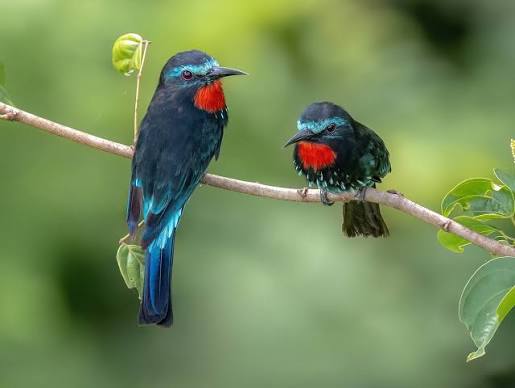
Black Bee-Eater: Uganda’s Rare Riverine Jewel
Most of Africa’s bee-eaters favor open country, savanna, riverbanks, and scrubland where their acrobatic mid-air hunting has room to work. The Black Bee-eater breaks that pattern entirely. It’s a genuine forest specialist, tucked into the dense lowland rainforest of western Uganda’s Albertine Rift, and its scarcity, striking coloring, and restricted range have made it one of the most sought-after ticks on any serious Uganda birding itinerary.
A Bird of the Albertine Rift’s Riverine Forest
The Black Bee-eater, scientifically classified as Merops gularis, occurs across a genuinely limited range spanning Nigeria, northern Angola, and, distinctively, western Uganda, making Uganda’s population one of the more geographically isolated outposts of this species anywhere on the continent. Its Ugandan stronghold centers on Semuliki National Park, a park whose very name reflects its defining feature: it sits along the Semliki River, in a lowland tropical forest ecosystem that extends westward into the Democratic Republic of Congo’s Ituri forest. This riverine forest setting, dense canopy pressed close against the water, is exactly the kind of habitat the Black Bee-eater favors, distinguishing it from the more open-country bee-eater species found elsewhere in Uganda.
What the Black Bee-Eater Looks Like
True to its name, the Black Bee-eater carries deep black plumage across much of its body, offset by a vivid crimson throat patch and touches of blue that catch the light as the bird moves through dappled forest canopy. This combination of dark, almost velvety black against the bright red throat gives the species a genuinely striking appearance, one that stands out sharply against Semuliki’s green forest backdrop and makes even a brief sighting memorable for photographers and casual birders alike.
Hunting Behavior and Diet
Like all bee-eaters, the Black Bee-eater feeds primarily on bees and other flying insects, captured with remarkable mid-air agility as the bird sallies out from a perch to snatch prey before returning to the same or a nearby branch. This hunting style, watch, dart, catch, return, makes for genuinely rewarding birding once a bird has been located, since a patient observer can often watch repeated hunting sorties from a single vantage point rather than needing to track a constantly moving target. The abundance of flying insects in Semuliki’s lush lowland forest and surrounding open patches provides exactly the kind of prey base this species depends on.
Breeding Behavior
The species’ breeding season brings some of its most interesting behavior into view. Male Black Bee-eaters perform elaborate courtship displays, aerial acrobatics paired with deliberate showing off of their striking plumage, aimed at attracting a mate, and this display period is widely considered one of the best windows for observing the species at its most active and visible. Once paired, the female excavates a nesting tunnel into sandy or loamy soil, where she lays and incubates her clutch while the male takes on the role of providing food throughout the incubation period, a division of labor common among bee-eater species generally but worth knowing if you’re hoping to time a visit around active nesting behavior.
Where to Find the Black Bee-Eater in Uganda
Semuliki National Park: The Primary Stronghold
Semuliki National Park, in the Albertine Rift Valley of western Uganda right on the border with the Democratic Republic of Congo, is consistently identified as the top destination for this species in the country. The park’s tropical lowland forest habitat, extending west into the Ituri forest, supports more than forty bird species found nowhere else in Uganda, and the Black Bee-eater sits alongside other genuinely special sightings here, including the black-headed waxbill, blue-headed and regal sunbirds, the black-billed turaco, and Shelley’s crimsonwing. With over 440 recorded species overall and roughly two-thirds of the country’s forest bird species represented, Semuliki rewards travelers willing to make the journey to Uganda’s western edge specifically for its birding value.
Bwindi Impenetrable Forest
The Black Bee-eater also turns up in Bwindi Impenetrable Forest, appearing on several birding checklists alongside other forest specialists like the African green pigeon and African harrier hawk. For travelers already planning gorilla trekking in Bwindi, this gives a realistic secondary opportunity to spot the species without a dedicated trip to Semuliki, though sighting probability here is generally considered lower than at Semuliki’s more specialized habitat.
Best Time to Visit for Birding
Semuliki National Park experiences its highest breeding activity in March, generally considered one of the strongest windows for observing the Black Bee-eater’s courtship and nesting behavior specifically. More broadly, the park sees dry spells from December through February and heavier rainfall from March through mid-May and again from August through October, though birding here is genuinely possible year-round given the forest’s consistent habitat conditions regardless of season. Travelers specifically targeting the Black Bee-eater’s breeding display should prioritize the March window, while those simply hoping for a solid overall birding day can plan around Semuliki’s broader dry-season access advantages instead.
Planning a Trip to Semuliki
Semuliki’s location on Uganda’s western border, near the base of the Rwenzori Mountains, places it somewhat off the standard safari circuit most travelers follow, and it’s worth planning for the additional travel time this requires. For serious birders, though, the detour is consistently described as worthwhile precisely because of the sheer concentration of species found nowhere else in the country, and pairing a Semuliki visit with Kibale National Park, itself a strong birding destination with over 375 recorded species and six Albertine Rift endemics, creates a genuinely efficient western Uganda birding circuit within a single extended itinerary.
The Black Bee-Eater Among Uganda’s Other Bee-Eater Species
Uganda hosts a genuinely impressive range of bee-eater species beyond the Black Bee-eater, each favoring different habitat. The red-throated bee-eater nests in colonies along the Nile’s banks at Murchison Falls National Park, making it the country’s true riverbank specialist among the family. The blue-breasted bee-eater turns up around wetland habitat like Mabamba Swamp near Entebbe, while the white-throated bee-eater favors forest edges around Queen Elizabeth National Park, and the cinnamon-chested bee-eater appears across several of Uganda’s forest parks including Bwindi. For birders working through Uganda’s bee-eater diversity as a specific goal, the Black Bee-eater’s forest specialization makes it one of the more distinctive entries on that list, requiring a genuinely different kind of habitat visit than the country’s more open-country and wetland species.
Why This Sighting Matters to Serious Birders
Given its restricted range, limited to pockets of western and central Africa, and its specific dependence on lowland forest habitat, the Black Bee-eater carries a certain prestige among birders working through an Africa-wide checklist, a species that can’t simply be picked up incidentally on a standard savanna game drive the way many of Uganda’s other bee-eaters can. This scarcity is precisely what makes Semuliki National Park worth the extra travel time for birders with a genuine interest in checking this species off their list, and it’s a strong example of how Uganda’s birding value extends well beyond its more heavily marketed parks.
If you’re planning a dedicated birding trip to Uganda and want to build in a visit to Semuliki National Park for the Black Bee-eater and its other Albertine Rift specialties, our team at Murchison Falls Park Safari can design an itinerary that combines Semuliki with Kibale, Bwindi, or your broader wildlife circuit. Contact us to start planning a Uganda birding safari built around Uganda’s rarest and most rewarding species.
For more on Uganda’s exceptional birdlife, our guides on the Great Blue Turaco, pangolin sightings and conservation, and Kibale National Park’s chimpanzee tracking are all available, here and pair well with this guide.