
Olive Baboon Behavior: What to Know Before Your Uganda Safari
Almost every traveler on a Uganda safari sees olive baboons within the first hour, and almost every traveler underestimates them within that same hour. They are common enough to become background scenery quickly, lounging along roadsides, grooming in loose clusters near lodge grounds, or trotting across a track in front of a safari vehicle without much apparent concern. That familiarity is exactly why they deserve more attention than they usually get. Olive baboon behavior is genuinely sophisticated, built around a complex social structure that rewards a closer look, and understanding it also matters for a very practical reason: baboons are intelligent, food-motivated, and occasionally bold enough around camps and lodges to cause real problems for travelers who do not know how to behave around them.
Uganda’s Only Baboon Species
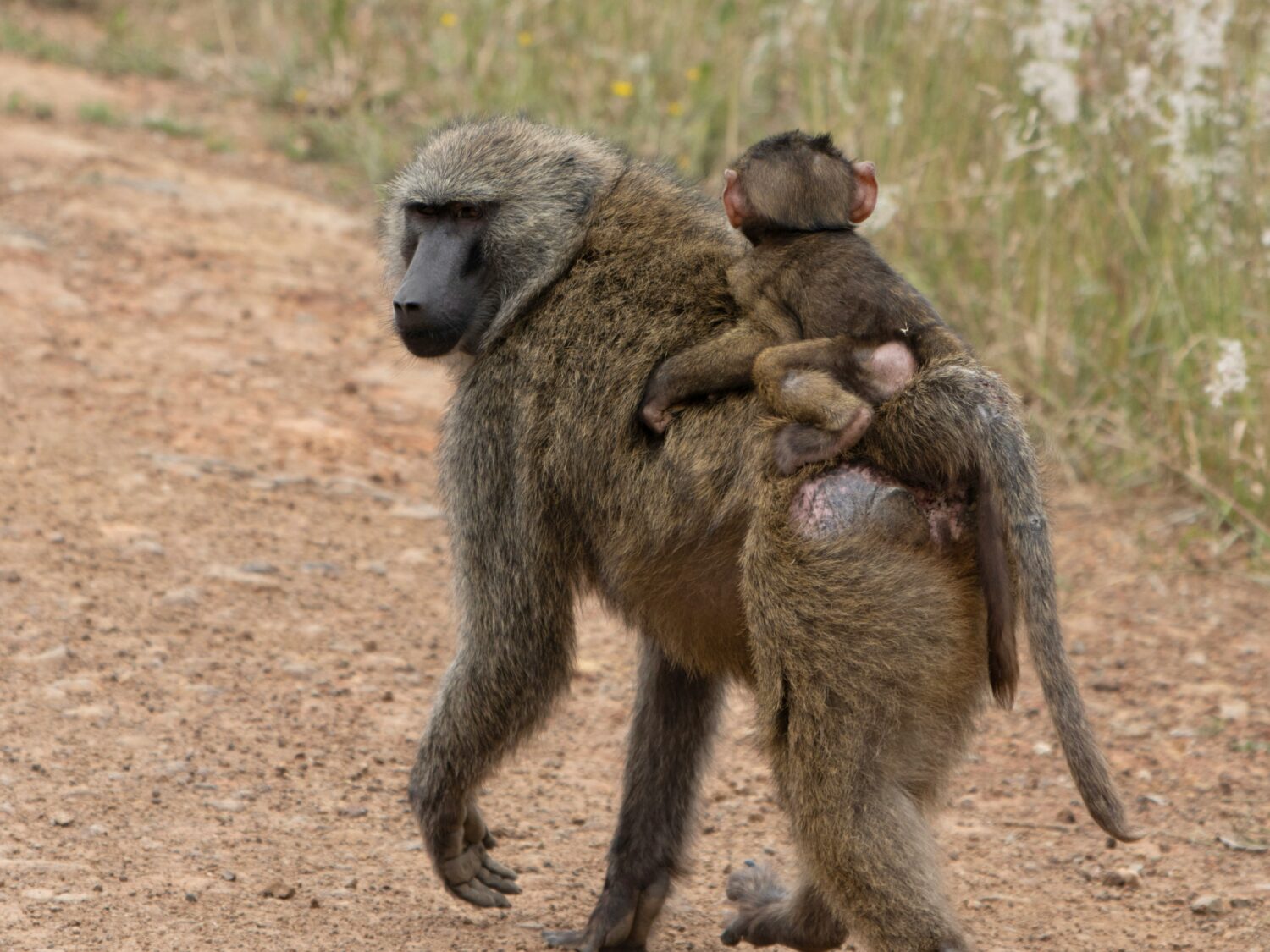
The olive baboon, scientifically named Papio anubis, is the only baboon species found in Uganda, and it is also one of the most widely distributed primates in the country, present in Murchison Falls National Park, Queen Elizabeth National Park, Kibale Forest, Semuliki National Park, and Lake Mburo National Park, among others. Unlike Uganda’s more famously sought-after primates, the mountain gorilla and the chimpanzee, both of which require a dedicated trekking permit and a specific park visit to encounter, olive baboons need no special arrangement at all. They are simply part of the everyday landscape across nearly every park in the country, making them, by a wide margin, the primate travelers are guaranteed to see the most often during a Uganda trip, whether they specifically sought out a primate encounter or not.
Physically, olive baboons carry a coarse, olive-gray to brown coat, a distinctly dog-like muzzle, and a notably robust, muscular build, with males considerably larger than females, often close to double the female’s body weight, a difference that plays directly into the social dynamics described below. Their habitat range is broad, spanning open savanna, woodland, and even dense tropical forest edges, which explains why they turn up reliably across such a wide variety of Uganda’s parks regardless of habitat type.
Life Inside a Troop
Olive baboons live in large, tightly organized social groups called troops, typically ranging from fifteen to over one hundred fifty individuals depending on habitat and food availability, with a fairly typical troop composed of roughly seven or eight adult males alongside close to twice that number of adult females and their offspring. This is a genuinely large, complex society to manage, and baboons handle it through a surprisingly structured social system built on hierarchy, kinship, and near-constant social maintenance.
A troop’s daily rhythm follows a consistent pattern worth knowing, since it helps explain when and where travelers are most likely to encounter one. Baboons typically descend from their overnight sleeping sites, often cliffs, rock outcrops, or tall trees chosen specifically for safety from nighttime predators, around seven or eight in the morning, spending the next few hours foraging as they move, often covering a distance of several miles over the course of a day. The middle of the day, particularly during the hottest hours, is generally spent resting and grooming in the shade, before a second active foraging period in the afternoon as temperatures cool, with the troop returning to a safe sleeping site by early evening. This pattern closely mirrors the daily rhythm of many other Uganda wildlife species, and travelers who understand it can time their own game drives to align with periods of higher baboon activity, much as the early morning and late afternoon windows favor most other wildlife across the country.
The Hierarchy That Holds It All Together
Beneath the surface of a foraging troop sits a genuinely intricate social hierarchy, and understanding it adds real depth to what might otherwise look like simple, chaotic group movement. Male status within a troop is earned rather than inherited, established through direct competition and shifting alliances between males, sometimes involving temporary coalitions where two or more males cooperate to challenge a higher-ranking rival, a dynamic that means the top position within a troop can change hands relatively often as younger, stronger males rise and older ones are displaced. Young males typically leave their birth troop entirely upon reaching maturity, joining a different troop instead, a pattern that helps maintain genetic diversity across the wider population by preventing close relatives from breeding within the same group.
Female status works on an entirely different principle. Rather than competing directly for rank, females inherit their social position from their mothers, remaining within their birth troop for life and forming stable, long-term alliances with related females, known as a matriline. A female born into a high-ranking matriline holds a correspondingly high rank throughout her life, largely independent of her own individual size, strength, or assertiveness, and this matrilineal structure is, in many respects, the true backbone of troop stability, since it is female kinship networks, rather than the more visibly dramatic male status competition, that hold a troop together across generations and through the periodic turnover of dominant males.
Communication, Grooming, and Social Bonding
Olive baboons maintain this complex society through a rich array of communication tools, including a wide vocabulary of vocalizations ranging from deep alarm barks that alert the troop to a nearby predator, to softer grunts used to signal friendliness or ease tension between individuals, alongside an equally expressive set of facial expressions and postures that convey everything from submission to aggression to simple reassurance. Grooming sits at the center of this social world, functioning simultaneously as basic hygiene, removing parasites and debris from fur, and as the primary currency of social bonding within the troop, with individuals grooming allies, relatives, and higher-ranking troop members as a way of reinforcing relationships and easing social tension. A traveler watching a resting troop during the heat of the day is very likely watching this grooming behavior in action, an unassuming but genuinely important piece of the troop’s daily social maintenance.
Baboons also display real intelligence beyond social sophistication, including documented tool use in some populations, using stones to crack open hard foods or occasionally as a means of threat display against rivals or predators, and a notably flexible, opportunistic diet that includes grasses, fruit, roots, insects, small mammals, and, given the chance, human food left unguarded, a trait directly relevant to the safety guidance below.
Predators and Defense
Despite their size, confidence, and numbers, olive baboons remain genuine prey for several of Uganda’s larger predators, including leopards, lions, and large birds of prey such as the crowned eagle, which is capable of taking young or smaller baboons. Troops manage this risk collectively, typically posting sentries who remain alert for danger while the rest of the group forages, and responding to a spotted threat with a coordinated alarm system of vocalizations that alerts the entire troop simultaneously. This collective vigilance is part of why baboon troops appear so calm and unbothered around safari vehicles specifically, since a vehicle poses no genuine predatory threat and the troop’s sentries clearly recognize the difference, a distinction worth remembering, since it also explains why baboons can seem remarkably unafraid of humans in a way that occasionally leads to problems around lodges and camps.
Why Baboon Confidence Around Camps Requires Real Caution
This is the most practically important part of understanding olive baboon behavior for any traveler on safari. Because baboons are intelligent, highly food-motivated, and have learned through repeated exposure that humans and lodge grounds often mean easy access to food, troops living near frequently visited camps and picnic sites can become notably bold, sometimes approaching outdoor dining areas, entering unattended tents or rooms through open doors or windows, or snatching food directly from a table or a traveler’s hands if given the opportunity. This is not aggression in any predatory sense but rather simple opportunistic behavior from an intelligent animal that has learned where food is available, and it is a pattern seen at lodges and picnic areas across many of Uganda’s parks, not a defect specific to any one property.
The practical guidance here is straightforward and worth taking seriously rather than treating as an overcautious formality. Food, including anything in a bag, a backpack pocket, or left visibly on a table or windowsill, should always be kept out of sight and, wherever possible, behind closed doors or zipped away entirely, since a baboon that spots food will not hesitate to approach and attempt to take it. Direct feeding of baboons, even a seemingly harmless small snack offered by hand, should never happen under any circumstances, since it actively reinforces the exact behavior that causes problems for future travelers and for the baboons themselves, sometimes leading parks and lodges to euthanize repeat offenders that become too aggressive or dependent on human food. If a baboon does display genuine aggressive signals, including bared teeth, loud barking vocalizations, or a direct charge, the correct response is a slow, calm retreat to a safer distance rather than running, which can trigger a chase instinct, or direct confrontation, which can escalate a situation that would otherwise resolve on its own once the animal loses interest.
Following the guidance of park rangers and experienced local guides, who understand the specific behavioral patterns of the baboon troops resident to their particular lodge or camp, is consistently the best practical safeguard, and most reputable Uganda properties brief guests on baboon safety specifically upon arrival for exactly this reason.
Where and When to See Them at Their Best
For travelers specifically interested in observing baboon behavior rather than simply passing a troop on the roadside, the early morning hours, shortly after a troop descends from its overnight sleeping site, and the late afternoon, as the troop resumes activity after the midday rest period, offer the richest windows for watching grooming, social interaction, and juvenile play, the latter a particularly entertaining sight given how much mock fighting, chasing, and general roughhousing young baboons engage in as part of developing both physical coordination and social bonds within the troop. This timing lines up closely with the broader wisdom that governs most Uganda wildlife viewing, and travelers structuring their days around Murchison Falls’ strongest game-viewing windows will likely find baboon activity peaking at roughly the same hours as the park’s larger, more headline wildlife. Our detailed guide on the best time of day for game drives in Murchison Falls covers exactly this daily rhythm in depth, and the same early morning and late afternoon emphasis applies just as usefully to baboon watching as it does to lion and elephant sightings.
A Primate Worth a Second Look
Olive baboons rarely feature on a traveler’s must-see list before arriving in Uganda, and that is understandable given the country’s genuinely spectacular headline primates, the mountain gorilla and the chimpanzee, both requiring dedicated trekking activities that naturally draw more anticipation and planning. But precisely because baboons require no special arrangement at all, appearing constantly and reliably throughout nearly every park visited, they offer a rare opportunity: a genuinely sophisticated primate society, fully on display, requiring nothing more than a bit of patience and a closer look than most travelers think to give it. Understanding the hierarchy, the grooming rituals, and the matrilineal bonds holding a troop together turns what could be background scenery into one of the more quietly rewarding wildlife observations available on a Uganda safari.
If you are planning a Murchison Falls itinerary and want to make sure your schedule accounts for the park’s strongest wildlife-viewing windows, including baboon activity alongside the bigger headline species, our team is glad to help build a day-by-day plan around it.
Ready to plan a Uganda safari that pays attention to every layer of the country’s wildlife, from lions and elephants down to the fascinating social world of its baboon troops? Reach out and let us help you build an itinerary that makes the most of every sighting.