Lake Kyoga: Uganda’s Overlooked Central Lake
Ask most travelers to name Uganda’s great lakes, and you will hear Lake Victoria first, quite reasonably, followed perhaps by Lake Albert or Lake Edward further west. Almost nobody mentions Lake Kyoga, the vast, shallow, papyrus-fringed body of water sitting squarely in the middle of the country, and that is a genuine oversight, because Kyoga plays a quietly essential role in Uganda’s geography, its fishing economy, and, most relevantly for safari travelers, in the very journey the Nile takes on its way toward Murchison Falls National Park.
Where Lake Kyoga Sits and Why It Looks the Way It Does
Lake Kyoga occupies the heart of central Uganda, spreading across roughly 1,720 square kilometers and touching several districts, including Lira, Soroti, Nakasongola, Kayunga, and Apac, at an elevation of just over a thousand meters above sea level. Unlike Lake Victoria, which feels like a genuine inland sea with clear, deep water stretching to the horizon, Kyoga is something altogether different, a many-armed, labyrinthine lake formed directly by the Victoria Nile during its middle course as it winds northward from Lake Victoria toward Lake Albert. That formation story explains almost everything distinctive about Kyoga’s character, since rather than occupying a single deep basin, the lake sprawls outward into a network of swampy channels, papyrus-choked inlets, and satellite lakes, including Lake Kwania, Lake Bisina, Lake Opeta, and Lake Bugondo, all loosely connected to the main body of water.
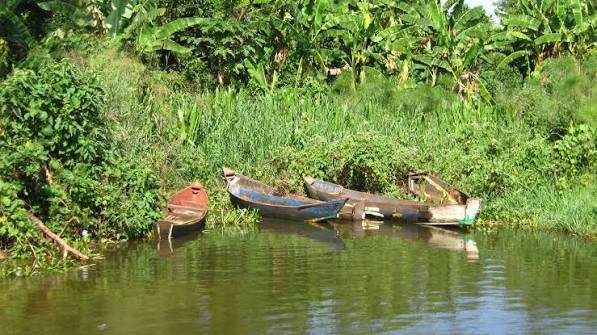
Kyoga is remarkably shallow for its size, averaging around three meters in depth and rarely exceeding five to six meters even at its deepest points, and this shallowness has shaped the lake into three distinct environments existing side by side. Open water deeper than three meters occupies the central channels, shallower stretches are blanketed almost completely in water lilies, and the extensive shoreline disappears into dense papyrus swamp, occasionally interrupted by floating papyrus islands substantial enough to break loose entirely and drift across the lake, sometimes clogging navigation channels so thoroughly that boat traffic grinds to a halt until the mats clear. This same swampy, ever-shifting shoreline has occasionally caused serious flooding in the surrounding region, particularly during periods when heavy rains combine with blockages from papyrus and invasive water hyacinth, a recurring challenge for communities living around the lake’s edges.
A Quiet but Vital Fishery
Despite its unassuming reputation among international travelers, Lake Kyoga has long been one of Uganda’s most economically significant fisheries. The lake is home to around forty-six recorded fish species, the majority closely related to fauna found in neighboring Lake Victoria, alongside a scattering of species found nowhere else. Nile perch, now one of the lake’s most commercially important catches, was deliberately introduced into Kyoga in the late 1950s as part of a broader effort to boost regional fish production, and the species has since become a dominant presence in the lake’s ecosystem, reshaping the balance of native fish populations in the decades since its introduction. Alongside Nile perch, tilapia and catfish remain popular targets for both commercial fishing communities and visiting anglers, and Kyoga’s fishery has at times accounted for a substantial share of Uganda’s total national fish production, underscoring just how much the surrounding communities depend on these waters for their livelihoods.
For visiting anglers, Kyoga offers a genuinely different fishing experience compared to the country’s more famous fishing destinations, with a quieter, less crowded atmosphere and a landscape of narrow channels and swamp edges that feels more intimate than open-water fishing on Lake Victoria or the Nile itself. Fishing here requires a proper permit and your own gear, arranged in advance through a licensed operator, and several chartering services operate in the lake’s vicinity for travelers keen to spend a morning or afternoon on the water targeting Nile perch or tilapia among Kyoga’s maze of channels and floating vegetation.
Wildlife and Birding Along the Papyrus Shoreline
Lake Kyoga’s extensive wetlands, papyrus swamps, and marshy shoreline do far more than shape the lake’s physical character, they also create an extraordinary mosaic of habitats that supports a genuinely diverse range of wildlife. Hippos move through the lake’s channels and shallows in meaningful numbers, and Nile crocodiles, notoriously aggressive apex predators, patrol the same waters, making guided boat excursions a far safer and more rewarding way to experience the lake than any independent exploration along its edges. River otters round out the lake’s more visible mammal life, adding another layer of interest for wildlife-focused visitors willing to spend time quietly observing the water’s edge.
Birders, in particular, have good reason to take Kyoga seriously as a genuine, if underrated, destination in its own right. The lake’s wetlands and papyrus swamps serve as critical breeding grounds for waterfowl and a wide range of avian species, and the surrounding region is recognized as home to the rare Fox’s weaver, a genuinely localized species that draws dedicated attention from serious birders working through Uganda’s full checklist of specialties. Beyond this headline species, Kyoga’s marshes support large numbers of migratory birds during the appropriate season, and guided birdwatching tours through the swamp vegetation and open channels regularly turn up a rewarding variety of waterbirds that many visitors would otherwise never encounter on a standard Uganda itinerary focused purely on the major national parks.
The Lake’s Quiet but Crucial Role in the Nile’s Journey to Murchison Falls
For safari travelers specifically, Kyoga’s most compelling feature may be its position directly along the Nile’s route toward Murchison Falls National Park. Water entering Kyoga via the Victoria Nile from Lake Victoria continues onward after passing through the lake’s maze of channels, flowing north and eventually reaching the dramatic narrow gorge that gives Murchison Falls its name, where the entire river is forced through a gap barely seven meters wide before crashing down into the basin below. Kyoga effectively functions as a vast natural buffer and regulator along this journey, its extensive wetlands slowing and dispersing the river’s flow across a wide swampy basin before the Nile reconstitutes itself and continues its more famous, more dramatic descent through Murchison Falls further downstream. Understanding this connection gives travelers a genuinely different appreciation for the falls themselves, recognizing that the thunderous spectacle awaiting them at Murchison is only the most visually dramatic chapter in a much longer, quieter story that begins at Lake Victoria and passes directly through this overlooked central lake along the way.
This same hydrological role also makes Kyoga genuinely important to Uganda’s broader infrastructure, feeding into hydroelectric power generation and irrigation systems that depend on a steady, well-regulated flow of Nile water continuing north, giving the lake a practical significance that extends well beyond tourism or fishing alone.
Nyero Rock Paintings and Cultural Life Around the Lake
Travelers who make the effort to visit Lake Kyoga often find that the surrounding region offers worthwhile cultural stops as well, most notably the Nyero rock paintings, an important rock art site located just a short distance from the lake’s shores. These ancient geometric paintings, added to Uganda’s UNESCO World Heritage Tentative List in 1997, represent one of the country’s most significant examples of prehistoric artistic expression, and guided tours are available directly at the site’s entry gate for visitors interested in learning more about their history and significance. Beyond the rock art, exploring the fishing villages scattered along Kyoga’s shoreline offers genuine insight into traditional fishing practices, subsistence farming, and the broader rhythms of daily life for the communities who have depended on this lake for generations, giving cultural travelers a rewarding complement to the area’s natural attractions.
Getting to Lake Kyoga and Making the Most of a Visit
Reaching Lake Kyoga from Kampala typically involves either a drive to Zengebe followed by a car ferry crossing to Namasale on the lake’s far shore, or an alternative route via Soroti and the Lale road for travelers approaching from Uganda’s eastern side. Once at the lake, boat and canoe excursions represent the best way to actually experience Kyoga’s character, giving visitors access to its floating islands, swampy channels, and fishing villages while offering genuine opportunities to spot birdlife and aquatic wildlife along the way. The lake remains accessible year-round, though as with most of Uganda’s water bodies, conditions and water levels shift somewhat with the seasons, and travelers planning a dedicated fishing or birding excursion should check current conditions with a local operator before finalizing specific dates.
Because Kyoga sits along a natural route between central Uganda and the northern safari circuit, it makes genuine sense as a stop for travelers with a bit of extra time built into their itinerary, rather than a destination requiring an entirely separate trip. A morning or afternoon spent on the lake, whether fishing, birding, or simply cruising quietly through its papyrus channels, offers a distinctly different rhythm from the game drives and boat cruises that define a typical Murchison Falls safari, and that contrast is precisely what makes Kyoga worth the detour for travelers who want to see a side of Uganda that most visitors never encounter.
Adding Lake Kyoga to Your Uganda Safari Itinerary
At Murchison Falls Park Safari, we occasionally build a Lake Kyoga stop into longer itineraries for travelers heading north toward Murchison Falls National Park, particularly those with a strong interest in birding, fishing, or simply seeing a quieter, less-visited corner of Uganda’s remarkable water systems. Since Kyoga sits directly along the same river system that eventually powers through the gorge at Murchison Falls itself, a stop here adds genuine context and depth to the rest of your Nile-focused safari experience, connecting the dots between Uganda’s largest lake and its most dramatic waterfall in a way that few standard itineraries take the time to explore. Reach out to our team today to find out whether a Lake Kyoga stop makes sense for your specific route and interests, and let us help you build a Uganda itinerary that goes well beyond the country’s most obvious highlights.