

Sempaya Hot Springs: Semuliki’s Boiling Natural Wonder
Deep within the forest interior of Semuliki National Park, in Uganda’s remote far-western Bundibugyo District, a genuinely startling natural phenomenon bubbles and steams from the earth. Sempaya Hot Springs ranks among Uganda’s most unusual geological attractions, a pair of scalding geothermal features capable of boiling an egg within minutes, wrapped in local legend that adds a rich cultural dimension to what is already a fascinating scientific spectacle. For travelers exploring the Rwenzori region or venturing into one of Uganda’s lesser-visited national parks, Sempaya offers a genuinely different kind of safari experience, one built around geology and folklore rather than the classic wildlife encounter most visitors associate with a Uganda trip.
This guide takes a detailed look at what makes Sempaya Hot Springs such a compelling destination, covering the geological forces behind this natural phenomenon, the distinct male and female springs and the folklore surrounding them, practical guidance for visiting, and how this attraction fits into a broader western Uganda itinerary. Our team has guided travelers through this remote corner of the country, and we understand precisely how Sempaya complements a wider Uganda safari built around the Rwenzori region and Semuliki National Park.
Understanding the Science Behind Sempaya’s Boiling Waters
Sempaya Hot Springs sits within the Albertine Rift Valley, part of the broader western arm of Africa’s Great Rift Valley system, an area defined by ongoing seismic and geothermal activity shared with the neighboring eastern Democratic Republic of Congo. This tectonic setting is precisely what makes Sempaya’s dramatic boiling water possible. As groundwater seeps deep into fractures within the Earth’s crust, it encounters intense heat generated by magma and superheated rock far below the surface. Under enormous pressure, this superheated water is forced back upward through the ground, emerging at the surface as the bubbling, steaming spring visitors encounter today.
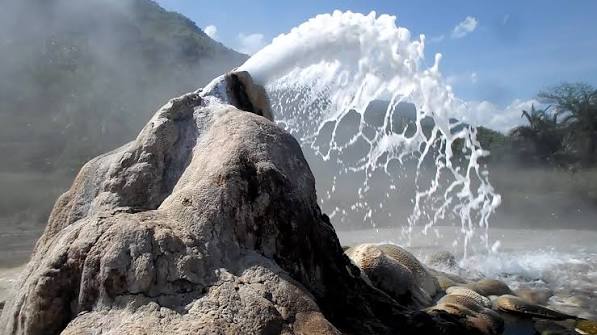
The resulting water temperatures are genuinely extraordinary, with the springs’ main features reaching surface temperatures that consistently measure above the standard boiling point of water, with some sources recording temperatures as high as 103 degrees Celsius, or roughly 217 degrees Fahrenheit. This intense heat leaves visible evidence throughout the surrounding landscape, including white sulphur mineral deposits crusted around the springs themselves and visibly scorched vegetation within the immediate vicinity of the hottest vents, a striking visual reminder of just how much thermal energy is escaping from beneath the forest floor at this single, geologically remarkable location.
The Male and Female Springs
Sempaya’s defining feature is the presence of two distinct hot springs, each carrying its own local name, physical character, and cultural significance among the communities living near Semuliki National Park. The female spring, known locally as Nyasimbi, stands as the more dramatic and frequently visited of the two, taking the form of a genuinely spectacular gushing fountain that ejects boiling water and steam up to two meters into the air from a broad vent roughly eight meters across. The surrounding area takes on an almost otherworldly, steam-filled atmosphere, with visitors frequently describing a low, steady hissing sound accompanying the rising jets of vapor.
A short walk away through the surrounding forest brings visitors to the male spring, locally known as Bitente or sometimes Mumbuga depending on the specific local source consulted. Rather than the dramatic gushing fountain characteristic of Nyasimbi, the male spring takes the form of a wide, steadily boiling pool roughly twelve meters in diameter. While somewhat less visually dramatic than its female counterpart, local tradition holds that Bitente was the first of the two springs to form, predating Nyasimbi and, according to local folklore, standing as her husband within the broader cultural narrative surrounding the springs.
The Legend Behind the Springs
Beyond their scientific origin, Sempaya Hot Springs carry deep cultural and spiritual significance for the Bamaga clan, the indigenous community residing near this remarkable natural feature. According to oral tradition passed down through clan leadership, the springs trace their origin to a story involving Bamaga women who encountered something extraordinary while gathering firewood deep in the surrounding forest, an event that local elders connect directly to the eventual emergence of the steaming male spring at this specific location. This origin story has been preserved and retold across generations, with community elders continuing to serve as custodians of the specific details and deeper meaning behind the tale for visitors interested in the cultural dimension of a Sempaya visit.
Beyond this origin narrative, both springs continue to hold genuine spiritual significance for local communities today. Many local visitors come to the springs seeking healing, carrying a belief that ancestral spirits associated with the site hold the power to address physical ailments, while pregnant women in particular have traditionally visited the springs in the hope that the site’s spiritual significance might ease their upcoming delivery. This living cultural practice, continuing alongside the springs’ modern role as a tourist attraction, adds a genuinely meaningful layer of depth to a Sempaya visit that goes well beyond the purely geological spectacle.
Cooking With Nature’s Own Heat
Perhaps the most memorable and interactive element of a Sempaya visit involves the springs’ capacity to cook food using nothing more than their own natural heat. Local guides regularly demonstrate this phenomenon for visiting travelers, dropping raw eggs, cassava, plantains known locally as matooke, or Irish potatoes directly into the boiling water and retrieving them fully cooked within just five to ten minutes. Travelers are typically invited to bring their own eggs specifically for this purpose, offering a genuinely hands-on way to experience the springs’ remarkable heat firsthand rather than simply observing it from a distance. Guides frequently note, with a touch of local pride, that eggs cooked in Sempaya’s boiling water emerge just as thoroughly cooked as those prepared over a conventional stove or open fire, a small but memorable detail that consistently ranks among visitors’ favorite parts of the overall experience.
Reaching Sempaya Hot Springs
Sempaya Hot Springs sits within Semuliki National Park, located in Bundibugyo District in Uganda’s far west, close to the border with the Democratic Republic of Congo and situated at the edge of the Rwenzori Mountains. The springs lie roughly fifty-two kilometers from Fort Portal town, a journey that typically takes two to three hours along the scenic but occasionally rough Fort Portal-Bundibugyo road, a route that winds through the ridges of the Rwenzori Mountains and offers travelers genuinely striking views over the Semuliki Valley along the way.
From Kampala, travelers typically face a considerably longer overall journey, generally covering somewhere in the range of 370 to 465 kilometers depending on the specific route chosen, with total travel time ranging from roughly five to eight hours by road. Given this distance, most travelers incorporate a Sempaya visit as part of a broader western Uganda circuit that includes Fort Portal, Kibale Forest National Park, and the wider Rwenzori region, rather than treating the springs as an isolated day trip from the capital.
Once within the park, reaching the springs themselves requires a walk of approximately thirty minutes along forest tracks leading off the main road, an easy, well-established trail that gives visitors a taste of Semuliki’s dense tropical forest environment before arriving at the steaming clearing where the springs themselves emerge from the ground.
Beyond the Springs: Semuliki National Park’s Broader Appeal
While Sempaya Hot Springs represents the single most famous attraction within Semuliki National Park, the park itself offers considerably more for travelers with time to explore beyond this single feature. Established as one of Uganda’s newest gazetted national parks in October 1993, Semuliki sits at the edge of the great Ituri Forest extending into the neighboring Democratic Republic of Congo, giving the park a genuinely distinct Central African forest character compared to Uganda’s more classic savannah parks. The Semuliki River winds through the park’s mountainous terrain before eventually draining into Lake Albert, while the surrounding wetlands and woodlands support a rich variety of birdlife and wildlife.
The park offers three main hiking trails beyond the direct route to Sempaya itself. The Kirumia Trail runs through dense forest toward the Semuliki River, offering a longer, more immersive forest experience for travelers with additional time. The Red Monkey Track leads toward the park’s eastern boundary, where visitors have a chance of spotting the rare De Brazza’s monkey, a distinctive primate species found in only a handful of locations within Uganda. For travelers interested in cultural engagement alongside the park’s natural attractions, Semuliki also offers the opportunity to meet the Batwa people, indigenous forest dwellers whose traditional hunter-gatherer lifestyle was closely tied to the Semuliki Forest before conservation-driven relocation, and who now share their traditional knowledge and cultural heritage directly with visiting travelers as an important source of income following that displacement.
Nearby Semuliki Wildlife Reserve, distinct from but often visited alongside Semuliki National Park, adds further wildlife viewing opportunities across its savannah grassland tracks, with game drives regularly turning up sightings of forest elephants, waterbuck, buffalo, warthog, and Uganda kob, along with excellent nocturnal game drives revealing leopard, bush babies, and white-tailed mongoose after dark.
Combining Sempaya With a Wider Uganda Itinerary
Given its remote western location, Sempaya Hot Springs works most naturally as part of a broader circuit through Uganda’s western region rather than as a standalone destination. Travelers already visiting Kibale Forest National Park for chimpanzee tracking, or exploring the Rwenzori Mountains for hiking and birdwatching, can readily extend their itinerary to include a Sempaya visit given the relative proximity of these destinations to one another around Fort Portal. Travelers building a longer Uganda circuit that includes Queen Elizabeth National Park or continuing onward toward Bwindi Impenetrable National Park for gorilla trekking can similarly weave in a Semuliki and Sempaya detour, adding a genuinely distinctive geological and cultural highlight to what might otherwise be an itinerary focused purely on classic wildlife viewing.
Planning Your Visit to Sempaya Hot Springs
Incorporating Sempaya Hot Springs and the wider Semuliki National Park into a Uganda itinerary requires thoughtful route planning given the park’s relatively remote western location and the somewhat rough road conditions along parts of the journey. Our team has extensive experience arranging exactly this kind of itinerary, ensuring your route through western Uganda makes the most of Sempaya’s geological drama and cultural richness alongside the region’s broader wildlife and hiking opportunities. Contact us today to start planning a Uganda safari that includes a visit to Sempaya Hot Springs, giving you the chance to witness one of the country’s most genuinely unusual natural wonders alongside the classic wildlife highlights of Murchison Falls National Park and the wider Uganda safari circuit.