Honey Badger in Uganda: Africa’s Fearless Small Predator
Ask any ranger in Uganda which animal they respect most, and don’t be surprised if the answer isn’t a lion or an elephant. Plenty of them will say the honey badger in Uganda, a creature barely the size of a medium dog that has somehow built a reputation as one of the most fearless animals on the continent. It’s not the size or the strength that earns that reputation. It’s the sheer, apparently unshakeable willingness to stand its ground against almost anything that crosses its path, from venomous snakes to lions many times its weight.
For safari travelers who’ve never heard of this animal before booking a trip to Uganda, it’s worth knowing a little about it in advance, both because spotting one is a genuine highlight for anyone lucky enough to see it, and because the honey badger’s story says something interesting about how survival in the wild doesn’t always come down to size.
What exactly is a honey badger
 Despite the name, the honey badger isn’t closely related to the badgers found in Europe or North America. It belongs to the mustelid family, the same broad group that includes weasels, otters, and wolverines, and its scientific name, Mellivora capensis, translates roughly to “honey eater of the Cape,” a nod to its well-known fondness for raiding beehives. Locally and across much of Africa, it’s often called a ratel, a name that shows up frequently in older wildlife literature and among long-time safari guides.
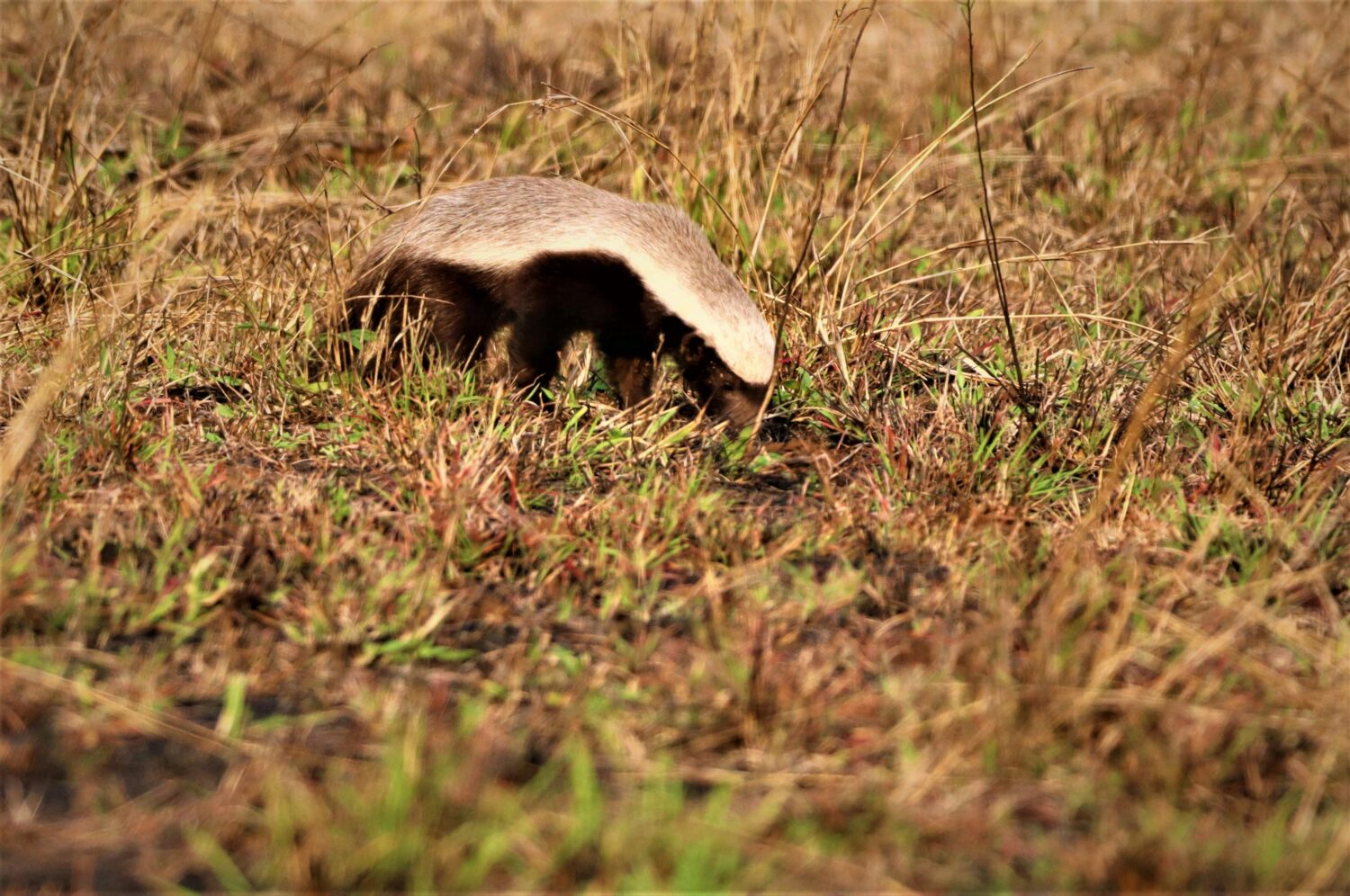
Physically, a honey badger is stocky and low-slung, typically weighing somewhere between 9 and 14 kilograms, with a body built more for digging and fighting than for speed. Its coat is distinctive: a broad silvery-grey stripe runs along the back from the top of the head to the base of the tail, sitting in sharp contrast against jet-black fur on the face, legs, and underside. That two-tone pattern isn’t just for show. In the animal kingdom, bold contrasting coloring like this often functions as a warning sign to potential predators, a visual signal that says, in effect, that this particular animal is more trouble than it’s worth.
Why it has a reputation for fearlessness
The honey badger’s fame rests on a combination of physical toughness and sheer behavioral audacity that’s fairly unusual among animals its size. Its skin is remarkably thick and loose, which allows it to twist and turn inside its own hide during a fight, making it extraordinarily difficult for a predator to get a solid, disabling bite even after landing one. That loose skin has also been documented allowing a honey badger to turn around and counterattack even while gripped by the neck, something that would end most confrontations immediately for almost any other animal its size.
Then there’s its relationship with venom. Honey badgers have developed a notable degree of resistance to snake venom, which allows them to prey on venomous snakes, including cobras and puff adders, that most other predators avoid entirely. This doesn’t mean a honey badger is immune to a fatal dose, but it can survive bites that would kill many other mammals of similar size, sometimes appearing to recover from a bite that briefly incapacitates it before continuing on with its day. Combined with an aggressive, almost indifferent attitude toward much larger threats, including recorded instances of honey badgers standing their ground against lions and leopards, it’s easy to see how the species built its reputation as one of Africa’s boldest animals, regardless of what’s actually in front of it.
Diet and hunting behavior
Honey badgers are opportunistic and remarkably varied eaters, which suits their reputation as one of the continent’s more adaptable predators. Their diet includes small mammals, reptiles, birds, eggs, insects, and, true to their name, honey and bee larvae raided directly from wild hives, a habit that has occasionally left honey badgers with faces full of stings that don’t appear to slow them down much. They’re also known to eat carrion when the opportunity presents itself, and their front claws, long and powerfully built for digging, make them highly effective at excavating burrowing prey like mice, ground squirrels, and even the young of larger animals from underground dens.
There’s a well-documented, though still debated, relationship between honey badgers and a bird called the greater honeyguide, which is said to lead the badger to wild beehives, benefiting afterward from the scraps of wax and larvae left behind once the badger has broken the hive open. Whether this behavior happens as consistently with honey badgers as it’s often described doing with humans in parts of Africa is less certain, but the story has become part of the honey badger’s broader folklore regardless.
Where to find the honey badger in Uganda
Honey badgers are found across a wide range of habitats in Uganda, from savanna grassland to dry woodland and even forest edges, and they’re present in several of the country’s major national parks, including Murchison Falls National Park, Queen Elizabeth National Park, and Kidepo Valley National Park. That said, seeing one on safari is genuinely a matter of luck rather than something a guide can reliably plan for. Honey badgers are largely solitary, wide-ranging, and often active at dawn, dusk, or overnight, which means daytime game drives, when most safari activity happens, simply don’t align with when the species is typically most active.
Murchison Falls in particular offers reasonable odds for a sighting given its size and habitat diversity, especially along the drier, more open stretches of the park’s northern game-viewing circuit, where burrows and diggings are sometimes visible even when the animal itself isn’t. Early morning game drives, just as the light comes up, tend to offer the best window, since honey badgers occasionally finish a night of foraging just as the first vehicles head out. Guides who’ve spent years in a particular park often develop a feel for the areas where sightings cluster, which is one more reason a knowledgeable local guide is worth having along rather than trying to self-drive through unfamiliar terrain hoping for a chance encounter.
Behavior and social structure
Honey badgers are mostly solitary animals outside of breeding season, with males and females coming together briefly to mate before going their separate ways. Females raise their cubs alone, typically giving birth to one or two young in an underground den, and cubs stay with their mother for an extended period compared with many similarly sized mammals, sometimes over a year, learning the hunting and foraging skills they’ll rely on once they’re independent. Home ranges can be surprisingly large, especially for males, who may cover many square kilometers in their nightly search for food, which partly explains why sightings remain uncommon even in parks where the species is known to be present in healthy numbers.
Their vocalizations and body language during a threat display are distinctive too. A cornered or provoked honey badger will often growl, hiss, and raise the hair along its back to appear larger, sometimes releasing a strong-smelling secretion from glands near the base of the tail as an additional deterrent, not unlike the defensive strategy used by skunks, though far less commonly discussed. Combined with its willingness to charge rather than flee, this display is usually enough to convince most potential predators that a honey badger simply isn’t worth the trouble, which, functionally, is exactly the outcome the animal is going for.
Conservation status and threats
Honey badgers are currently classified as a species of least concern by conservation authorities, reflecting their wide distribution across sub-Saharan Africa and parts of the Middle East and South Asia, along with their genuine adaptability across a range of habitats. That said, the species does face real localized pressures. Conflict with beekeepers and farmers is one of the more persistent issues, since a honey badger raiding a hive or henhouse can cause real economic damage, occasionally leading to retaliatory killing in areas where human and honey badger territory overlap. Habitat loss and, in some regions, the illegal wildlife trade also pose ongoing risks, even if the species as a whole isn’t considered endangered.
Protected areas like Murchison Falls play a meaningful role here, offering honey badgers space to forage and den without the same level of human conflict found outside park boundaries, which is one more reason well-managed national parks matter beyond simply protecting the more famous large mammals travelers come to see.
Why this matters for a safari beyond just the “big” animals
It’s easy for a first-time visitor to arrive in Uganda with a mental checklist built entirely around lions, elephants, and gorillas, and there’s nothing wrong with that; those encounters are extraordinary for good reason. But some of the most memorable moments on a well-guided safari come from the animals that don’t make the standard checklist at all. A honey badger crossing the track at first light, utterly unbothered by the vehicle nearby, tends to stick in a traveler’s memory in a way that’s different from a distant lion sighting, precisely because it’s unexpected and because the animal’s reputation makes the encounter feel like witnessing something slightly rebellious in the middle of an otherwise calm morning.
A good guide who knows a park’s smaller residents, not just its headline species, tends to make for a noticeably richer safari overall, and it’s one of the things worth asking about when choosing a safari operator for a Uganda trip.
Planning a Murchison Falls safari with wildlife diversity in mind
Murchison Falls National Park offers exactly this kind of layered wildlife experience, from the dramatic Nile itself to the big game along the northern circuit, and down to smaller, less predictable residents like the honey badger, side-striped jackal, and various mongoose species that reward travelers who take the time to look closely rather than only scanning for the largest animals in view. If you’d like a safari built around genuinely experienced guiding, with a strong chance of encountering the park’s full range of wildlife rather than just the headline species, our team can help design an itinerary around that goal specifically.
Get in touch through our contact page to start planning, or explore our Murchison Falls safari packages to see how game drives, boat cruises, and early-morning wildlife viewing typically come together in a well-paced trip. For travelers interested in Uganda’s wider wildlife diversity beyond a single park, our Uganda safari tours page covers how Murchison Falls pairs with destinations like Kidepo Valley and Queen Elizabeth National Park, both of which offer their own strong honey badger habitat and a similarly rich range of smaller, less-photographed species.
The honey badger may never headline a safari brochure the way a lion or a gorilla does, but it embodies something that makes African wildlife endlessly fascinating: the idea that toughness and character aren’t always measured in size. For travelers who take the time to notice it, a Uganda safari built around genuine wildlife diversity, not just the biggest animals in the park, tends to be the kind that’s remembered for the smaller surprises just as much as the obvious highlights.