

Karamojong Cattle Culture: Life in Uganda’s Last Frontier
Most Uganda safari itineraries revolve around a familiar circuit: Murchison Falls, Queen Elizabeth, Bwindi, perhaps Kibale for chimpanzee tracking. Far fewer travelers make it to the northeastern corner of the country, a rugged, sparsely populated region bordering South Sudan and Kenya, where a very different Uganda unfolds. This is Karamoja, home to the Karamojong people, whose entire way of life still centers on cattle in a way that has largely disappeared elsewhere in the country. Understanding Karamojong cattle culture offers a genuinely rare window into one of East Africa’s last living pastoralist traditions, and for travelers willing to make the journey, usually as an extension paired with Kidepo Valley National Park, it delivers one of the most memorable cultural encounters available anywhere in Uganda.
Who the Karamojong Are
The Karamojong are a Nilotic pastoralist people whose ancestors, according to most anthropological accounts, migrated into the region from present-day Ethiopia several centuries ago as part of a broader Ateker cluster of related peoples that eventually split into several distinct groups across East Africa, including branches that became the Kalenjin and Maasai in neighboring Kenya and Tanzania. The Karamojong who settled in what is now northeastern Uganda developed a way of life built almost entirely around livestock, particularly cattle, in a landscape too dry and unpredictable for the kind of settled agriculture that dominates much of the rest of the country.
Today, the Karamoja region encompasses several districts and is home not just to the Karamojong proper but to related subgroups sharing similar language and customs, including communities around Kotido, Moroto, and Kaabong. The broader region also includes the small, distinct Ik people, who live at higher elevation in the Morungole Mountains near Kidepo and maintain their own separate language and traditions, often visited alongside a Karamojong cultural stop by travelers with extra time in the area.
Why Cattle Sit at the Center of Everything
To understand Karamojong culture is to understand the near-total centrality of cattle to nearly every aspect of daily and spiritual life, a relationship considerably deeper than the practical livestock-keeping found in most agricultural societies. Traditionally, the Karamojong hold a spiritual belief that Akuj, their supreme deity, granted their people an ancestral right to all cattle, a belief that historically shaped both herding practices and, less positively, the region’s long and difficult history of cattle raiding between neighboring pastoralist groups, a practice discussed honestly further below.
Cattle function simultaneously as currency, as a measure of a family’s wealth and a man’s social standing, as the centerpiece of marriage negotiations where bride price is traditionally paid in livestock, and as the primary source of subsistence itself. A traditional Karamojong diet has long relied heavily on milk, and in some households, blood drawn carefully from a live animal’s vein and mixed with milk, alongside meat, ghee, and yogurt, a diet remarkably well adapted to a landscape where crop farming is unreliable and unpredictable rainfall makes cattle, which can be moved toward water and pasture, a far more resilient foundation for survival than fixed fields.
The sheer number of cattle a family head possesses remains, even today, one of the clearest markers of status within Karamojong society, and conversations with community members during a cultural visit often circle naturally back to livestock, herd size, and grazing conditions, since these remain the practical concerns shaping daily life for many families in the region.
Life in a Manyatta
The traditional Karamojong homestead, known as a manyatta or sometimes an ere, is a striking piece of architecture in its own right and one of the most visually memorable aspects of visiting the region. These circular, fortified settlements are enclosed by rings of thorny brushwood, historically built for genuine defensive purposes given the region’s history of raiding, with narrow, deliberately restricted entry points for people and larger gated openings specifically for moving cattle in and out. Within the enclosure sit family huts, grain storage structures, and a central cattle pen, often housing several related families within a single manyatta, reflecting the extended, communal family structure common throughout Karamojong society.
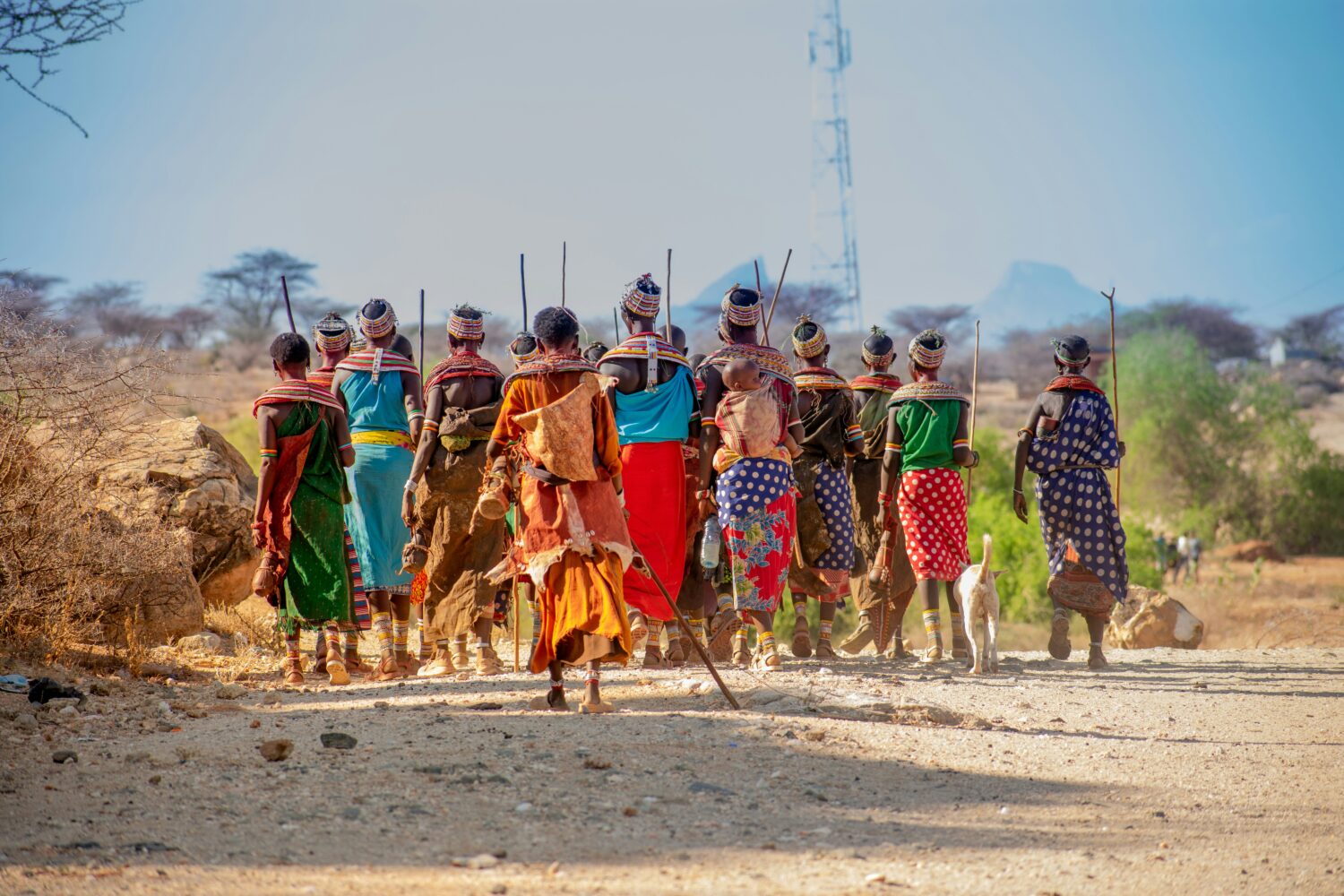
Daily life within a manyatta follows a division of labor shaped directly by the demands of pastoralism. During the wetter months, families tend to remain settled at the manyatta, but in the dry season, men and older boys traditionally lead cattle on extended migrations in search of water and grazing land, sometimes for considerable distances and considerable stretches of time, while women, children, and elders remain behind managing the homestead, cultivating small garden plots when conditions allow, and brewing traditional sorghum beer, itself an important part of communal and ceremonial life.
Traditional dress remains genuinely part of everyday life in Karamoja in a way that has largely faded elsewhere in Uganda, another reason the region is sometimes described, with real justification, as one of the country’s last frontiers of unbroken cultural continuity. Men traditionally wear a cloak, often paired with a distinctive hat, sometimes decorated with feathers to signal status, while women commonly wear elaborate beaded necklaces, a visible and enduring marker of Karamojong identity that visitors notice immediately during any cultural visit.
A Region That Has Weathered Real Hardship
It would be incomplete, and somewhat dishonest, to present Karamoja purely as an untouched cultural idyll without acknowledging the genuine hardship the region endured for decades. Cattle raiding between Karamojong communities and their neighbors, including related groups across the borders in Kenya and South Sudan, escalated significantly through the latter half of the twentieth century as automatic weapons, rather than traditional spears, entered circulation, transforming a long-standing but historically lower-casualty practice into a source of serious violence and insecurity. Combined with recurring drought and chronic underdevelopment, Karamoja was, for a considerable stretch of recent Ugandan history, one of the country’s most marginalized and least visited regions, largely absent from national infrastructure investment and, for understandable safety reasons, almost entirely absent from tourism itineraries.
A sustained government disarmament program over the past two decades, combined with meaningful investment in security, roads, health services, and education across the region, has changed this picture substantially, and Karamoja today is considerably more stable and accessible than it was a generation ago. This is precisely why Kidepo Valley National Park, long overlooked despite consistently ranking among Africa’s most spectacular and wildlife-rich parks, has become an increasingly viable and increasingly recommended addition to well-planned Uganda itineraries, and why Karamojong cultural visits have become a realistic, welcomed part of that experience rather than a security risk to avoid. Travelers researching the region should still confirm current conditions with an experienced operator before finalizing plans, as is sensible practice for any remote destination, but the broad trajectory of the past two decades has been one of substantial improvement.
Experiencing Karamojong Culture as a Visitor
For travelers making the journey to Kidepo Valley, whether by the long overland route through Gulu and Kitgum or via a considerably faster charter or scheduled flight into Kidepo airstrip, a visit to a Karamojong manyatta is typically arranged as a half-day or full-day cultural add-on, and it consistently ranks among the most memorable single experiences of a northeastern Uganda itinerary. A typical visit includes a genuine welcome into the homestead itself, often with traditional song and dance performed not as a staged tourist show but as an authentic expression of communal celebration that predates tourism entirely and continues regardless of visitors, along with storytelling, explanation of the manyatta’s layout and defensive design, and conversation about marriage customs, initiation traditions, and the rhythms of pastoral life across the seasons.
Travelers with a particular interest in timing their visit around a larger cultural event should look into the annual Karamoja Cultural Festival, typically held in Moroto town and drawing not just Karamojong communities but related Ateker-cluster peoples from across the borders in Kenya, South Sudan, and Ethiopia, offering an even richer, larger-scale showcase of traditional dance, dress, and craft than a single manyatta visit alone provides. This kind of event is worth building an itinerary around specifically if the dates align with your travel window, since it offers a scale and energy that a standard village visit cannot fully replicate.
Photography and gift-giving both deserve a thoughtful approach during any Karamojong cultural visit, as they do throughout any respectful cultural tourism experience in Uganda. Asking permission before photographing individuals, rather than assuming it is welcome simply because a visit has been arranged, remains good practice, and purchasing beadwork, crafts, or other items directly from community members, rather than treating the visit as a purely observational experience, ensures tourism revenue translates into direct, tangible benefit for the families hosting you.
Combining Karamoja With the Rest of Your Uganda Itinerary
Karamoja and Kidepo Valley sit far from Uganda’s more commonly visited parks, over five hundred kilometers from Kampala by road, which means most travelers treat this region as a dedicated extension rather than a quick add-on, typically requiring at minimum three to four additional days to make the journey worthwhile given the distances involved. Flying is a genuinely strong option for this particular leg of a Uganda trip, since the overland alternative, while scenic and passing through towns like Gulu and Kitgum in Uganda’s north, adds considerable travel time that many travelers would rather spend inside the park and the surrounding cultural landscape itself. If you are weighing how to reach a remote park efficiently, our comparison of fly-in versus road safari options for Murchison Falls covers the same underlying trade-offs between time, cost, and comfort that apply, in an even more pronounced way, to a Kidepo and Karamoja extension.
Travelers building a longer, more culturally immersive Uganda circuit, one that pairs the wildlife of Murchison Falls with deeper cultural encounters across the country, will find that a Karamojong cultural visit complements other cultural stops covered elsewhere on this site particularly well. Our detailed look at Batwa culture and community tourism in southwestern Uganda explores a very different but similarly important indigenous story, and reading the two alongside each other offers a genuinely broader picture of Uganda’s cultural diversity than a wildlife-only itinerary ever could.
Kidepo Valley Itself: A Park Worth the Journey on Its Own Merits
While this guide focuses on Karamojong culture specifically, it is worth noting briefly that Kidepo Valley National Park, the wildlife destination most closely tied to a Karamoja cultural visit, is frequently cited by experienced Africa travelers and safari professionals as one of the continent’s most underrated parks, offering a dramatic, rugged landscape of mountains and semi-arid valleys entirely distinct from Murchison Falls’ Nile-side savannah, along with strong populations of lions, cheetahs, and other wildlife rarely found together in a single Ugandan park. Pairing Kidepo’s wildlife with a Karamojong cultural visit gives travelers a genuinely complete northeastern Uganda experience, one that very few visitors to the country ever make time for, which is precisely what makes it feel like such a rewarding, comparatively undiscovered addition to a longer Uganda itinerary.
Planning a Trip That Includes Karamoja
A Karamoja and Kidepo Valley extension is not a decision to make lightly or add at the last minute, given the distances, the logistics, and the genuine value of local expertise in structuring a route that makes the most of the time and cost involved in reaching this remote corner of the country. Our team has experience building itineraries that combine the more familiar Murchison Falls circuit with a well-planned northeastern extension, and we are glad to walk you through what that combination would realistically look like for your travel dates and interests.
Ready to explore Uganda beyond the standard safari circuit, including a genuine encounter with Karamojong cattle culture near Kidepo Valley? Reach out through Murchison falls park safari and let our team help you plan a trip that reaches Uganda’s last frontier the right way.