Golden Monkey Trekking in Mgahinga: Uganda’s Other Primate Trek
Ask most travelers what primate they associate with a Uganda safari and the answer comes back instantly: the mountain gorilla. It is a fair answer, and gorilla trekking rightly anchors most southwestern Uganda itineraries. But tucked into the same corner of the country, inside the compact, bamboo-forested slopes of Mgahinga Gorilla National Park, sits a genuinely rewarding, far less crowded, and considerably more affordable primate encounter that surprisingly few travelers know to plan for: golden monkey trekking. This guide covers everything worth knowing about the experience, from cost and logistics to how it compares with gorilla trekking, and why it deserves a spot on more Uganda itineraries than it currently gets.
What Golden Monkeys Actually Are
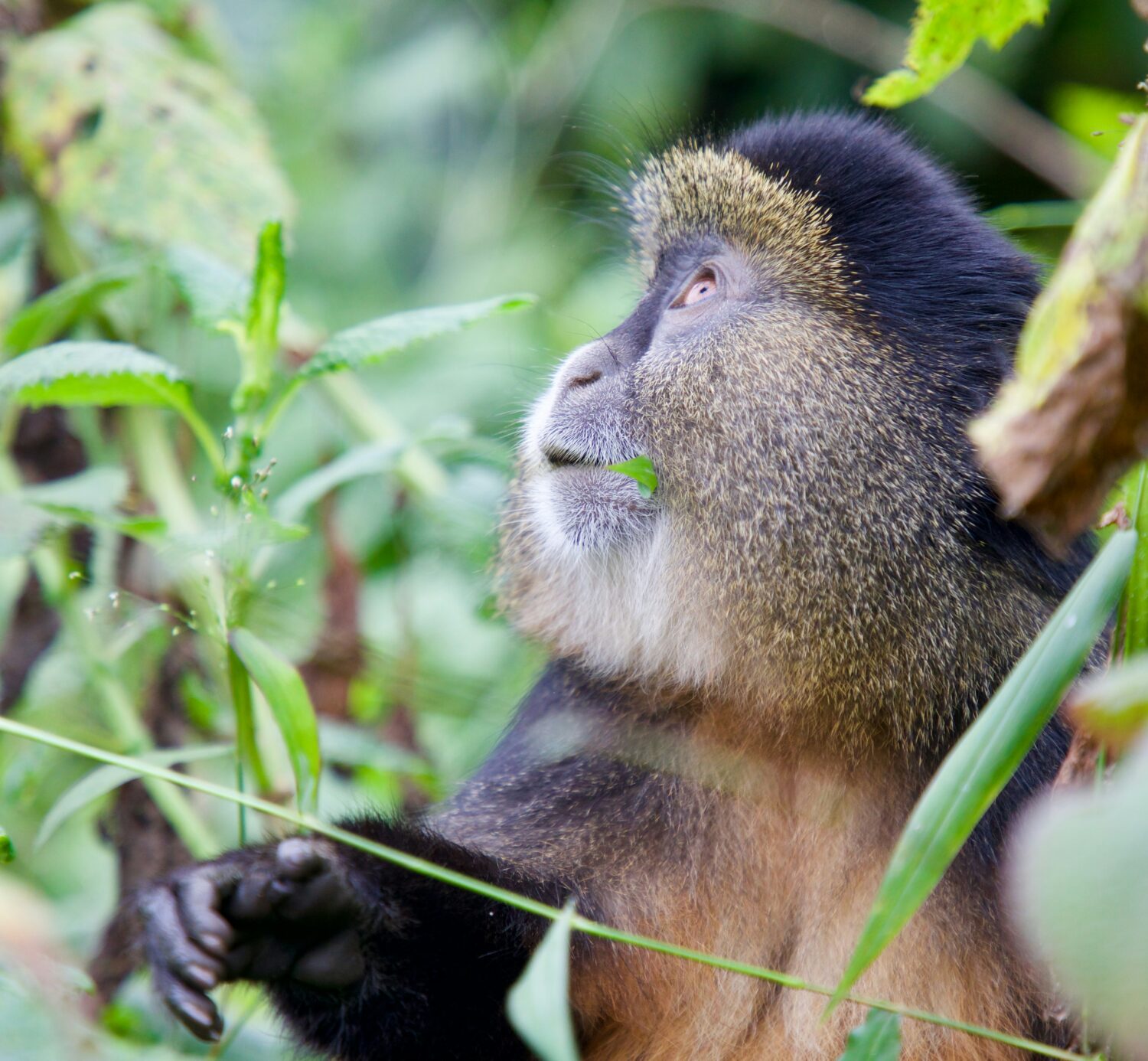
Golden monkeys are a striking, endangered subspecies of the blue monkey, distinguished by a vivid orange-gold coat across their back and flanks that contrasts sharply against black limbs, face, and tail, making them one of the more visually spectacular primates found anywhere in East Africa’s forests. They inhabit high-altitude bamboo forest, a fairly specific and limited habitat type, which restricts their range to a small handful of protected areas across the Virunga Massif, the volcanic mountain range straddling the borders of Uganda, Rwanda, and the Democratic Republic of Congo. In Uganda specifically, Mgahinga Gorilla National Park is the only place golden monkeys can be trekked, making it a genuinely unique wildlife opportunity found nowhere else in the country.
Unlike mountain gorillas, which tend to move in a slow, deliberate manner that makes for a calm, contemplative wildlife encounter, golden monkeys are energetic, fast-moving, and highly social, living in troops that can number well over thirty individuals and spending much of their day foraging actively through the bamboo canopy. This makes for a genuinely different kind of primate encounter, lively and visually dynamic rather than quiet and reflective, and travelers who have already done a gorilla trek often describe golden monkey trekking as a fun, high-energy contrast to the gorilla experience rather than a lesser version of it.
Where Mgahinga Fits Into Uganda’s Geography
Mgahinga Gorilla National Park is Uganda’s smallest national park, tucked into the far southwestern corner of the country near the town of Kisoro, bordering both Rwanda and the Democratic Republic of Congo at the point where the three countries meet along the Virunga volcanic chain. Its small size and volcanic, high-altitude terrain give it a genuinely distinct character compared to Uganda’s larger savannah parks, with dramatic views of the Virunga volcanoes, including Mount Muhabura, Mount Gahinga, and Mount Sabyinyo, forming a striking backdrop to any activity undertaken within the park.
Mgahinga sits close enough to Bwindi Impenetrable National Park, Uganda’s primary gorilla trekking destination, that combining both experiences in a single southwestern Uganda leg is entirely practical, with the drive between the two typically taking somewhere in the range of two to three hours depending on the specific sectors involved. This proximity is one of the strongest arguments for adding golden monkey trekking to an itinerary that already includes gorilla trekking, since the additional detour required is modest relative to the experience gained.
What the Trek Itself Involves
A golden monkey trek begins at the Ntebeko Visitor Center, the starting point for essentially all activities within Mgahinga, where a park ranger briefs the group on trekking protocols, safety guidelines, and background on golden monkey behavior before the walk itself begins. From there, trekkers head into the park’s bamboo forest, accompanied by armed rangers and experienced trackers who typically have a strong sense of where the habituated troop has been feeding recently, since golden monkeys move through the forest in search of bamboo shoots, fruit, and insects rather than remaining in one fixed location.
The trek to locate the monkeys can take anywhere from a brisk thirty minutes to as long as three hours round trip, depending entirely on where the troop happens to be feeding on a given day, making it considerably more variable, though on average shorter, than gorilla trekking, which can run longer depending on the specific gorilla family and terrain. Once the troop is located, trekkers are given a full hour to observe them, a period most visitors describe as genuinely thrilling given how much movement and activity is packed into that hour, from monkeys leaping between bamboo stalks to grooming, feeding, and the playful chasing typical of young monkeys within a troop. Photography is considerably more challenging than with the slower-moving gorillas, given the monkeys’ constant motion, which is itself part of the appeal for photographers seeking a livelier subject.
For travelers wanting an even deeper encounter, Mgahinga also offers a golden monkey habituation experience, a longer, more immersive option that extends observation time to roughly four hours rather than one, placing visitors alongside researchers and trackers working directly with a semi-habituated troop. This mirrors the structure of the gorilla habituation experience offered in Bwindi and is a strong choice for serious photographers or anyone who wants considerably more time with the monkeys than the standard permit allows.
What Golden Monkey Trekking Actually Costs
This is where golden monkey trekking earns its reputation as one of the best-value wildlife experiences available anywhere in Uganda. Current standard trekking permits run in the range of sixty dollars per person for foreign visitors, plus a separate park entrance fee of roughly forty dollars, bringing the effective total to somewhere around one hundred dollars per person for the standard trekking experience. The habituation experience, offering the extended four-hour encounter, runs closer to one hundred dollars for the permit alone before park entrance fees are added.
Set this against the eight hundred dollar gorilla trekking permit required for a standard Bwindi or Mgahinga gorilla trek, and the price gap becomes genuinely striking, a difference of roughly seven to eight times the cost for a considerably shorter, though admittedly different, kind of primate encounter. For budget-conscious travelers, families looking to add a meaningful wildlife activity without a steep additional cost, or simply anyone who has already spent significantly on a gorilla permit and wants a complementary primate experience without doubling down on another major expense, golden monkey trekking represents outstanding value relative to what it delivers.
Booking is also considerably more relaxed than gorilla trekking. Golden monkey permits rarely sell out and generally do not require the months of advance planning gorilla permits demand, though reserving ahead during Uganda’s busiest travel months, June through September and December through February, remains sensible practice rather than a strict necessity. As with gorilla permits, current UWA rules require these to be booked through a licensed tour operator rather than purchased independently by foreign visitors, a policy worth understanding fully if you are also planning gorilla trekking on the same trip; our guide on booking gorilla permits directly versus through a tour operator covers exactly how this process works under current regulations, and the same operator-based booking approach applies to golden monkey permits as well.
How Golden Monkey Trekking Compares to Rwanda’s Option
Golden monkeys can also be trekked just across the border in Rwanda’s Volcanoes National Park, part of the same Virunga ecosystem, and travelers researching this activity will often find themselves weighing the two options against each other. Rwanda’s golden monkey permit typically runs somewhat higher than Uganda’s standard trekking permit, and the experience itself, in terms of duration and general structure, is broadly comparable between the two countries, since the monkeys, habitat, and trekking format are fundamentally similar on either side of the border. For travelers whose itinerary is already anchored in Uganda, doing the trek in Mgahinga avoids an additional border crossing and the visa and logistics considerations that come with it, making it the more practical choice for most Uganda-based trips, while travelers already planning a Rwanda leg for other reasons may find it convenient to fold the activity into that portion of their trip instead.
Building Golden Monkey Trekking Into a Broader Itinerary
Golden monkey trekking works best as a complement to, rather than a replacement for, the primate encounters most travelers already have planned. For travelers doing gorilla trekking in Bwindi, adding a day for Mgahinga and golden monkeys, given the relatively short drive between the two parks, extends a southwestern Uganda itinerary by only a day or two while adding a genuinely distinct wildlife experience and a very different park landscape, with Mgahinga’s volcanic peaks and bamboo forest offering a striking visual contrast to Bwindi’s dense, ancient rainforest.
Mgahinga’s location near Kisoro also places it within reach of some of the region’s other notable stops, including the Batwa Trail, one of the most respected community tourism initiatives in Uganda, run within Mgahinga itself and offering deep insight into the Batwa community’s history and connection to this same forest landscape. Travelers building a full southwestern Uganda itinerary around gorilla trekking, golden monkey trekking, and a Batwa cultural visit will find these three activities complement each other unusually well within a compact geographic area, and our detailed guide to Batwa culture and community tourism beyond Bwindi covers exactly how the Mgahinga-based Batwa Trail experience works alongside the park’s more famous primate treks.
Travelers combining this southwestern circuit with a Murchison Falls safari, as many Uganda itineraries do given how well the two regions complement each other in terms of landscape and wildlife diversity, should plan for meaningful travel time between the two, since Murchison Falls sits in the northwest while Mgahinga and Bwindi sit deep in the southwest, on essentially opposite sides of the country. Deciding how to connect these two legs, whether by road, by air, or a combination of both, is worth planning early, and our comparison of fly-in versus road safari options offers a useful framework for thinking through that decision, even though it was written specifically with the Murchison Falls route in mind, since the same cost, time, and comfort trade-offs apply broadly across Uganda’s longer domestic routes.
Fitness and Practical Preparation
Golden monkey trekking involves moderate hiking through montane forest terrain, generally less physically demanding than gorilla trekking given Mgahinga’s shorter average trek times, but still requiring reasonable fitness, sturdy closed footwear, and the same kind of layered clothing recommended for any Uganda forest activity, since Mgahinga’s elevation makes for noticeably cooler temperatures than the lowland parks. Neutral-colored clothing and a light rain jacket are worth packing given the forest environment and the genuine possibility of rain at this altitude regardless of season. Trekkers should be at least fifteen years old, consistent with UWA’s minimum age requirement for both gorilla and golden monkey permits, and should be prepared for a similarly structured day to gorilla trekking, including an early morning briefing and the possibility of muddy or uneven forest trails depending on recent weather.
Why This Activity Deserves More Attention
Golden monkey trekking occupies an unusual position in Uganda’s tourism landscape: genuinely rare, visually spectacular, significantly more affordable than the country’s headline primate experience, and logistically easy to add onto an already-planned gorilla trekking itinerary, yet it remains largely absent from the itineraries of first-time Uganda visitors who simply have not heard of it. For travelers who have the flexibility to spend even one extra day in the southwest, it is difficult to find another Uganda wildlife activity that delivers this much distinctiveness and value relative to its cost.
If you are planning a southwestern Uganda circuit and want to know whether golden monkey trekking fits naturally into your dates alongside gorilla trekking and a Murchison Falls safari, our team can help you map out a realistic, well-paced itinerary that makes the most of everything the region offers.
Ready to add golden monkey trekking to your Uganda itinerary? Reach out and let us help you build a trip that pairs Mgahinga’s golden monkeys with the rest of Uganda’s best wildlife experiences.