Sitatunga vs Bushbuck: Spotting the Difference on Safari
Uganda is home to nearly thirty species of antelope, and few pairs among them cause more confusion for first-time visitors than the sitatunga vs bushbuck comparison. The two are close relatives, similar in size, similar in coloring, and similar enough in silhouette that even attentive travelers sometimes walk away from a sighting unsure which one they actually saw. That confusion is entirely understandable, since the two species share a common ancestry and a broadly similar body plan, but they differ in several distinct, learnable ways once you know what to look for. This guide breaks down exactly how to tell them apart, where each one lives, and why the distinction matters more than it might seem for anyone serious about getting the most out of their Uganda wildlife viewing.
Why These Two Get Confused So Often
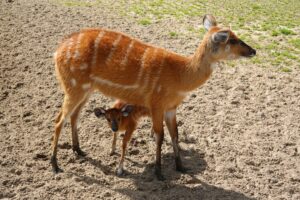 The sitatunga and the bushbuck both belong to the same broader group of spiral-horned antelope, a family that also includes the much larger kudu and the eland, and this shared lineage explains why the resemblance is so strong. Both species carry a generally reddish-brown to dark brown coat, both display varying degrees of white spotting and faint striping along the body, and both are, relative to Uganda’s open-plains grazers like the Uganda kob or the impala, notably shy, solitary, and inclined to stay close to cover rather than moving in large, visible herds across open grassland. Add in the fact that both species can appear in overlapping habitat at the fringes of wetlands and riverine woodland, and it becomes easy to see why even experienced safari-goers occasionally second-guess themselves.
The key to reliably telling them apart comes down to three things: habitat, physical build, and hoof structure, each of which offers a clear, consistent clue once you know to look for it.
Habitat: The Single Best Clue
If there is one shortcut to identifying which of these two animals you are looking at, it is location. The bushbuck is, by a wide margin, the more widespread and adaptable of the two, found in forests, riverine woodland, and thicketed habitat across nearly every national park in Uganda, including Murchison Falls, Queen Elizabeth, Bwindi Impenetrable, Kibale Forest, and Lake Mburo. Its comfort with a wide range of wooded and scrubby environments, rather than a narrow habitat requirement, is a large part of why it ranks among the most commonly encountered antelope species in the country, even though its shy, solitary nature means it is often glimpsed only briefly at a forest edge rather than observed at length.
The sitatunga, by contrast, is a genuine wetland specialist, and this single fact does more to distinguish the two species than any visual detail. Sitatunga are found almost exclusively in papyrus swamps, marshland, and other permanently or seasonally flooded habitats, a highly specific ecological niche that sharply limits where they can be seen at all. In Uganda, sitatunga inhabit suitable wetland pockets within several parks, including areas around Murchison Falls, Semliki National Park, and the wetlands surrounding Lake Kyoga, but by far the most reliable and consistent place to actually see one on safari is Katonga Wildlife Reserve in western Uganda, a smaller, less-visited reserve built around the wetlands of the Katonga River specifically because it offers such strong sitatunga viewing. Mabamba Swamp, better known among travelers as a premier birding destination for the elusive shoebill stork, is another spot where sitatunga occasionally turn up, adding a pleasant bonus sighting for birders already visiting for entirely different reasons.
This habitat distinction alone answers the identification question in the vast majority of real-world sightings: an antelope glimpsed in dense forest or dry woodland is almost certainly a bushbuck, while one seen wading through papyrus or standing partially submerged at a swamp’s edge is almost certainly a sitatunga.
Physical Build and Hooves: The Confirming Details
Beyond habitat, a handful of physical features confirm the identification for travelers who want certainty rather than a strong guess. The sitatunga has evolved a genuinely distinctive adaptation for life in the swamp: long, splayed hooves that spread its weight across soft, muddy, and semi-floating vegetation, allowing it to move through terrain that would cause a bushbuck, or almost any other antelope, to sink. This hoof structure is unique enough among African antelope that it is considered one of the clearest diagnostic features of the species, and it directly supports a broader behavioral pattern: sitatunga are strong swimmers, capable of submerging almost entirely with just their nostrils above the waterline to avoid predators, and they are, by comparison, clumsy and awkward on dry, solid ground, a trait almost never seen in the considerably more nimble, ground-adapted bushbuck.
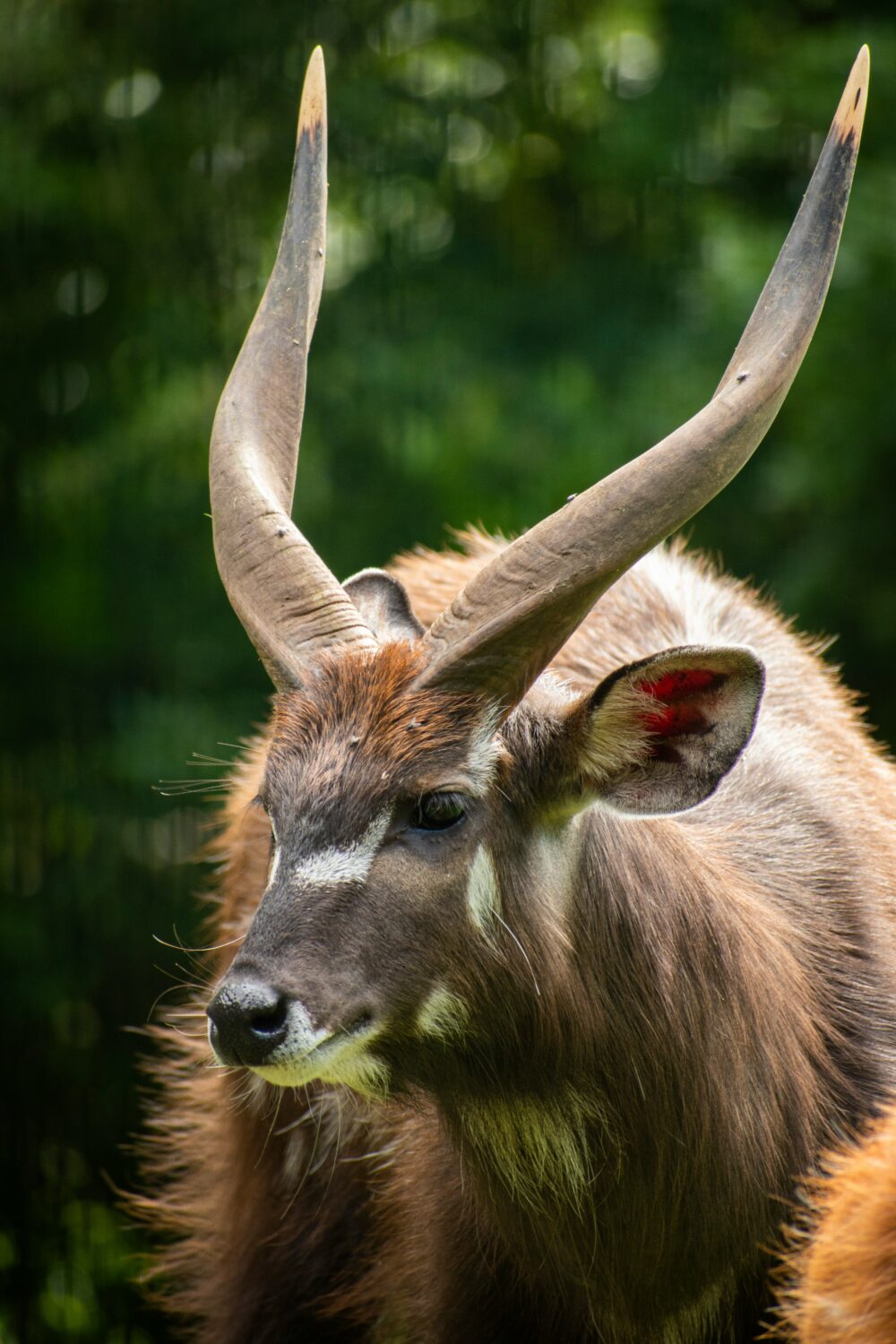
Build differences add a further layer of distinction. Male sitatunga tend to carry a notably shaggier, longer coat than the sleeker-coated bushbuck, an adaptation suited to a life spent partly submerged in water and mud, and only male sitatunga carry horns, which grow in a distinctive spiraled, twisted shape. Bushbuck males also carry horns, generally straighter and less dramatically spiraled than the sitatunga’s, giving an attentive observer another point of comparison when both horns and coat texture are visible clearly enough to judge.
Behavior: A Quieter but Useful Signal
Behavior offers a final, more subtle clue for travelers spending enough time with either species to observe it. Sitatunga are largely nocturnal or most active during the cooler hours around dawn and dusk, spending much of the hottest part of the day resting hidden within dense papyrus rather than moving about visibly, which is part of why sightings, even within their preferred wetland habitat, require patience, a quiet approach, and often the help of a guide who knows exactly where a resident individual tends to rest. Bushbuck, while similarly shy and inclined toward cover, are somewhat more likely to be glimpsed during a standard daytime game drive or forest walk, typically bolting for cover the moment they sense a vehicle or group of people rather than freezing in place, a startled, quick retreat that is itself a fairly reliable behavioral signature once you have seen it a few times.
Both species share a notably solitary or loosely social disposition compared to Uganda’s herd-forming grazers, and neither is likely to be seen in the large, visible groups typical of Uganda kob or buffalo, which is worth knowing simply so travelers do not mistake a single, quiet, half-hidden antelope for an unremarkable sighting when it may, in fact, be one of the harder species to spot well.
Where to See Each on a Murchison Falls Itinerary
For travelers whose Uganda trip centers on Murchison Falls National Park, bushbuck are a realistic and fairly common sighting throughout the park’s wooded riverine areas and forest fringes, particularly along tracks bordering the Nile and its surrounding vegetation, making them one of the more attainable antelope sightings during a standard game drive without requiring any special detour. Sitatunga are a considerably rarer prospect within Murchison Falls itself, present in suitable wetland pockets but nowhere near as reliably sighted as they are in a dedicated wetland reserve like Katonga, so travelers hoping specifically to check the sitatunga off their list should treat a Murchison Falls-only itinerary as a possible but unlikely opportunity rather than a guaranteed one.
Travelers who want a strong chance at a genuine sitatunga sighting, rather than leaving it to chance within a larger, wildlife-diverse park, should consider building in a stop at Katonga Wildlife Reserve, roughly two hundred kilometers west of Kampala, either as a standalone add-on for travelers with extra time or as part of a broader western Uganda circuit that might also include Queen Elizabeth National Park or Kibale Forest. Katonga is explored primarily on foot or by canoe rather than by vehicle, given its wetland terrain, which itself makes for a genuinely different and rewarding kind of safari activity compared to the vehicle-based game drives that dominate most Murchison Falls itineraries. If you are curious how a walking or canoe-based wildlife activity compares to a standard game drive in terms of pacing and experience, our guide on the best time of day for game drives in Murchison Falls offers useful context on how timing and activity type shape what you are likely to see, even though it focuses specifically on the vehicle-based game drives more typical of that particular park.
A Broader Appreciation for Uganda’s Antelope Diversity
The sitatunga and bushbuck comparison is a genuinely good entry point into a broader appreciation of just how diverse Uganda’s antelope population actually is, spanning nearly thirty species across habitats ranging from open savannah to dense montane forest to permanent wetland. Travelers who arrive expecting only the country’s headline species, lions, elephants, and gorillas, often find that this quieter layer of wildlife, the antelope species requiring a slightly more attentive eye and a bit of background knowledge to properly appreciate, becomes one of the more satisfying parts of a well-guided safari, precisely because it rewards curiosity and careful observation rather than simply scale or drama.
Guides across Uganda’s parks are generally well versed in exactly these kinds of identification details, and asking directly, whether about a sitatunga’s splayed hooves, a bushbuck’s habitat preferences, or any of the dozens of other antelope species found across the country, tends to open up a genuinely rich vein of conversation during a long game drive, adding real depth to what might otherwise be a simple checklist approach to wildlife viewing.
Bringing This Knowledge Into Your Trip
Knowing the difference between a sitatunga and a bushbuck before you arrive means you will spot the distinction yourself in the moment, rather than relying entirely on a guide’s explanation after the fact, and that small piece of preparation genuinely sharpens the experience of a Uganda safari. If wetland wildlife and antelope diversity are part of what draws you to Uganda specifically, it is worth mentioning this interest when planning your itinerary, since a stop at a wetland-focused reserve like Katonga, or a specific wetland walk built into a broader park visit, can be added to most Uganda itineraries with the right advance planning.
Ready to build a Uganda itinerary that goes beyond the headline wildlife and includes the country’s full range of antelope, wetland species, and lesser-known parks? Reach out and our team will help you plan a trip that gives Uganda’s quieter wildlife the attention it deserves alongside Murchison Falls’ bigger-name residents.