Uganda Kob vs Impala: Telling Africa’s Common Antelope Apart
Few wildlife mix-ups happen more often on an East Africa safari than confusing the Uganda kob with the impala, and it is easy to understand why. Both are medium-sized, reddish-brown, lyre-horned antelope that move in groups across open grassland, both share a similar general silhouette, and both are common enough that travelers encounter them repeatedly throughout a trip rather than in a single, careful sighting. Yet the Uganda kob vs impala distinction is one well worth learning, not just as a fun identification challenge but because the two species barely overlap geographically within the country, meaning knowing which one you are looking at often tells you something useful about exactly where you are. This guide breaks down precisely how to tell them apart and where each one is reliably found across Uganda’s parks.
A Shared Resemblance With Separate Ancestry
Despite looking remarkably alike, the Uganda kob and the impala are not closely related, a fact that regularly surprises first-time visitors expecting a shared family tree given how similar the two appear at a glance. The resemblance is instead a striking example of convergent evolution, where two unrelated species, adapting independently to broadly similar open savannah environments across the African continent, arrived at comparable body plans, coloring, and horn shapes simply because those traits work well for the ecological niche both species occupy. The Uganda kob is more closely related to the waterbuck and reedbuck, both larger, shaggier-coated antelope, while the impala belongs to its own distinct subfamily, more closely related to hartebeest and oryx than to any of Uganda’s kob-like species. Knowing this upfront helps explain why identification comes down to careful physical observation rather than any obvious family resemblance guiding the eye.
Coloring and Markings: The Fastest Visual Clue
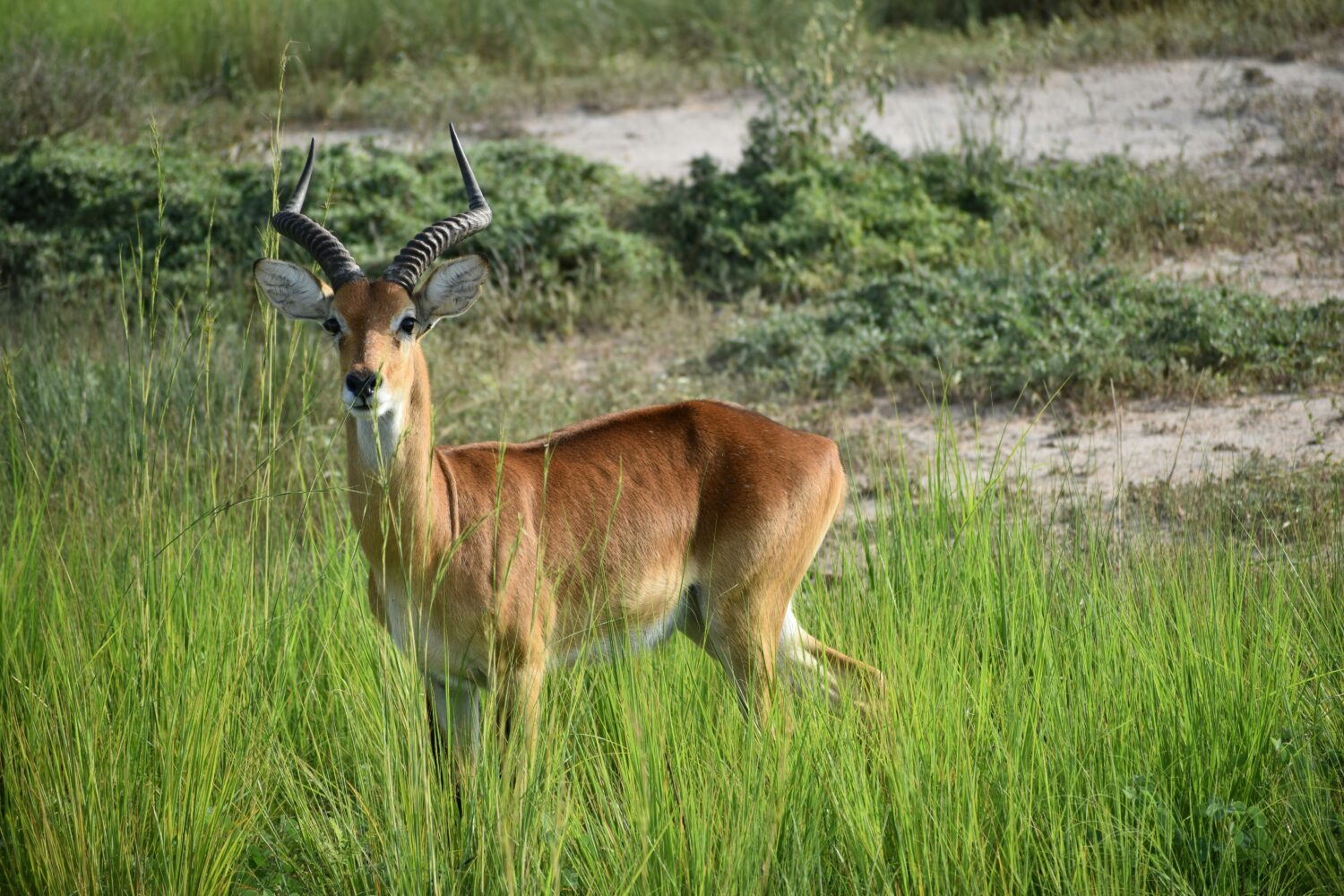
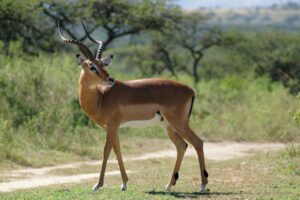 The clearest and quickest way to distinguish the two, once you know what to look for, comes down to the pattern of markings on the body rather than the base coat color, since both animals share a broadly similar reddish-brown to golden-brown tone that alone will not settle the question. The Uganda kob carries a distinctive white ring around each eye, a white patch or chevron marking on the throat, and a black stripe running down the front of each foreleg, but critically, it lacks any dark stripe or blaze along the sides of its body. The impala, by contrast, displays a very different and equally distinctive set of markings: a vertical black blaze on each buttock, a black stripe running down the center of its white tail, and, most usefully for quick identification at a distance, a small but distinctive tuft of black hair on the lower rear edge of each hind leg, a feature genuinely unique to the impala among Africa’s antelope and shared with no other species, including the kob.
Overall build offers a secondary confirming clue. The Uganda kob is a noticeably heavier, more sturdily built animal, with a thicker neck and more developed hindquarters suited to powerful, explosive bounds when fleeing danger, while the impala carries a leaner, more delicately proportioned frame, giving it a sleeker, almost gazelle-like appearance despite belonging to an entirely separate subfamily from true gazelles.
Horns: A Subtler but Reliable Difference
Both male Uganda kob and male impala carry lyre-shaped horns, curving outward and then back in a graceful arc, which is part of why the two are so often confused even by attentive observers. Looking closely, however, reveals real differences. Uganda kob horns tend to be shorter, noticeably thicker at the base, and ridged almost the entire length of the horn, often finishing with a distinctive forward flip at the very tip. Impala horns, by comparison, run longer and more slender, with a more consistently parallel upward sweep and ringed texture running along most of their length, but without the same pronounced forward hook that characterizes a mature kob’s horn tips. Female kob and female impala are both hornless, so this particular identification method only applies to males, which fortunately make up a visible portion of any herd given the social structure both species maintain.
Habitat and Range: Where Each One Actually Lives
Perhaps the single most useful practical fact for travelers is this: across most of Uganda, the ranges of these two species barely overlap at all, which means location alone often answers the identification question before you even need to examine markings or horns closely. The Uganda kob is by far the more widespread of the two within the country, found in substantial herds, sometimes numbering close to a hundred animals, across Murchison Falls National Park, Queen Elizabeth National Park, Semliki National Park, and Katonga Wildlife Reserve, favoring moist floodplains, riverine grassland, and open plains near water, habitat that closely matches much of Murchison Falls’ northern bank game-viewing territory. This is precisely why the Uganda kob holds the honor of being Uganda’s national animal, featured prominently on the country’s coat of arms, a status that reflects just how abundant and emblematic the species is across the country’s most visited savannah parks.
The impala tells a very different geographic story. Within Uganda, impala are found almost exclusively in Lake Mburo National Park, along with small numbers in Katonga Wildlife Reserve, making Lake Mburo effectively the only reliable place in the entire country to see this species. This is a genuinely striking contrast to the impala’s status elsewhere in East and southern Africa, where it ranks among the most numerous and widely distributed antelope on the continent; in Uganda specifically, its range is unusually restricted, a reflection of the fact that Uganda kob and impala occupy largely separate, non-overlapping ecological ranges across the broader region, effectively dividing the continent’s savannah habitat between them rather than competing directly for the same space.
This means that for travelers whose itinerary centers on Murchison Falls, and does not include a stop at Lake Mburo, encountering an impala at all during the trip is genuinely unlikely, while Uganda kob sightings will be frequent and essentially guaranteed across any reasonable number of game drives. Conversely, travelers adding Lake Mburo to a broader itinerary, often as a stopover point between Kampala or Entebbe and destinations further west or southwest such as Bwindi, will find impala among the park’s signature and most reliably spotted species, alongside zebra and eland, two other animals found in few or no other Uganda parks.
Behavior: A Further Point of Contrast
Beyond appearance, the two species differ somewhat in social structure and behavior, details that add richness to a sighting for travelers interested in more than a simple identification checklist. Uganda kob rely on a mating system known as lekking, in which males establish and defend small, tightly clustered territories that females move through and select from during breeding periods, a behavior that produces the distinctive sight of numerous males holding small adjacent territories within view of each other across open grassland, an arrangement biologists find fascinating for how it concentrates male competition into a small, visible space. Impala instead follow a more conventional territorial system, where dominant males defend a broader territory and the females moving through it, a structure shared with numerous other African antelope species. Uganda kob herds also tend to be larger and more fluid than impala groupings, contributing to some of Murchison Falls’ most memorable wide-angle game-viewing moments, when dozens or more kob spread across open floodplain in a single sweeping herd.
Building This Identification Skill Into Your Safari
For travelers on a Murchison Falls-focused itinerary, Uganda kob sightings will be frequent enough that learning to identify the species properly, rather than lumping every reddish-brown antelope together as a generic “gazelle-type” animal, meaningfully sharpens the experience of repeated game drives across the trip. Understanding the kob’s white eye ring, throat chevron, and foreleg stripe, and knowing that any similar-looking animal spotted in Murchison Falls is almost certainly a kob rather than an impala given the park’s geography, turns a potentially repetitive sighting into a more engaged, informed one.
Travelers curious about Uganda’s broader antelope diversity, beyond just this particular pair, may also enjoy our companion guide on sitatunga versus bushbuck identification, which covers a very different kind of antelope comparison centered on wetland versus woodland habitat rather than open savannah, and together the two guides offer a fairly complete picture of how to approach antelope identification across a typical Uganda circuit. If your itinerary includes or might include Lake Mburo National Park, whether as a stopover en route to southwestern Uganda or as a dedicated stop for zebra, eland, and impala sightings unavailable elsewhere in the country, it is worth mentioning this interest when planning your trip, since Lake Mburo pairs naturally with several common Uganda routing options and adds a genuinely distinct set of species to an itinerary otherwise centered on Murchison Falls or Queen Elizabeth.
Timing Your Best Sightings
Uganda kob are active throughout the day but tend to be most visibly engaged in lekking and territorial displays during the cooler morning and late afternoon hours, aligning closely with the general wisdom that early morning and evening game drives offer the strongest wildlife viewing across Murchison Falls more broadly. If you are still finalizing how to structure your daily schedule around the park’s strongest viewing windows, our detailed guide on the best time of day for game drives in Murchison Falls covers exactly this, and the same morning and evening emphasis that benefits predator and elephant sightings applies equally well to catching Uganda kob herds at their most active and visually striking.
A Small Skill With a Real Payoff
Telling a Uganda kob from an impala is one of those small pieces of safari knowledge that costs nothing to learn in advance but pays off repeatedly throughout a trip, turning what might otherwise be a repetitive parade of similar-looking antelope into a series of confidently identified, genuinely appreciated sightings. Given how rarely the two species’ ranges actually overlap within Uganda, simply knowing where you are standing often does most of the identification work before markings or horns even come into play.
If you would like help building an itinerary that includes Lake Mburo alongside Murchison Falls, or want a trip planned around getting the strongest possible wildlife viewing across whichever parks you visit, our team is glad to help put together a route tailored to what you most want to see.
Ready to plan a Uganda safari that helps you spot and understand the country’s antelope diversity, from kob to impala and beyond? Reach out and let us help you build an itinerary suited to your wildlife interests.