Salt Mining Tour at Lake Katwe: A Living Tradition
Most travelers pass through Queen Elizabeth National Park chasing lions and elephants, and few realize that just beyond the park’s savanna and channel lies one of the oldest continuously operating industries in East Africa, hiding inside a volcanic crater. Lake Katwe isn’t a wildlife destination in the conventional sense — there are no fish, no hippos, barely any birdlife on the water itself, because the lake is simply too saline to support them. What it offers instead is something rarer on a standard Uganda safari: a direct, unscripted look at a community that has extracted salt from this same crater using largely unchanged methods for more than seven centuries. This guide walks through what makes Lake Katwe worth the detour, what a salt mining tour actually involves, and how to build it thoughtfully into a broader itinerary through southwestern Uganda.
A Lake Born From Violence, Now Defined by Stillness
Lake Katwe sits inside a volcanic crater on the floor of the Western Rift Valley, part of a much larger volcanic field within Queen Elizabeth National Park that spans roughly two hundred ten square kilometers and contains dozens of similar explosion craters, some reaching three kilometers wide and a hundred meters deep. These craters formed between eight and ten thousand years ago, not through the slow lava flows most people associate with volcanic activity, but through violent explosions caused by superheated steam and gas forcing their way through blocked vents deep underground, ejecting rock and ash without ever producing a lava flow at all. The result is a landscape of dramatic, cauldron-like depressions scattered across the park, several of which have since filled with water and, in Katwe’s case, evolved into something genuinely unusual: a lake so saline it supports essentially no plant or animal life, remaining shallow at just a few feet deep at its maximum point, yet never fully drying out despite the intense evaporation that defines the surrounding landscape.
The lake sits close to Lake Edward and the Kazinga Channel, in a stretch of terrain that sits in the rain shadow of the nearby Rwenzori Mountains, meaning the area rarely receives the moisture that falls just a short distance away, contributing to the harsh, sun-scorched conditions that have shaped both the lake’s chemistry and the working lives of everyone who mines it. Because there’s no outlet for the water that does reach the crater, minerals and salts accumulate steadily, and the relentless heat draws the water toward the surface where it evaporates, leaving behind crystallized salt deposits that form the basis of the entire local economy.
Seven Centuries of an Unbroken Trade
What separates Lake Katwe from a merely interesting geological curiosity is the human history layered on top of it. Local communities have mined salt from the lake for more than seven hundred years, making it one of the oldest continuously worked industrial sites anywhere in East Africa, predating almost every other economic activity for which the region is known today. In precolonial Uganda, salt held value on par with gold, since it was essential not just for food preservation and flavor but for trade routes stretching across the interior of the continent, and control of Lake Katwe’s salt production became a genuine strategic prize. The lake fell under the control of the Toro Kingdom for a stretch of its history before the Omukama of Bunyoro, Kabalega, seized control in the late 1870s, a conflict that eventually drew in British colonial forces under Captain Frederick Lugard and became a real flashpoint in the broader struggle for regional dominance in the area.
European awareness of the site came later than its actual founding by centuries, with British explorer John Hanning Speke recording the salt works during his travels in 1863, followed shortly after by fellow explorer James Grant in 1864. By the time these accounts reached the wider world, Lake Katwe had already been mined for roughly four hundred years, a detail that tends to reframe how travelers think about “discovery” narratives in East African exploration history. Today, ownership and working rights to individual salt pans within the lake are still passed down through families, generation to generation, exactly as they have been for centuries, giving the site a genuinely living cultural weight rather than a preserved-for-tourism reconstruction of a historical practice.
How the Salt Is Actually Extracted
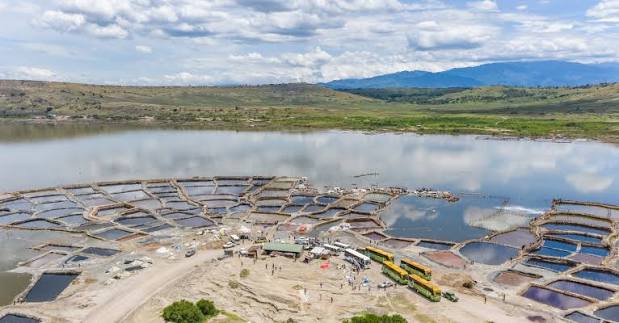
The extraction method at Lake Katwe has remained largely unmechanized, and watching it in person is the central draw of any visit. Workers divide the lake into a patchwork of individually owned or leased salt pans, shallow sections where lake water is allowed to sit and evaporate under the intense equatorial sun until crystallized salt forms on the surface and along the pan’s edges. Miners then wade into these pans, often standing in the hypersaline water for extended stretches, to manually break up and gather the crystallized salt using simple hand tools, before hauling it to the shore in baskets or sacks for further drying and sorting. It’s slow, physically demanding, unglamorous labor, carried out under direct sun in a landscape that offers almost no natural shade, and there’s real value in a guided tour framing it honestly as such rather than romanticizing the difficulty away.
Beyond salt itself, the lakebed also yields trona, a dark mineral-rich mud with its own commercial applications in fertilizer production and glassmaking, adding a secondary income stream for some families working the site. It’s worth noting, and most reputable guides will mention this directly, that prolonged exposure to the lake’s hypersaline water carries real health risks for the miners themselves, and local workers have developed their own protective practices over generations to manage this reality as best they can given limited access to modern protective equipment or healthcare in the immediate area. This is a genuine, ongoing part of the community’s daily working life, not a historical footnote, and a well-run tour treats it with the seriousness and respect it deserves rather than glossing over it for the sake of a tidier tourism narrative.
What a Guided Tour Actually Involves
A standard Lake Katwe salt mining tour typically runs a half day, though some operators structure it as a fuller excursion when combined with the surrounding Katwe-Kabatoro township, and it generally begins with your guide walking you along the crater rim for a sweeping first view of the lake itself, its reddish-tinted water and geometric patchwork of individual salt pans visible from above in a way that’s genuinely striking, especially in the low light of early morning or late afternoon. From there, the tour typically descends toward the lake edge, where you can watch the extraction process at close range and, depending on the specific tour and the willingness of individual miners on a given day, speak directly with workers about their family’s history with the trade, how long they’ve worked their particular section of the lake, and how the industry has changed, or in many ways hasn’t, over the decades.
Most tours extend beyond the lake itself into the neighboring town of Katwe-Kabatoro, where you’ll walk past traditional grass-thatched homesteads and get a broader sense of daily community life connected to the salt trade, sometimes including a stop to see traditional cooking methods demonstrated, or a visit to the local school, giving the experience a fuller, more human context than a narrow focus on the industrial process alone would provide. Because Lake Katwe sits directly within Queen Elizabeth National Park’s boundaries near the Crater Gate entrance, it’s straightforward to combine with a morning or afternoon game drive or a Kazinga Channel boat cruise on the same day, making it an efficient addition to an already-packed park itinerary rather than requiring a separate dedicated excursion.
Why This Belongs on a Thoughtful Uganda Itinerary
It’s worth being direct about why this experience matters alongside the wildlife-heavy activities most travelers associate with a Uganda trip. Game drives and primate treks show you Uganda’s extraordinary biodiversity, but they say relatively little about the people who’ve called this landscape home for centuries and built entire economies and family lineages around its specific geography. Lake Katwe offers something genuinely different: an unfiltered look at labor, tradition, and economic resilience that connects directly to precolonial trade history, colonial-era conflict, and the ongoing, present-tense reality of a community still working the same crater their ancestors worked seven hundred years ago. For travelers interested in Uganda as more than a wildlife backdrop, this kind of cultural and historical texture adds real depth to a trip that might otherwise consist entirely of savanna and forest.
It’s also, frankly, one of the more affordable and accessible cultural additions available in southwestern Uganda, requiring no special permit, no advance booking months out the way gorilla trekking does, and no significant additional cost beyond a modest guide fee, making it an easy, low-friction addition to an itinerary that’s already built around Queen Elizabeth National Park.
Combining Lake Katwe With the Rest of Your Trip
Lake Katwe sits within easy reach of Queen Elizabeth National Park’s core wildlife circuit, making it a natural half-day addition for travelers already spending time in the park for game drives and the Kazinga Channel boat cruise, one of Uganda’s most rewarding wildlife-viewing experiences given the sheer concentration of hippos, elephants, and birdlife along the channel’s banks. Many travelers build a broader western Uganda circuit that includes Queen Elizabeth National Park, Kibale Forest National Park for chimpanzee trekking, and Bwindi Impenetrable National Park for gorilla trekking, and Lake Katwe fits naturally into the Queen Elizabeth leg of that itinerary without requiring significant additional driving time or logistical complexity.
For travelers whose primary safari destination is Murchison Falls National Park in Uganda’s northwest, Lake Katwe sits considerably further south and would generally require extending the itinerary to include Queen Elizabeth National Park as an additional stop rather than a simple day trip from Murchison Falls itself. This is a common and rewarding way to build a longer, multi-region Uganda trip, pairing the raw scale and power of Murchison Falls in the north with the crater lakes, salt works, and channel wildlife of Queen Elizabeth in the south, giving travelers a genuinely comprehensive picture of Uganda’s geographic and cultural diversity within a single, well-planned circuit.
Practical Notes Before You Visit
A few practical details are worth knowing before adding Lake Katwe to your itinerary. The area around the lake offers almost no natural shade, and temperatures at the crater floor can be genuinely intense given the surrounding rain-shadow conditions, so sun protection, a wide-brimmed hat, and plenty of water matter more here than on a typical shaded forest walk. Sturdy, closed footwear is worth wearing given the uneven, sometimes muddy terrain around the salt pans, and it’s respectful, as with any community-based tour, to ask your guide about appropriate etiquette before photographing individual miners at work, since this is someone’s actual daily labor rather than a staged demonstration. Tours are best arranged through your safari operator or a local guide based near Queen Elizabeth National Park, and building it into your park itinerary alongside a game drive or Kazinga Channel cruise, rather than treating it as a separate standalone trip, tends to make the most efficient use of your time in the region.
Planning a Trip That Includes Lake Katwe
A well-built Uganda itinerary increasingly means going beyond wildlife alone, and Lake Katwe offers exactly the kind of grounded, historically rich addition that rounds out a trip built primarily around Murchison Falls or Queen Elizabeth National Park. Our team at Murchison Falls Park Safari can help you plan a multi-region itinerary that connects the raw drama of Murchison Falls in the north with the crater lakes, salt works, and channel wildlife of Queen Elizabeth National Park further south, including a well-timed stop at Lake Katwe along the way. Reach out through our contact page to start building a trip that includes this kind of cultural depth alongside your wildlife activities, or browse our current Murchison Falls safari packages to see how our core northern itinerary typically comes together before extending south. If you’re mapping out the full cost of a longer, multi-park Uganda circuit, our guide to estimating your Uganda safari cost by month is a useful companion for budgeting a trip of this scope.
Lake Katwe won’t show you lions or gorillas, but it offers something a wildlife encounter can’t: a direct line into seven centuries of Ugandan history, still being written today by the families who wade into that crater every morning to do exactly what their ancestors did before them.