Uganda vs Namibia Safari: Two Very Different African Experiences
Africa is not one safari experience, and few comparisons make that clearer than putting Uganda and Namibia side by side. Both rank among the continent’s most rewarding destinations, both attract serious, well-traveled safari-goers, and both regularly appear on the same shortlists when people start researching an African trip. But the Uganda vs Namibia safari comparison is really a comparison between two almost entirely different kinds of travel, one built around lush, primate-rich forest and a great river, the other built around vast desert landscapes and self-directed exploration. Understanding those differences properly, rather than treating both destinations as interchangeable “African safari” options, makes it far easier to choose the trip that actually fits what you are looking for.
Two Fundamentally Different Landscapes
 The most immediate difference between the two countries is simply what the land looks like, and it shapes everything else about the trip. Uganda earns its long-standing nickname, the Pearl of Africa, through genuine lushness: dense tropical forest, rolling green hills, wetlands, and the Nile River cutting dramatically through Murchison Falls National Park before thundering through a narrow rocky gorge. Rainfall is relatively reliable across much of the country, vegetation stays green for most of the year, and the overall visual character of a Uganda safari leans toward rich, textured, biodiverse landscapes rather than open, sweeping vistas.
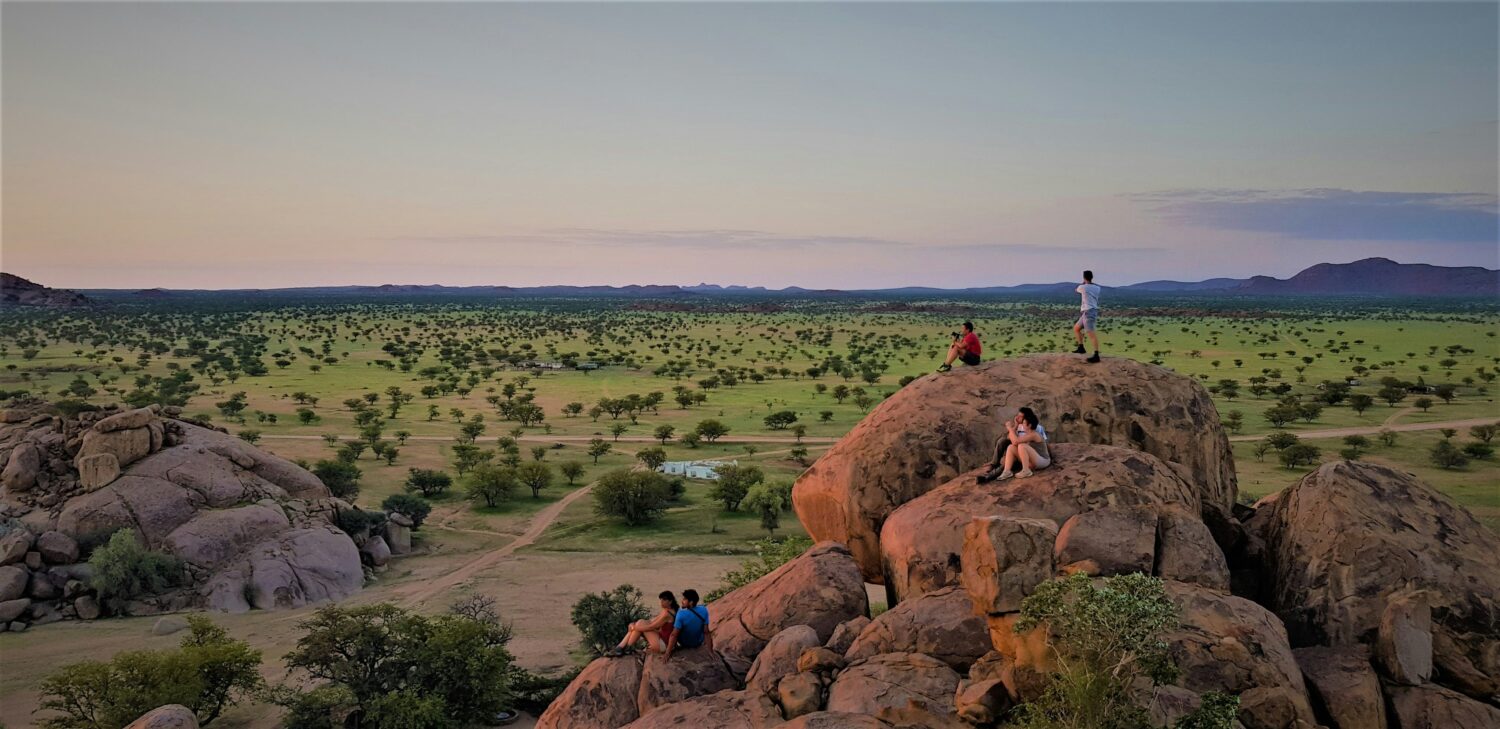
Namibia offers almost the exact opposite. This is a country defined by desert, from the towering red dunes of Sossusvlei, among the tallest in the world, to the stark, otherworldly Skeleton Coast, to the semi-arid plains and pans of Etosha National Park. Namibia’s beauty is a beauty of scale, emptiness, and dramatic light rather than density and greenery, and travelers drawn to vast horizons, minimalist landscapes, and a genuine sense of remoteness tend to find Namibia’s aesthetic uniquely powerful in a way a lusher destination cannot replicate.
Neither landscape is objectively better, and this distinction alone often does more to determine which destination suits a given traveler than any comparison of wildlife checklists or cost.
Wildlife: Density and Predictability vs Primates and Rivers
Namibia’s flagship wildlife destination, Etosha National Park, built around a vast salt pan that draws animals to a network of natural and man-made waterholes, offers genuinely excellent, concentrated game viewing, particularly during the dry season from May through October, when water scarcity forces wildlife to congregate predictably at known points. This concentration effect is one of Etosha’s defining strengths: rather than searching broadly across a large park, visitors can often simply wait at a well-positioned waterhole and watch elephants, lions, rhinos, and giraffes come to them, including remarkable floodlit night viewing at camps like Okaukuejo, where black rhino sightings after dark are a genuine highlight. Etosha also supports one of Africa’s largest remaining black rhino populations, a species increasingly difficult to see reliably elsewhere on the continent, along with abundant Angolan giraffe and enormous herds of springbok, Namibia’s national animal.
Uganda’s wildlife strength lies elsewhere. Murchison Falls National Park delivers strong, reliable Big Five-adjacent viewing, including elephants, buffalo, and lions across its northern savannah sector, alongside a hippo and Nile crocodile population lining the riverbanks in genuinely striking numbers during the park’s signature boat cruise to the base of the falls. But Uganda’s real, defining wildlife advantage is primates, a category where Namibia offers essentially nothing comparable. Uganda holds roughly half the world’s remaining mountain gorillas, trackable through Bwindi Impenetrable National Park, along with strong chimpanzee populations at Kibale Forest and within Murchison Falls’ own Budongo Forest, and the rare, prehistoric-looking shoebill stork found in wetlands near the park. This primate dimension is not a minor addition to a Uganda itinerary; for many travelers, it is the entire reason to choose Uganda over other African safari destinations in the first place, since nowhere in Namibia offers anything resembling a gorilla trekking experience.
Travel Style: Self-Drive Freedom vs Guided Immersion
Perhaps the sharpest practical difference between the two countries is how travelers typically move through them. Namibia has built an entire tourism identity around self-drive travel, supported by well-maintained gravel roads, clearly marked routes, and a network of rest camps and lodges designed with independent travelers in mind. A self-drive Namibia safari, renting a vehicle in Windhoek and driving yourself between Sossusvlei, Swakopmund, Damaraland, and Etosha, remains one of the most popular and genuinely rewarding ways to experience the country, offering a level of independence, flexibility, and adventure that appeals strongly to confident, experienced travelers who enjoy the driving itself as part of the trip. It is worth noting that as of 2026, fuel availability at some in-park rest camps, particularly within Etosha, has faced disruptions serious enough that self-drive travelers need to plan refueling more carefully than in past years, a detail worth confirming with current sources closer to any Namibia trip.
Uganda’s terrain, road infrastructure, and wildlife-viewing logistics point firmly toward guided rather than self-drive travel. Gorilla trekking permits require a licensed guide and ranger escort by regulation, unpaved park roads and river crossings via ferry demand local knowledge to navigate efficiently, and the sheer value of an experienced driver-guide’s ability to read animal behavior, know which tracks are producing sightings on a given day, and manage the logistics of multi-park itineraries makes guided travel the standard, expected approach for the vast majority of Uganda visitors, rather than a limitation on independence. Most travelers new to Uganda find this a genuine advantage rather than a drawback, since it removes the burden of navigation and vehicle logistics entirely, letting the trip focus on wildlife and experience rather than route planning. If you are weighing how ground transport actually works within a Uganda itinerary, our comparison of fly-in versus road safari options for Murchison Falls explains the guided-transport landscape in detail, including how driver-guides structure a typical multi-day itinerary.
Cost Comparison: Two Different Value Propositions
Cost comparisons between the two destinations depend heavily on travel style, but some broad patterns hold. A self-drive Namibia trip, particularly one mixing camping with mid-range lodges, can be genuinely affordable relative to its guided-safari equivalent, with independent travelers able to control costs tightly by choosing their own accommodation tier and pace; budget and mid-range self-drive options in Namibia can run considerably lower per day than a fully guided East African safari. A fully guided, private Namibia trip, by contrast, particularly one built around premium lodges and fly-in circuits linking Sossusvlei, Damaraland, and Etosha, climbs to a considerably higher price point, often several hundred dollars per person per day or more for a comfortable to premium guided experience.
Uganda’s cost structure looks different because gorilla trekking permits, currently eight hundred dollars per person for foreign visitors, represent a fixed, substantial expense that has no real Namibia equivalent, since nothing in Namibia carries a comparable single-activity price tag. Outside of gorilla trekking, however, a Uganda safari focused on Murchison Falls and the northern circuit can be structured at a genuinely wide range of budgets, from modest mid-range lodges and shared group vehicles to high-end private safaris, generally without the same self-drive-versus-guided cost gap that defines Namibia’s budget spectrum, since guided travel is simply the default and expected mode throughout most of the country rather than a premium upgrade over a cheaper self-drive alternative.
Put simply: Namibia offers a wider genuine range between budget self-drive and luxury guided travel, giving cost-conscious independent travelers more room to economize on their own terms. Uganda’s cost structure centers more around whether gorilla trekking is included, with that single decision often shaping the overall trip budget more than any other single factor.
Climate and Best Time to Visit
Namibia’s dry season, running roughly May through October, is unambiguously the strongest period for wildlife viewing, since the very water scarcity that concentrates animals at Etosha’s waterholes is itself a dry-season phenomenon, with September and October standing out as particularly strong for predator sightings as vegetation thins and visibility improves. Namibia’s climate overall runs considerably cooler and more variable than Uganda’s, particularly at night during the dry season winter months, a genuine consideration for packing that differs meaningfully from Uganda’s more consistently warm, humid equatorial climate.
Uganda, sitting on the equator, experiences far less dramatic seasonal temperature swings, with its two dry seasons, roughly December through February and June through September, offering the easiest road conditions and strongest game viewing without the same extreme heat-driven wildlife concentration effect that defines Namibia’s dry season. Uganda’s wetter months bring lush scenery and strong birding rather than a wildlife-viewing disadvantage as pronounced as Namibia experiences outside its dry season, making Uganda a somewhat more forgiving destination for travelers whose dates are constrained to a specific window regardless of season.
Combining or Choosing Between the Two
For travelers with the time and budget for an extended African trip, Uganda and Namibia are sometimes combined into a single, longer itinerary precisely because they offer such different experiences rather than redundant ones, giving a traveler both the primate-and-river immersion of Uganda and the vast desert landscapes of Namibia within one extended African journey. For most travelers working within a single, focused trip, though, the choice comes down to what kind of experience matters most: travelers whose priority is gorilla trekking, a broader primate-focused itinerary, or the specific appeal of the Nile and Murchison Falls’ dramatic waterfall and boat cruise should choose Uganda without hesitation, since nothing in Namibia offers a comparable experience. Travelers drawn specifically to self-drive independence, desert landscapes, and the particular thrill of watching wildlife converge on a waterhole in genuinely vast, open terrain will likely find Namibia the better fit for that specific kind of trip.
What Makes Uganda the Right Choice for Many Travelers
For travelers already leaning toward Uganda, or simply curious what a well-built Uganda itinerary actually looks like, the country’s strength lies in combining several genuinely distinct experiences within a single, moderately sized country: strong Big Five-adjacent game viewing at Murchison Falls, one of Africa’s most dramatic river and waterfall settings, chimpanzee tracking accessible directly within that same park via Budongo Forest, and, for travelers extending further, mountain gorilla trekking in Bwindi, an experience genuinely unmatched anywhere else on the continent outside Rwanda and the Democratic Republic of Congo. Our guide to Big Five versus Big Seven safari planning in Uganda walks through exactly how these different wildlife experiences fit together into a single, well-paced Uganda itinerary, and it is a useful next read for travelers weighing how much of Uganda’s full range to build into their trip.
Travelers specifically comparing the cost and logistics of reaching Uganda’s flagship destinations, whether choosing to fly or drive to Murchison Falls, will also find our dedicated fly-in versus road safari comparison useful groundwork, since transport decisions shape the overall Uganda trip budget in a way that has a real parallel to the self-drive-versus-guided decision central to planning a Namibia trip.
Making the Right Choice for Your Trip
Neither Uganda nor Namibia is the “better” African safari destination in any absolute sense, and travelers well-served by one are often not the ideal audience for the other. What matters is matching the destination to what you actually want from the trip: vast desert landscapes, self-drive independence, and concentrated big-game viewing at legendary waterholes point toward Namibia; lush forest, a great river, dramatic primate encounters, and a guided, immersive travel style point toward Uganda. Both deliver world-class experiences within their own distinct character, and knowing which character actually appeals to you is the real decision worth making before booking either trip.
If Uganda’s combination of Murchison Falls wildlife, the Nile, and the possibility of gorilla trekking sounds like the trip you are after, our team can help you build an itinerary that makes the most of everything the country offers.
Ready to start planning a Uganda safari built around what makes the country genuinely distinctive? Reach out through Murchison falls park safari and let us help you design a trip around Murchison Falls, the Nile, and Uganda’s primate-rich forests.