Imbalu: The Bagisu Circumcision Ceremony Explained
Uganda’s safari reputation rests largely on gorillas, tree-climbing lions, and the source of the Nile, but some of the country’s richest travel experiences have nothing to do with wildlife at all. On the slopes of Mount Elgon in eastern Uganda, one of the continent’s most striking living traditions plays out every two years, drawing anthropologists, photographers, and increasingly, curious travelers. Imbalu, the traditional male circumcision ceremony of the Bagisu people, is not a staged cultural performance put on for visitors. It is a genuine rite of passage, still practiced with the same seriousness and pride it carried generations ago, and understanding it offers a window into a side of Uganda that most safari itineraries never touch.
Who Are the Bagisu, and Why Does Imbalu Matter to Them
The Bagisu, also known as the Bamasaba, are a Bantu ethnic group settled across the districts of Mbale, Bududa, Sironko, and Manafwa, on the Ugandan side of Mount Elgon, with related communities across the border in western Kenya. Their name for the mountain itself, Masaba, reflects how deeply their identity is tied to this landscape, since Bagisu oral tradition holds that a founding ancestor named Masaba is the source of both the Bamasaba name and the practice of Imbalu. The word Imbalu comes directly from the Lugisu language and refers to the act of circumcision, but among the Bagisu it has never been understood as a purely medical procedure. It is a spiritual, social, and deeply symbolic passage from boyhood into recognized manhood, and everything surrounding it, from the brewing of beer to the choreography of a specific dance, exists to prepare a young man for that transition in front of his entire community.
Origin Stories and Oral Tradition
Accounts of Imbalu’s origins vary depending on which clan or elder is telling the story, and that variation is itself part of the tradition’s texture. Some versions trace the practice to Masaba as a divine directive passed down to establish standards of masculine maturity and communal responsibility. Other oral histories describe the custom arriving from neighboring groups, either the Kalenjin or the Sebei, sometimes framed around a story of a Bagisu man circumcised by his neighbors as a form of discipline, after which the practice was adopted, reshaped, and made permanently Bagisu. What all versions agree on is that the practice is centuries old and that it was thoroughly indigenized long before European contact, surviving colonial administration, Christian missionary pressure, and the arrival of formal schooling largely intact, even as its meaning has continued to shift and be debated within Bagisu society itself.
When Imbalu Takes Place
Imbalu takes place every even-numbered year, typically clustered between August and December, with the most significant public ceremonies concentrated in August. This biennial rhythm is fixed and well known throughout the region, which is part of why the ceremony has become such a notable point on Uganda’s cultural calendar; travelers and researchers can plan years in advance around it. The timing is traditionally linked to the lunar calendar as well, with the core ceremonial rituals historically beginning two to three days after the arrival of a new moon, when an offering is made at a shrine associated with Weri, a deity credited in Bagisu tradition with creating the universe. Boys eligible for initiation are typically between the mid-teens and early twenties, generally starting around age fifteen or sixteen, and every cycle produces hundreds of new initiates across the Bugisu sub-region, each expected to endure the ceremony without visible fear.
The Rituals Leading Up to the Ceremony
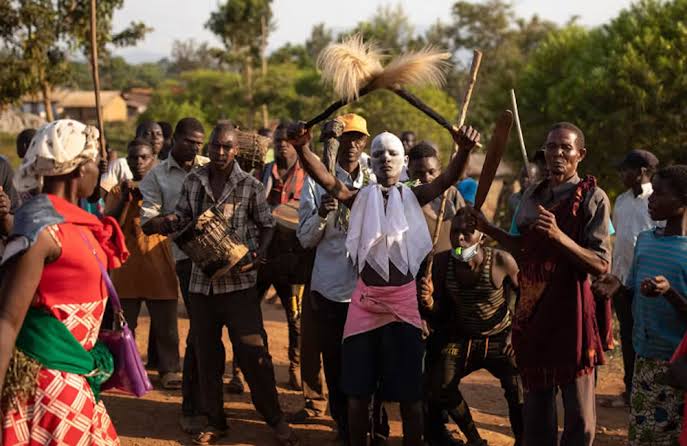
The lead-up to the actual procedure is where much of Imbalu’s cultural depth lives, and it unfolds over days rather than hours. Initiates, sometimes called basani, are smeared with a paste made from fermented millet or sorghum, a substance connected to the ceremonial brewing of local beer that begins several days before the main event and is considered one of the most elaborate rituals in the entire sequence. Covered in this paste and decorated with beads and traditional ornaments, candidates process through their villages accompanied by drumming, chanting, and a distinctive style of dance known as Kadodi, performed in tight, rhythmic movements meant to display composure and readiness.
The Role of Family and Clan
Family members, particularly maternal uncles, play a specific ceremonial role during this period, presenting gifts of cattle and goats, items understood in Bagisu custom as connected to the bride price obligations of the initiate’s father. In many accounts, candidates also visit rivers such as the Manafwa or Lwakhakaha to ritually bathe, and in some clan traditions the boys are led into the forest by a designated ritual specialist, where a goat may be sacrificed as part of the preparatory rites before the group returns to the village dancing.
The Ceremony at Mutoto Cultural Site
The public culmination of Imbalu happens at recognized ceremonial grounds, most famously the Mutoto Cultural Site near Mbale town, which functions as the closest thing Bagisu culture has to a national stage for the ritual. On the day of circumcision itself, initiates are washed thoroughly from the waist to the knees by the men of the community and led at a slow, deliberate pace toward the ceremonial ground, where the wider public, sometimes numbering in the tens of thousands at Mutoto during peak years, gathers to witness the event. The procedure itself is carried out by traditional circumcisers whose skill is treated with genuine reverence in Bagisu culture; practitioners with decades of experience are known to complete the operation in a matter of seconds, and this speed and precision, developed and passed down over generations, is regarded as a mark of mastery rather than mere efficiency. The expectation placed on the initiate is that he shows no visible fear or pain, since composure under the procedure is read publicly as proof of the courage and self-mastery a Bagisu man is expected to carry for the rest of his life.
Life After Imbalu: Becoming a Mukhebi
Once the procedure is complete, the young man is recognized with a new social status, often referred to locally as a mukhebi, and he is expected to take on the responsibilities that come with adult manhood in Bagisu society, including greater involvement in family decision-making, community obligations, and eventually marriage and land inheritance matters. The transition is not merely symbolic; it carries real weight in how a man is treated within his clan going forward, and failing to undergo Imbalu, historically, could carry lasting social consequences for a Mugisu man’s standing in his community. That weight is precisely why Imbalu has remained resilient even as Uganda has modernized rapidly in other respects; it functions as a durable marker of identity, a connection to ancestral practice, and a public demonstration of both individual bravery and family honor, all performed in front of the very community whose respect the initiate is trying to earn.
Witnessing Imbalu as a Traveler
For travelers, witnessing Imbalu is a markedly different experience from a typical Uganda safari activity, and it requires a different kind of planning and respect. The ceremony’s growth as a cultural tourism draw has been deliberate on the part of local authorities and cultural leaders, who have increasingly promoted the Mutoto grounds and the broader August festival period as an opportunity for outsiders to engage with the Bagisu tradition, and large public gatherings do welcome visitors during the ceremonial season. That said, this is fundamentally a community rite rather than a tourist production, and travelers should approach it the way they would any deeply significant cultural or religious ceremony elsewhere in the world: with a local guide who understands the customs, appropriate dress and behavior, and a clear sense of which moments are open to public viewing and which are private to the family or clan. Photography, in particular, should always be approached with sensitivity and, where possible, permission, since these are real families marking one of the most significant days in a young man’s life, not a scene staged for cameras.
Getting to Mbale and Combining the Trip
Mbale, the regional hub closest to the main Imbalu grounds, sits roughly four to five hours by road from Kampala and can be comfortably combined with a broader eastern Uganda itinerary. Travelers coming primarily for wildlife elsewhere in the country, whether in Murchison Falls National Park in the northwest or Queen Elizabeth National Park in the west, will find that a dedicated trip east to Mbale during an Imbalu year works best as an intentional cultural extension rather than a casual add-on, given the distances involved. The town itself sits at the base of Mount Elgon, meaning a visit built around the ceremony pairs naturally with hiking on Mount Elgon National Park, exploring the Sipi Falls area, and spending time in the coffee-growing communities that surround the mountain, giving visitors a fuller picture of eastern Uganda beyond the ceremony alone.
Imbalu in the Context of Uganda’s Cultural Diversity
Imbalu also raises a broader point worth making to anyone planning cultural travel in Uganda: the country’s ethnic diversity produces genuinely distinct traditions from one region to the next, and treating “Ugandan culture” as a single, uniform experience misses most of what makes travel here worthwhile. The Bagisu’s circumcision rite bears no resemblance to the customs of, say, the Batwa in the southwest or the Karamojong in the northeast, and travelers who take the time to understand even one tradition in depth, as Imbalu rewards, tend to come away with a far richer sense of the country than those who move quickly from park to park without engaging with the communities in between.
Plan Your Cultural Safari to Eastern Uganda
If eastern Uganda’s Imbalu season falls during your travel dates, our team at Murchison Falls Park Safari can help you build an itinerary around it, combining the ceremony with Mount Elgon hiking, Sipi Falls, and, if your schedule allows, a wildlife circuit through Murchison Falls or Queen Elizabeth National Park on either side of the cultural leg of your trip. Get in touch with us to start planning a Uganda safari that goes beyond the standard wildlife route and into the country’s living cultural heartland.
For more on Uganda’s ethnic and cultural diversity alongside its wildlife destinations, our guides on Karamojong culture in northeastern Uganda, chimpanzee trekking in Kibale Forest, and planning a multi-region Uganda itinerary are all available on murchisonfallsparksafari.com, and pair well with a trip built around Imbalu.