

Lake George: Wildlife and Fishing on Uganda’s Smaller Great Lake
Most travelers planning a Uganda safari arrive with the Kazinga Channel and the Kasenyi plains firmly circled on their itinerary, and rightly so. But tucked into the northeastern corner of Queen Elizabeth National Park is a quieter, shallower body of water that rarely gets the attention it deserves. Lake George is small by the standards of Africa’s Great Lakes, yet it plays an outsized role in the ecology of western Uganda, and it offers a version of the safari experience that feels distinctly different from a game drive or a boat cruise. This is a lake of fishing villages, papyrus swamps, and quiet mornings, and for travelers who want to understand the region beyond its most photographed corners, it rewards the detour.
Lake George sits within the Great Rift Valley in Kasese District, part of the same rift system that produced Lake Edward, Lake Albert, and the string of freshwater bodies that define western Uganda’s landscape. It is sometimes called Lake Dweru locally, and it was named, like several of its neighbors, after a member of the British royal family, Prince George, who later became King George V. The lake was first documented by the British explorer Henry Morton Stanley when he passed through the region in 1875, and it has been part of the story of this landscape ever since, long before Queen Elizabeth National Park existed in its current form. In the 1920s, the area functioned as separate Lake Edward and Lake George game reserves before the British colonial government consolidated the region into what was then called Kazinga National Park in 1952, later renamed in honor of Queen Elizabeth II’s visit.
What makes Lake George geologically distinctive is how modest it actually is. The lake covers roughly 250 square kilometers, which sounds substantial until you learn that its average depth is only about 2.4 meters. This shallowness is the defining fact of Lake George: it behaves less like a deep alpine lake and more like an enormous, shifting wetland, warmed quickly by the equatorial sun and constantly reworked by the rivers feeding into it. Those inflows arrive almost entirely from the Rwenzori Mountains, the legendary “Mountains of the Moon,” with rivers including the Mubuku, Nsonge, Rumi, Dura, Katonga, and Mpanga all draining down from the glaciers and forests above and emptying into the lake from the northeast. From there, the lake’s only outlet is the Kazinga Channel, the 32-kilometer waterway that carries Lake George’s water southwest until it joins Lake Edward, which itself straddles the border between Uganda and the Democratic Republic of Congo. This single hydrological thread, from Rwenzori glacier to rift valley wetland to international border lake, is one of the more elegant stories in East African geography, and it is worth telling to guests before they ever set foot on a boat.
Because Lake George sits at the edge of the park’s most productive savannah, it also anchors one of Queen Elizabeth’s best-known game circuits. The Kasenyi plains, famous for their short grass and dense wildlife concentrations, run east from the Kasese-Ishaka road down to Kasenyi fishing village on the lake’s western shore, and the two landscapes function as one continuous ecosystem. Game drives through Kasenyi regularly turn up large herds of Uganda kob, the antelope species that breeds here in significant numbers, alongside buffalo, warthogs, bushbuck, and elephants that stride unhurried across the open plains toward the water. Afternoons tend to be especially good for sightings near the lakeshore itself, since the heat of the day pushes many animals down toward the water to drink and cool off, giving visitors a natural reason to linger at the lake’s edge rather than rushing past it.
The wildlife around Lake George extends well beyond the plains game that dominates a typical Queen Elizabeth itinerary. The lake’s fringing papyrus swamps are the real ecological treasure here, and they support one of the more elusive species in the park: the sitatunga antelope, a shy, semi-aquatic animal with splayed hooves adapted for walking across marshy, waterlogged ground. Sitatunga are notoriously difficult to spot in most parts of Africa, and the northern shores of Lake George are one of the more reliable places in Uganda to try. Beyond the sitatunga, the swamps and shallows host hippos in substantial numbers, Nile crocodiles patrolling the margins, and waterbuck, eland, and duiker grazing the drier ground around the fishing villages. For travelers who have already seen lions and elephants elsewhere in Uganda but want a genuinely different wildlife encounter, the papyrus edge of Lake George delivers something none of the park’s other circuits quite replicate.
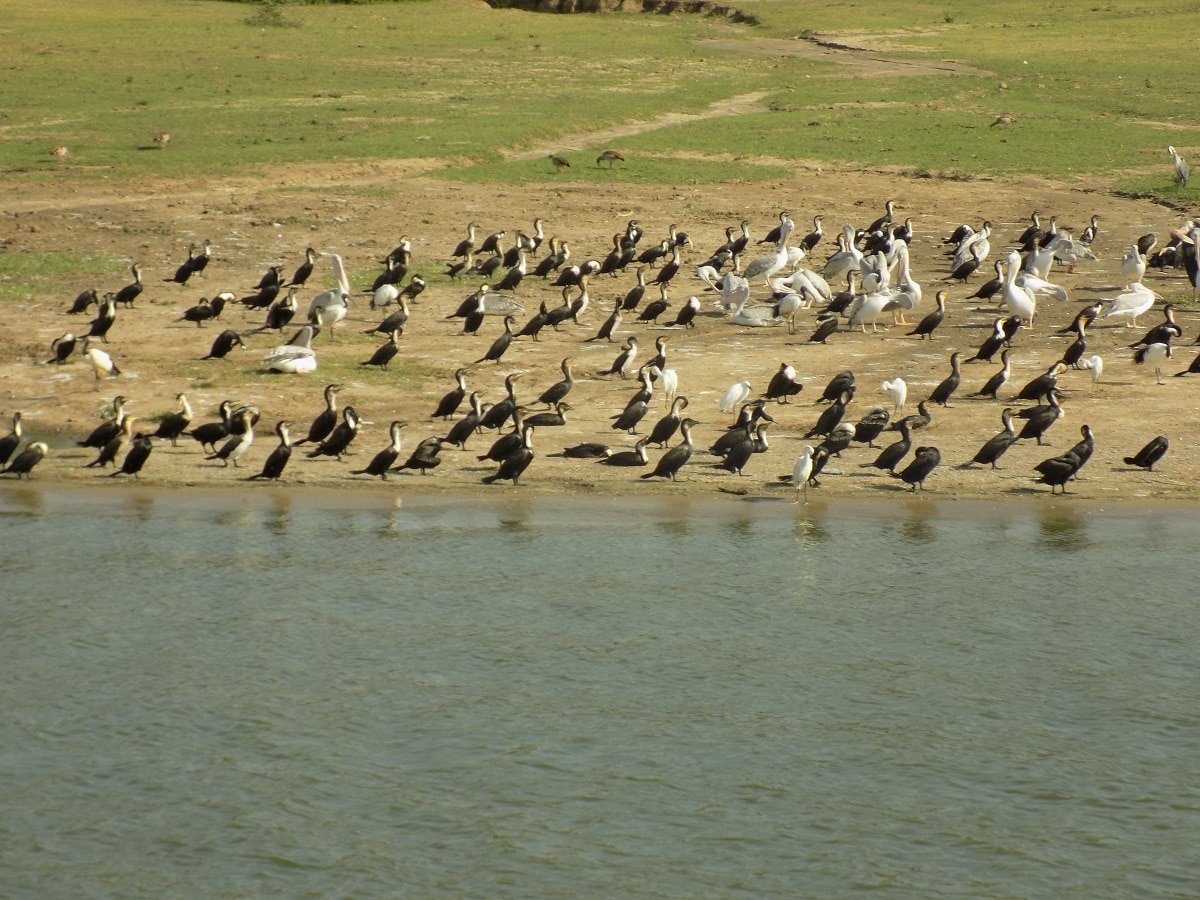
Birders, in particular, should treat Lake George as a priority rather than an afterthought. The wetlands here were significant enough to earn Lake George recognition as Uganda’s first Ramsar site, a designation given to wetlands of international ecological importance, and the birdlife reflects that status. Queen Elizabeth National Park as a whole records more than 600 bird species, and a meaningful share of that diversity concentrates around Lake George’s shoreline and swamps. Guided nature walks through the papyrus routinely turn up African fish eagles perched over the water, marabou storks stalking the shallows, grey-headed kingfishers, swamp nightjars, and Nubian woodpeckers working the fringing trees, and the shoebill, one of the most sought-after birds on the entire African continent, is also among the species resident along the lake. For anyone building a birding-focused Uganda itinerary, Lake George deserves a full morning rather than a brief stop on the way to somewhere else.
Fishing is where Lake George truly sets itself apart from the rest of the park, because unlike most of Queen Elizabeth’s attractions, it is not simply a wildlife spectacle to be observed from a vehicle or boat. It is a working lake, and the fishing communities along its shores, including the well-known Kahendero landing site near Kasenyi, have depended on it for generations. The lake’s saline water is often credited with giving its fish an especially good flavor, and locally caught tilapia nilotica, along with species such as haplochromis and the tiny, abundant thermocyclops, are sold into nearby towns like Kasese and Katunguru every day. This is subsistence and small-scale commercial fishing rather than sport fishing, and that distinction matters, because it means a visit to Lake George’s fishing villages offers something a typical safari day rarely does: direct contact with the rhythms of everyday Ugandan life, set against a backdrop of some of the country’s richest wildlife habitat.
For travelers who want to go further than watching from the shore, several operators arrange time with local fishermen directly on Lake George, where visitors can join the boats, learn traditional fishing techniques passed down through the lakeside communities, and in some cases bring their catch back to camp to be prepared for dinner. It’s a markedly different experience from the Kazinga Channel’s tourist launches, more intimate and unscripted, and it tends to leave a stronger impression on travelers who value cultural depth alongside wildlife viewing. Anglers hoping for a more conventional sport fishing outing are usually better served on the Kazinga Channel or Lake Edward itself, where species like Bagrus docmac, known locally as semutundu, and the African lungfish are more commonly targeted, but Lake George remains the place to understand fishing as a way of life rather than a recreational pursuit.
Visiting Lake George works best as part of a broader Queen Elizabeth National Park itinerary rather than a standalone destination, and the logistics support that. Most travelers base themselves near Mweya Peninsula or in the Kasenyi area, both of which put the lake within easy reach of a morning game drive. A typical day might combine the Kasenyi plains circuit with a stop at the lakeshore for birding or a village visit, followed by an afternoon boat cruise on the neighboring Kazinga Channel, which offers exceptional close-range views of hippos, elephants, buffalo, and crocodiles along its banks and is often rated among the best wildlife-viewing activities anywhere in Uganda. Combining the two gives visitors both the intimate, community-oriented character of Lake George and the concentrated big-game spectacle the channel is famous for, all within a single, efficient day.
The most practical time to build in a Lake George detour is during the drier stretches of the year, when park roads around Kasenyi are easiest to navigate and wildlife tends to cluster more predictably near permanent water sources, including the lake itself. That said, the region does experience two rainy periods, roughly around May and October, and while these months bring lusher scenery and excellent birding conditions, they can also make some of the tracks around the lake’s swampy fringes harder going, so travelers with tighter schedules may prefer to time a visit outside those windows. Whatever the season, engaging a knowledgeable local guide is worth the investment, both for spotting genuinely difficult species like the sitatunga and for navigating the etiquette of visiting an active fishing community respectfully.
Lake George is unlikely to ever compete with the Kazinga Channel or the Kasenyi plains for top billing on a Queen Elizabeth itinerary, and it probably shouldn’t have to. Its value lies elsewhere, in the way it connects the glaciers of the Rwenzori to the rift valley floor, in the sitatunga hiding in its papyrus, in the fish eagles and shoebills working its wetlands, and in the fishing families who have shaped their lives around its shallow, productive waters for generations. For travelers willing to slow down for half a day, Lake George offers a version of Uganda that feels less curated and considerably more real, and it rounds out a Queen Elizabeth safari with a dimension that the park’s headline attractions, for all their spectacle, simply don’t provide on their own.
If you’re planning a trip that includes Queen Elizabeth National Park, our team at Murchison Falls Park Safari can help you build an itinerary that pairs a Lake George excursion with the Kazinga Channel boat cruise, the Kasenyi game circuit, and a chimpanzee trekking add-on in Kyambura Gorge, all tailored around your travel dates and interests. Reach out to us to start planning your western Uganda safari today, and let us handle the logistics while you focus on the experience.
For travelers combining multiple parks into a single Uganda trip, we’d also suggest reading our guides on Kazinga Channel boat cruises, Uganda kob and wildlife viewing on the Kasenyi plains, and birding safaris in Queen Elizabeth National Park, all available on murchisonfallsparksafari.com. These pair naturally with a Lake George itinerary and can help you decide how much time to allocate to each part of the park.